Assetnote's php2shell-scanner installed in 6 seconds in our sandbox, but its VULNERABLE label needs corroboration: maintainers reproduced its empty-500 signal on patched PHP. Use it if you own the targets, can accommodate disruptive checks and will investigate the evidence. Skip it if your assessment must avoid memory-exhaustion probes or produce an automatic patch-compliance decision.
What you can do with php2shell-scanner
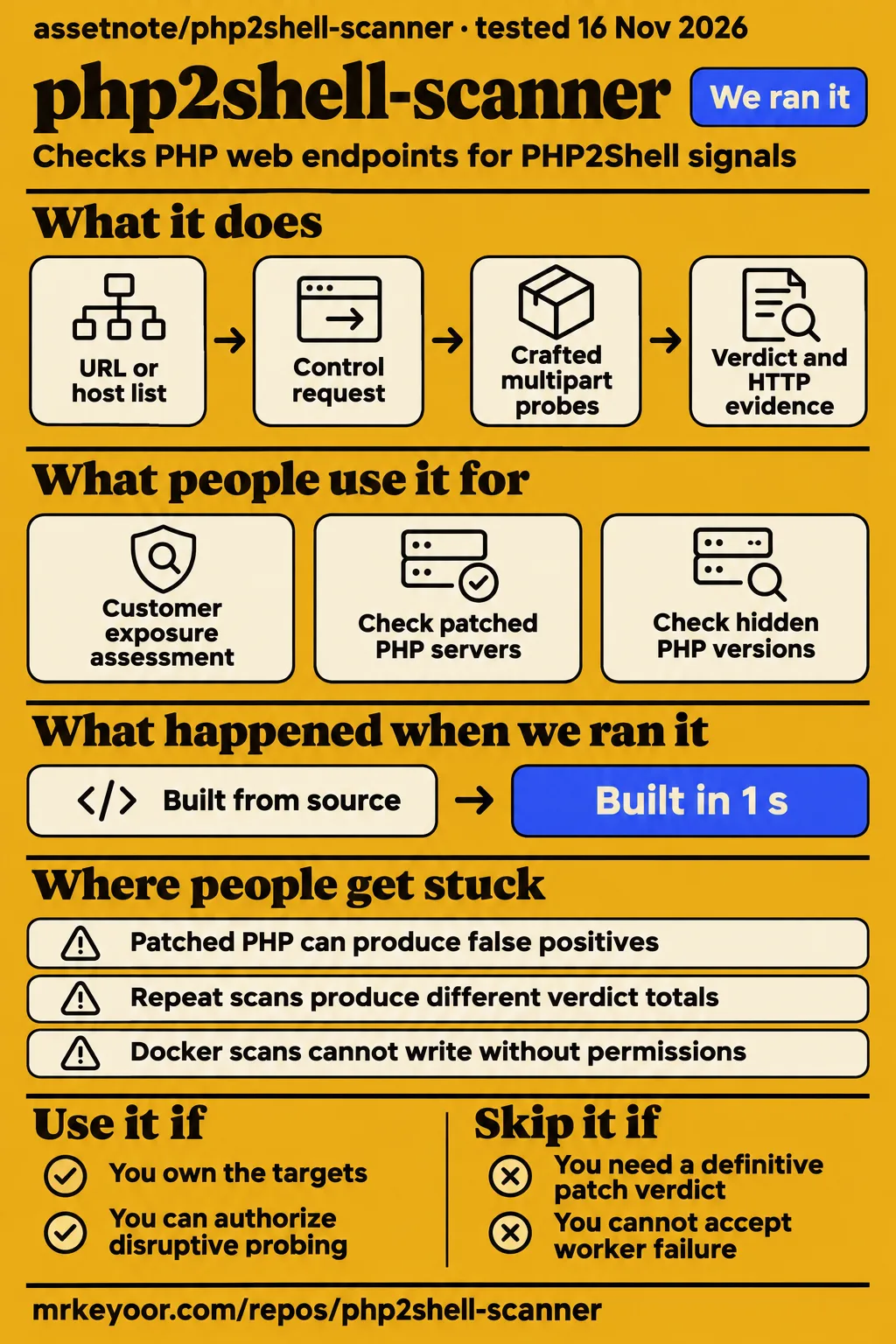
Assetnote's scanner combines memory-exhaustion probes, differential HTTP responses and a PHP-version fallback. It is a command-line detector for PHP2Shell, the PHP vulnerabilities identified as CVE-2026-109618 and CVE-2026-109619. The Assetnote README describes a control request followed by crafted multipart probes. You give it a URL or a host list, then inspect the verdict and its supporting evidence. That makes it useful for exposure investigation when you need more than an advertised version string.
The endpoint matters. Assetnote tests /index.php by default, preserves a supplied URL path and supports custom paths through --path and --path-file. Its default --sapi auto applies both Apache mod_php and PHP-FPM rules. If you already know which PHP interface serves the application, the README documents restricting detection to that interface. A host inventory, a correct application path and knowledge of the web runtime give the resulting response a much clearer context.
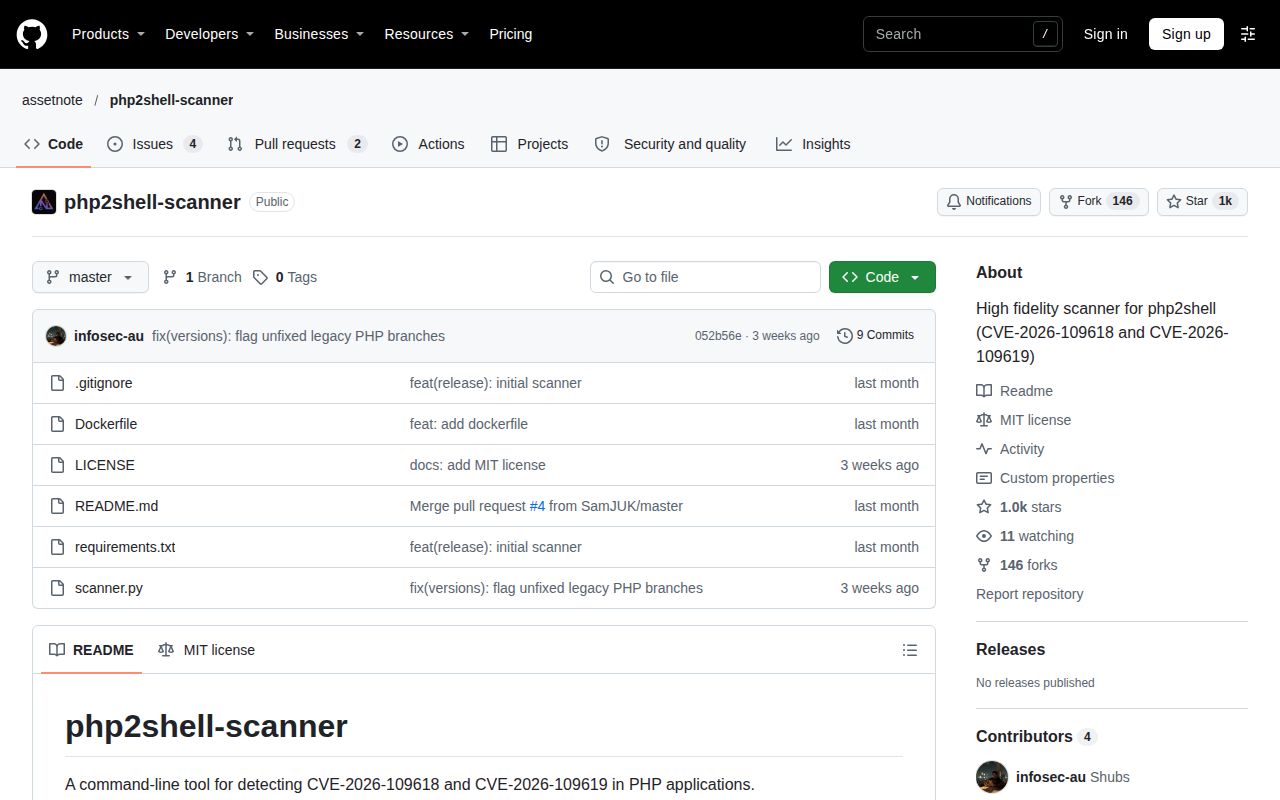
Several repositories use this name. This review covers assetnote/php2shell-scanner, whose logic came from Searchlight's Exposure platform. The local and SSH modes described in aancw's documentation belong to that separate project. When somebody shares a command, check the owner as well as the repository name. Installing Assetnote's Python tool does not give you the host-configuration inspection documented by aancw. Searchlight's release account and aancw's README make the distinction clear.
What people use php2shell-scanner for
Searchlight reports deploying the detection logic in its Exposure platform, while an Apache operator used the public scanner to check a patched server and received a false positive.
| Who used it | What they did | Recorded outcome |
|---|---|---|
| Searchlight Cyber research team | Implemented PHP2Shell detection in Exposure, then released Assetnote's scanner | Describes progressive behavioral checks followed by version fallback for customer exposure assessment. Release account |
| archon810 | Checked patched PHP 8.3.36 under Apache with its version hidden | Received VULNERABLE, reported the empty-500 behavior and prompted a maintainer reproduction. Issue #1 |
The second case is the more useful buying advice. The operator had already updated Apache's PHP environment and restarted it, according to the report. The scanner still raised the alarm. A maintainer then reproduced related behavior on patched builds. That is a reason to preserve the request, response and installed-package details when assessing a finding, rather than sending an isolated vulnerability label to the application owner.
Community attention adds less evidence than those two accounts. On r/blueteamsec, digicat shared the Assetnote repository and the supplied reply thanks them for sharing it. That is a distribution record, not an accuracy study. The X search also contains promotion of tools described as supporting URL, localhost and SSH modes, which should not be folded into Assetnote's feature list. Reddit record, X search.
What happened when we ran it
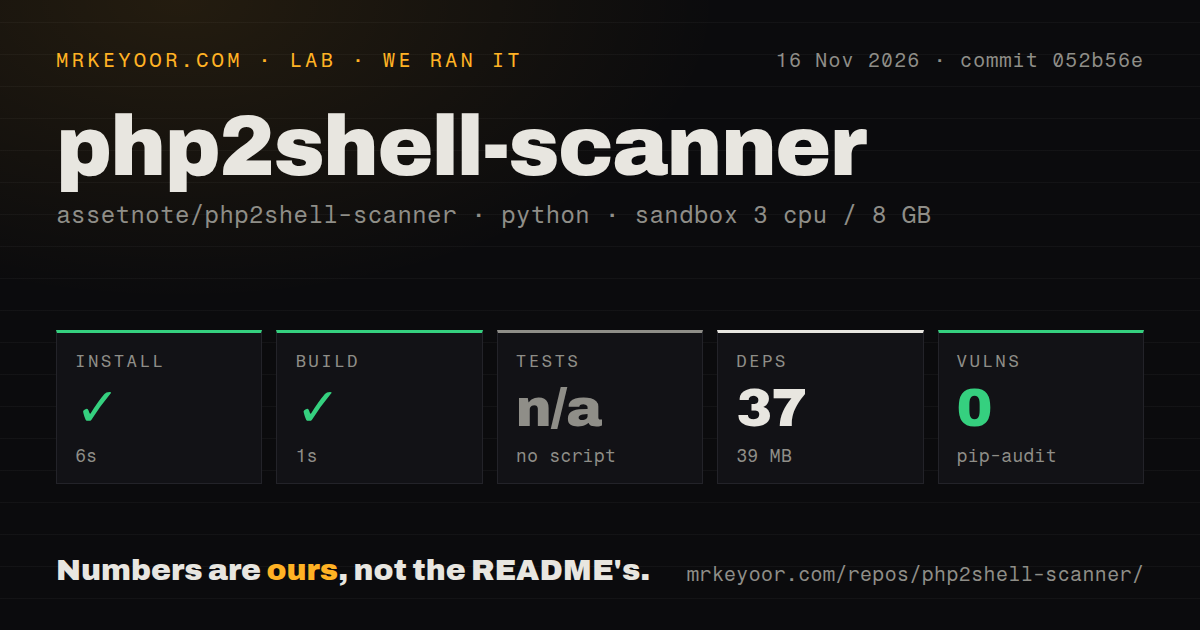
Our November 16, 2026 sandbox run at commit 052b56e installed successfully in 6 seconds and built successfully in 1 second; tests were skipped because no tests script or target existed.
| Recorded check | Result | What it tells you |
|---|---|---|
| Install | Succeeded in 6 seconds | Dependency setup completed in this sandbox |
| Dependencies | 37 recorded, 39 MB on disk | The recorded environment was small enough for a straightforward local evaluation |
| Build | Succeeded in 1 second | The harness build step completed |
| Tests | No tests script/target, skipped | There is no passing test-suite result to report |
| pip-audit | 0 known vulnerabilities | The audit reported no known advisories in this run |
| Repository signals | 0 CI workflows, Dockerfile present, no tests directory | Packaging exists, with no automated coverage demonstrated by these signals |
The recorded configuration was 3 CPUs, 8 GB RAM and image ghcr.io/astral-sh/uv:python3.12-bookworm. The image name is configuration metadata. Actual runtime and operating-system versions require the raw toolchain logs. The checkout contained six files and approximately 1,321 source lines. The quick installation removes a practical obstacle to trying the tool, but it says nothing about whether a particular HTTP error proves PHP2Shell exposure.
The separate hands-on safety step failed because none of compose.yaml, compose.yml, docker-compose.yaml or docker-compose.yml existed. The lab rule required a Compose file. This is a harness prerequisite failure, not evidence that the documented standalone Docker invocation fails. The run-summary record nevertheless says it deployed with its own Docker Compose and loopback-bound ports. Those records conflict, so this review treats deployment as blocked rather than claiming a working target scan.
Teardown was recorded as successful. There is no task result to turn into an accuracy score. For setup, the README documents Python 3.9 or newer and a requirements-file installation, along with a Dockerfile route. It also supports custom HTTP headers for endpoints that need them. Prepare the authorized target list, application paths and a writable output location before scanning. Those choices affect the usefulness of the report more directly than another second saved during installation. README.
Where people get stuck: patched servers, changing verdicts and JSON output
The sampled issues contain a reproduced false positive, maintainer-reported fixes for older-version gaps and open reports about repeat scans, endpoint checks and output permissions.
| Problem and source | What the record says | Practical response | Recorded status |
|---|---|---|---|
| archon810's patched-server result, #1 | Patched PHP returned the empty-500 memory-limit signal; a maintainer reproduced related cases | Compare the response with the installed web-runtime build and vendor patch record | Closed, with a linked commit and an acknowledged detection ambiguity |
| PHP 8.1 header miss, #5 | Reporter supplied an X-Powered-By version that was missed | Use a revision containing the maintainer-reported fix when assessing that branch | Closed, maintainer says a fix was pushed |
| Older-version verdict gap, #3 | Reporter asked about PHP 5.4 through 7.3 | Check the selected scanner revision's branch handling | Closed, maintainer says a fix was pushed |
| JSON write error, #10 | Reporter received permission denied for results.json | Check the container user's write access to the mounted output directory | Open, no successful resolution recorded |
| Repeat-scan changes, #12 | The same host list produced different verdict totals | Preserve per-host evidence from each run before consolidating findings | Open, no diagnosis recorded |
| Non-PHP endpoint, #11 | Reporter describes an index.php 404 followed by an ingress bad gateway | Establish that the selected path reaches PHP before interpreting a crash-like response | Open, no implemented preflight recorded |
The repeat-scan report deserves particular attention if your job is compiling a remediation queue. The author of #12 narrowed an initial scan to the same 32 hosts and ran that list three times over 20 minutes. The reported vulnerable totals were 15, 23 and 16, while inconclusive/error totals were 17, eight and 16. These are one operator's results, not our measurements. The thread supplies no cause. Retaining the individual response evidence lets an investigator distinguish a changed result from a host that has actually been remediated.
The Docker report has a narrower lesson. Its exact failure is [Errno 13] Permission denied: 'results.json'. The thread includes a root-user invocation, but no recorded successful outcome. Our recommendation is to inspect ownership and write access for the mounted directory using the intended container user. A scan and its saved report are separate outcomes: don't discard terminal evidence while sorting out the output path.
Security: memory-exhaustion probes need an operating window
Searchlight says the scanner deliberately triggers an out-of-memory condition where possible and warns users to take care. Its expectation that workers usually recover quickly is an author expectation, not a service-availability guarantee. If a production owner cannot accept a worker failure during the assessment, choose a tool with a different default probing policy. Permission to perform inventory should cover the actual requests this scanner sends. Searchlight research.
The current README describes a small control request and up to three probes totaling about 29 MiB per tested path. It says probing stops when the verdict is settled and duplicate input URLs are scanned once. Those documented request sizes matter when choosing host lists and concurrency: a short CLI invocation can cause substantially more traffic than a header check. Our advice is to start with an agreed target and observe the application owner's monitoring before expanding the scope. Network-impact documentation.
Redirects are off unless requested, and TLS certificate checking has an explicit disable flag. Output deserves attention too: the README says saved findings contain verdict reasons and redacted HTTP request/response evidence. Keep that evidence with the assessment, under the same access controls as the target inventory. Redaction is a documented feature, and it still makes sense to inspect the report before sharing it outside the team responsible for the hosts.
php2shell-scanner vs passive scanners and host inspection
Pick an alternative by the evidence you can collect and the target impact you can accept, rather than by the shared php2shell-scanner name.
| Project | Documented approach | Pick it when |
|---|---|---|
| Assetnote/php2shell-scanner | Active behavioral checks with version fallback | You want response evidence and can accommodate memory-exhaustion probes. Searchlight |
| Ls-ComCSIRT/php2shell-scan | Adapts Assetnote logic, adds domain enumeration and defaults to passive version checks | You want domain discovery with crash probes kept behind an active-mode option. README |
| aancw/php2shell-scanner | URL checks plus local and SSH configuration inspection, deliberately avoiding the OOM path | You have host access and want configuration evidence alongside remote checks. README |
| PaulTimmins/php2shell-scanner | Ordinary requests and bounded HTML fingerprinting, without multipart uploads or session mutation | You want PHP inventory while preserving a distinct unknown-version result. README |
A passive scanner makes a different compromise. Hidden versions can leave it without a patch-level answer. Assetnote tries to collect behavioral evidence in that situation, but the patched-build report shows why more intrusive evidence still needs interpretation. If you control the server, installed-package and web-configuration evidence can resolve questions that a remote response leaves ambiguous. That is why aancw's host modes deserve consideration as a different workflow, rather than being treated as extra flags for Assetnote.
Pentest-Tools' own scanner video walks through a baseline request to /index.php, progressively larger bodies and a downloadable finding report. The transcript describes a finding that includes the endpoint. It is a demonstration of Pentest-Tools' service, not a recording of Assetnote's CLI. Use it to understand that product's reporting workflow, without transferring its demonstration outcome to this repository. Pentest-Tools scanner video.
What the other reviews get wrong
Searchlight's launch assurance needs the qualification supplied by its own maintainer: patched PHP can produce the same empty-500 signal. The launch article says the probes accurately determine patch status. In #1, kgervot-an explains that the patch prevents unsafe cleanup after memory exhaustion while memory exhaustion itself can still occur. That distinction changes how you use the result. Corroborate the installed build before treating a crash-like response as proof of this code-execution vulnerability. Launch article, maintainer response.
The blanket claim that end-of-life PHP cannot receive a backport is also too broad. walt3rblake's verdict documentation says its EOL category will not get a backport. The supplied aancw documentation explicitly acknowledges backports for PHP 7.4, 8.0 and 8.1. An upstream release boundary and a vendor's patched package are different evidence. For an older runtime, ask which package or source patch is installed instead of deciding solely from the branch number. walt3rblake documentation, aancw branch notes.
Finally, aancw's introduction understates URL-mode requests by describing the arming probe as the only request. The same README lists exposed-phpinfo crawling as enabled by default. Its OOM avoidance is a documented distinction, but describing it as a single-request scanner omits that crawling behavior. Count the enabled modes and options when planning traffic, whichever repository you choose. aancw README.
Questions people ask
Patched PHP can trigger a false positive because enforcing its memory limit can produce the same empty HTTP 500 response as the scanner's vulnerability signal. That explanation comes from the maintainer's reproduction in issue #1.
Why does php2shell-scanner flag an already patched PHP server as vulnerable?
The maintainer reproduced memory-limit false positives on patched PHP 8.4.27 and PHP 8.3.36 under specific settings. Without a disclosed PHP version, the empty-500 responses can be indistinguishable. The report concerns a remote detection signal, so compare it with the web server's installed PHP package and configuration. Issue #1.
Was the patched-server false positive actually fixed in code?
Issue #1 is closed and links commit 1d5878538642745c53e004daa7a652af8849ff9f, but the supplied thread does not include the commit's implementation or a successful regression result. The current README still documents patched-build false positives. A closed issue alone is insufficient grounds to call this detection ambiguity eliminated. Issue #1, current limitations.
Why do vulnerability results change when I rescan the same hosts?
The author of #12 reports changing totals across repeated scans, and the open thread contains no diagnosis. Assigning the changes to rate limits, worker recovery or a load balancer would add a cause absent from the record. Keep each host's verdict reason and responses when investigating your own run. Issue #12.
Can the scanner check whether index.php exists before sending further probes?
Issue #11 requests that preflight after a reported false positive on a non-PHP host. The supplied thread contains no implementation or maintainer response. The current README documents /index.php as the default and allows custom paths. Choose the application's real PHP endpoint rather than treating any response at that filename as PHP identification. Issue #11, path documentation.
Why was PHP 8.1 missed despite its X-Powered-By header?
The reporter in #5 describes a PHP 8.1 header that produced a not-vulnerable result and proposes handling branches below the fixed-version table. Maintainer infosec-au replies that a fix was pushed. This is a reported correction to that version-handling gap, rather than an open-ended claim that all older vendor builds are correctly classified. Issue #5.
Does the scanner provide verdicts for PHP 5.4 through 7.3?
The maintainer says a fix was pushed after #3 asked about missing verdicts for PHP 5.4 through 7.3. That supports reporting the gap as addressed according to the maintainer. The thread supplies neither a branch-by-branch result table nor evidence for every vendor's patched package. Issue #3.
How does the scanner handle older PHP versions patched by BaoTa?
Issue #13 raises the concern that BaoTa has patched some older versions while the scanner matches upstream fixed versions. The open thread provides no answer resolving that concern. For such a host, obtain BaoTa's package or patch evidence alongside the scanner result rather than assuming the upstream-looking version string settles its status. Issue #13.
How can I save Docker scan results without a JSON permission error?
The report in #10 shows a filesystem write failure, so check whether the container user can write the mounted output directory and selected file. A root-user command appears in the issue, but no successful outcome is recorded. Our recommendation is to make the intended output location writable for the intended user, then confirm the report was actually saved. Issue #10.
What license permits using or building on php2shell-scanner?
The current repository carries an MIT license, including permission to use, modify and distribute the software subject to its notice requirements. The older #9 thread requested a license and received a maintainer promise of MIT licensing. Reading today's actual file resolves that historical gap more directly than repeating the original complaint. MIT license, issue #9.
Is my PHP server exposed to PHP2Shell?
An Assetnote verdict is evidence to investigate alongside the installed web-runtime build and any vendor backport. The maintainer's patched-server reproduction shows why VULNERABLE can overstate the conclusion of a hidden-version scan. For a particular server, package evidence and the recorded request/response belong in the same assessment. Maintainer explanation.
How do I identify whether a website runs PHP and which version it uses?
PaulTimmins' scanner documentation separates exact PHP version headers from weaker PHP-identification signals such as a PHPSESSID cookie. A PHP signal with a hidden version becomes PHP_UNKNOWN. That is a useful reporting distinction: identifying PHP does not supply its version, and an arbitrary .php URL alone does not prove the backend uses PHP. Fingerprinting documentation.
How can PHP2Shell be reproduced in a demonstration?
The supplied Bilibili search lists demonstration videos, but listing titles is insufficient evidence for a reproducible procedure or a successful outcome. Our recommendation is to use an isolated, disposable target with a known package revision and recovery plan. Assetnote's active probes themselves can exhaust memory, so a demonstration needs the same operational care as an assessment. Demonstration search, probe warning.
What we have not tested yet
Our successful source setup and blocked Compose safety step leave detection accuracy unmeasured. We did not run a known-vulnerable and patched target matrix, measure false-positive or false-negative rates, reproduce #1 after its linked commit, or investigate the repeat-scan report. The next useful experiment would hold the target build and configuration constant, record every response and repeat the checks across patched and vulnerable web runtimes.
We also have no successful Docker output-permission reproduction, BaoTa backport validation, non-PHP preflight result, service-recovery timing or comparative workload across the alternatives. The audit's zero known advisories is not a code-security assessment. No screenshot or known-answer task result accompanies this pack, and the contradictory deployment summary cannot substitute for one. For now, keep the scanner's response evidence and the server's installed-build evidence together before assigning remediation work.