Short answer: setup passed, execution needs a matched lab
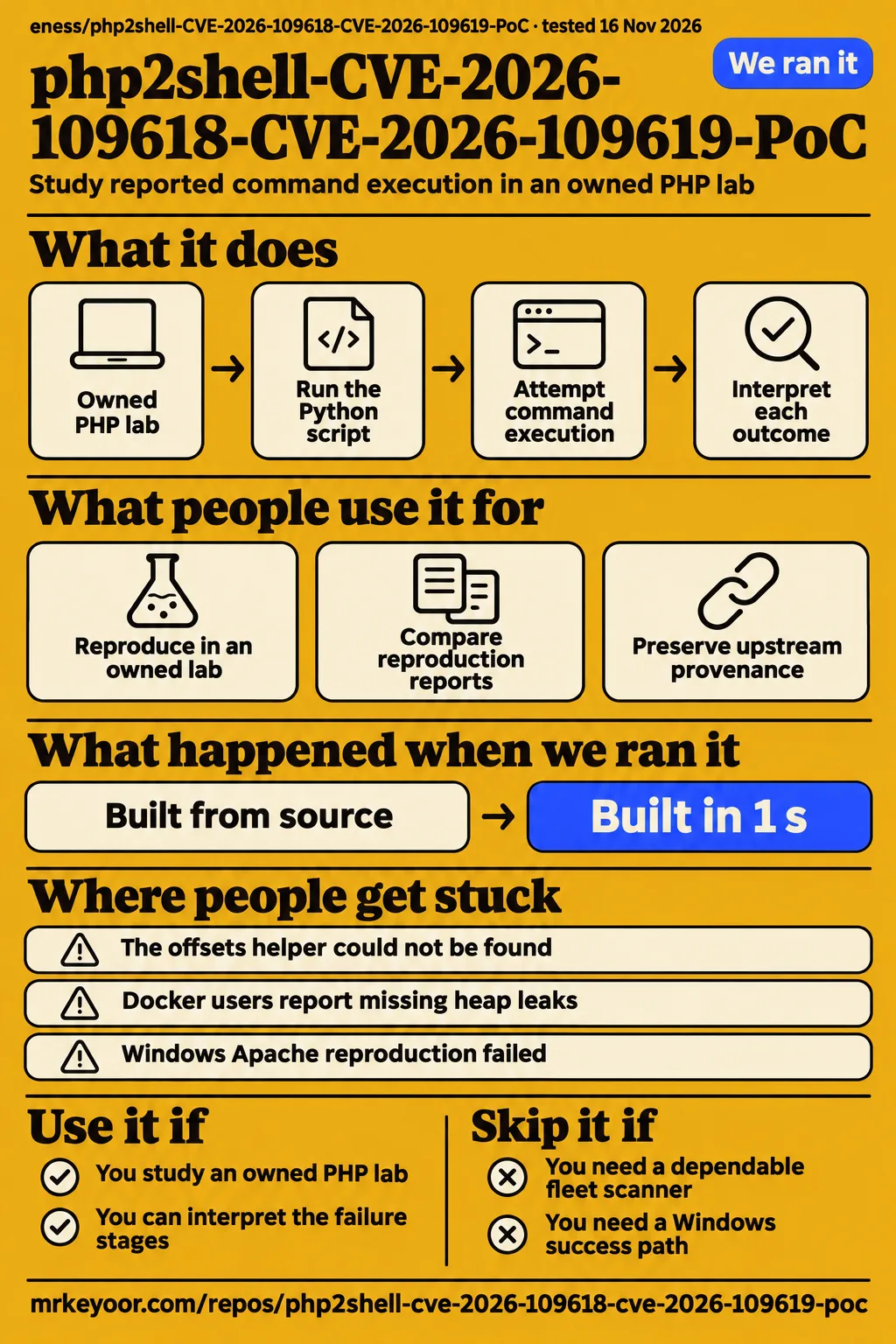
Our sandbox installed the checkout in 6 seconds and completed its build step in 1 second, while the separate hands-on attempt stopped at a missing-Compose safety check. Use eness's php2shell-CVE-2026-109618-CVE-2026-109619-PoC if you are a security researcher examining a specific, owned PHP lab. Skip it if you need a dependable fleet scanner, a Windows reproduction recipe or a failed exploit attempt to certify that a server is safe.
In issue #14, psikoma reports first-attempt success with the eness PoC in an owned PHP 8.4.26 Apache Bookworm WSL lab after fixing two lab prerequisites. That is a useful report because it names the environment and the adjustments. It also gives a better starting point than the README's promise of a one-click exploit. The decision is whether you can account for the target build and interpret each outcome, rather than whether Python starts. Psikoma's report supplies that distinction.
What people use php2shell-CVE-2026-109618-CVE-2026-109619-PoC for
Researchers have used the eness engine for an owned WSL reproduction and attributed downstream tooling, while other users report unsuccessful Docker and Windows attempts.
| Who and task | Reported outcome | Source |
|---|---|---|
| Psikoma, reproducing eness in a loopback-only WSL lab | Reports first-attempt execution after correcting two lab prerequisites | Issue #14 |
| Psikoma, incorporating the engine into reproduction tools | Received conditional vendoring permission from eness | Permission exchange |
| Issue #8 reporter and noahbroyles, trying Docker | Report missing heap leaks, including on PHP 8.4.26 Apache | Heap-leak thread |
| Issue #1 reporter, trying Windows Apache | Reports failure on PHP 8.2.12 | Windows report |
| Issue #6 reporter, trying nginx and PHP-FPM on Arch | Reports inability to reproduce; the captured issue has no replies | FPM question |
The reuse exchange is unusually helpful. Eness granted psikoma permission to vendor and reproduce the engine with full attribution and links to the repository and issue. The request describes retaining an unchanged upstream file so later changes can be distinguished from the original engine. For a researcher comparing results, that provenance is worth preserving: a modified downstream tool and the eness checkout are different experimental subjects, even when both carry the PHP2Shell name. Read the permission and request.
What happened when we ran it
Our hands-on safety step failed because none of the required Compose filenames existed. The step is dated 2026-11-16. It explicitly names compose.yaml, compose.yml, docker-compose.yaml and docker-compose.yml, then says a Compose file is required. This was the runner's deployment prerequisite, so the result is a blocked attempt rather than a failed PHP exploit.
The run-summary record says the project was deployed with its own Docker Compose on 2026-11-16, with every port bound to 127.0.0.1. That summary conflicts with the failed safety step. We treat the deployment as blocked because the step-level record supplies the concrete failure. The teardown record says "teardown: ok". Neither record supplies command output from a target.
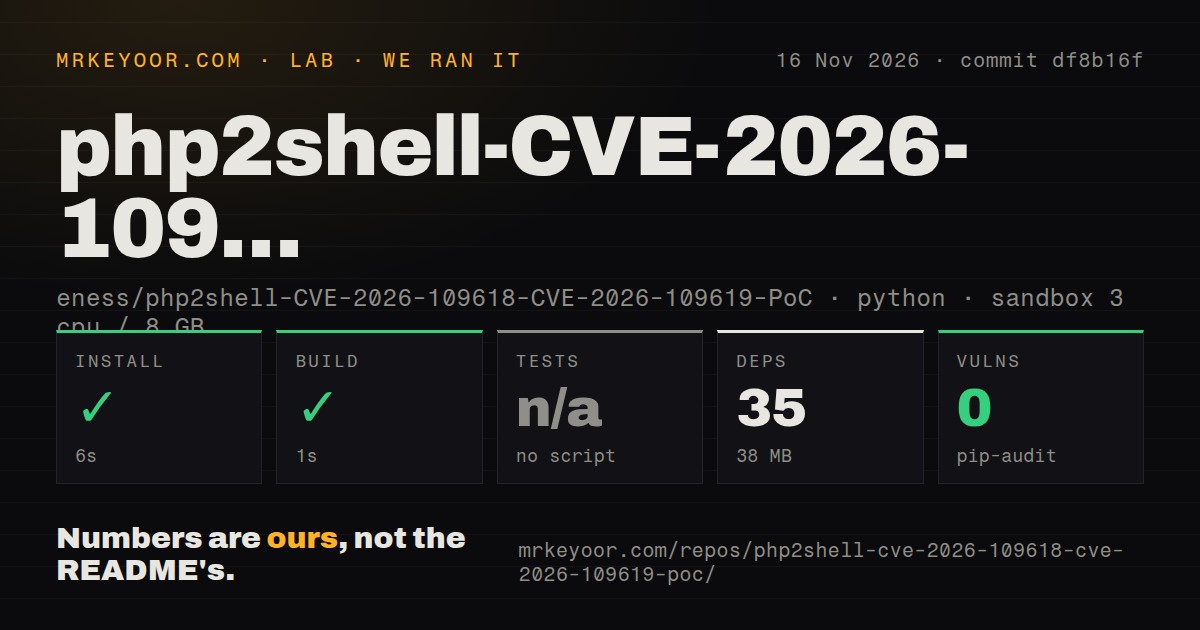
The separate build harness completed its recorded setup checks at commit df8b16f on 2026-11-16:
| Recorded check | Our sandbox result | Meaning for this review |
|---|---|---|
| Install | Succeeded in 6 seconds | The recorded dependency setup completed |
| Dependency footprint | 35 dependencies, 38 MB on disk | Small recorded setup footprint |
| Build | Succeeded in 1 second | The recorded build step completed |
| Tests | No tests script or target; skipped | No passing test-suite result |
| pip-audit | 0 known vulnerabilities | The dependency audit returned no known findings |
| Repository scan | 10 files, about 1,505 source lines, 0.3 MB checkout | A small checkout |
| Automation and packaging signals | 0 CI workflow files, no Dockerfile, no tests directory | These files were absent from the scan |
The configured sandbox had 3 CPUs and 8 GB RAM, with image label ghcr.io/astral-sh/uv:python3.12-bookworm. The label records configuration, while actual runtime and operating-system versions require the raw toolchain logs. The scan classified the ecosystem as Python. These results support a modest conclusion: preparing this checkout was cheap in our sandbox. They supply no PHP command-execution result. A zero-result dependency audit also says nothing about the correctness of the exploit or the repository's proposed PHP patch.
Where people get stuck: missing helpers and incompatible targets
Repeated missing-helper reports make the offset path the clearest documentation problem in the sampled tracker. Issue #5 reports that the referenced docker/offsets.py helper could not be located. The same filename appears in issues #10, #12 and #13. Closing #10 without a captured explanation leaves readers with no demonstrated repair, especially while the other reports remain open in the supplied records. Original missing-helper question, closed duplicate, issue #12 and issue #13.
| Symptom | Who reported it | Fix status in the captured evidence |
|---|---|---|
| Missing docker/offsets.py | Reporters of #5, #10, #12 and #13 | One closed report, three open reports, no demonstrated replacement helper |
| Heap leak missed | Issue #8 reporter and noahbroyles | Commenter proposes a pointer-filter workaround; no confirmed resolution in that thread |
| Malformed quick-fix/run.sh | Issue #2 reporter | Eness says fixed; issue closed |
| Windows Apache failure | Issue #1 reporter | Open; no successful Windows result recorded |
| nginx/PHP-FPM on Arch failure | Issue #6 reporter | Open, with no replies in the record |
In issue #8, noahbroyles reports the same heap-leak failure using php:8.4.26-apache. The same thread then changes direction: connorsaunders tries another project's container workflow and encounters an absent application endpoint in DVWA. That second failure is a different prerequisite problem, so it cannot explain the first reporter's missing heap leak. A reader needs the exact symptom and project attached to each attempted fix. Issue #8 discussion.
In issue #8, S4vz4d suggests changing the pointer-filter floor and raises kernel address randomization as a possible explanation. Treat that suggestion as a proposed diagnosis for an address-filter mismatch. It is neither a confirmed repair for every Docker failure nor evidence that eness merged a fix. For the malformed run.sh report in issue #2, eness replied "fixed." and the issue is closed. That is a maintainer-reported resolution, with a much narrower meaning than a successful independent rerun of the mitigation script. Pointer-filter suggestion and script repair.
Matching the PHP binary matters more than its banner
Psikoma reports that rebuilt images retained the PHP/8.4.26 banner while their offset profiles changed. A PHP version string therefore gives you less information than a matching module and its build provenance. The downstream account describes measuring symbols from the actual libphp.so module after its old constants stopped matching. Those details belong to psikoma's reproduction account, rather than a missing helper magically restored to the upstream checkout. Build and calibration account.
| Environment | Evidence attached to eness | Decision |
|---|---|---|
| PHP 8.4.26 Apache Bookworm in WSL | Psikoma reports success after lab adjustments | Closest reported starting point for an owned reproduction |
| PHP 8.4.26 Apache in Docker | Noahbroyles reports missed heap leaks | Matching a version tag alone is insufficient |
| Windows Apache, PHP 8.2.12 | Issue #1 reports failure | Do not choose it for a documented Windows success path |
| nginx/PHP-FPM on Arch | Issue #6 reports failure without a resolution | Keep this attempt separate from other projects' FPM results |
The README documents an Apache prefork profile and configuration prerequisites. Psikoma's account adds practical context: progress-update throttling and requests landing on different workers interfered with that lab. For a reader deciding how much effort to budget, recovering and recording an exact environment is the real work. Our quick Python setup should not set expectations for that process. Downstream environment report.
Security and reuse require separate decisions
Eness's README restricts the intended use to education and authorized research, while issue #14 records conditional permission for one downstream project. Those are separate questions: permission to test an owned target concerns the experiment; permission to redistribute code concerns reuse. The public repository's availability does not answer both. Its README includes mitigation scripts and a source patch, which deserve the same review as code you would otherwise run with administrative access.
For defensive operations, use the PHP package vendor's security guidance rather than treating a PoC result as an update decision. Nayrae explicitly calls disabling upload progress insufficient as a sole mitigation. The godylockz documentation likewise tells operators to install a package with both fixes and restart PHP-serving workers. An upload-progress setting is an interim control in those accounts. This review's install result is no reason to apply a repository patch to a live PHP runtime. Nayrae's mitigation warning and godylockz remediation guidance.
php2shell-CVE-2026-109618-CVE-2026-109619-PoC vs ikow, hack-ita and psikoma
Psikoma's project is the closest comparison for readers prioritizing provenance and a documented owned lab; the other candidates serve different experimental paths.
| Project | What its evidence says | When to consider it |
|---|---|---|
| eness reference PoC | Upstream engine used in psikoma's attributed reproduction | You want to study the reference checkout and its issue history |
| ikow/php2shell-poc | A commenter reports container success, then fails to transfer it to DVWA | You want to assess that project's own lab assumptions |
| hack-ita/php2shell-cve-2026-109618-109619 | Author advertises added automation and profile fallback | You want to inspect those claimed changes against eness |
| psikoma/php2shell-CVE-2026-109618-109619 | Author records a frozen upstream reference, loopback enforcement and lab reports | You value recorded provenance and an explicitly owned reproduction environment |
In issue #8, connorsaunders reports success with ikow in its own container setup, followed by failure to reproduce it in the DVWA setup. The reported missing LFI endpoint matters because an application-dependent route cannot be inferred from the PHP version. Commenter's comparison.
Hack-ita advertises automatic preliminary stages and fallback across known profiles. Its description of eness as a reference stage-3 PoC also differs from the current eness README, which describes an automated sequence. Compare the actual snapshots before crediting that feature difference. Psikoma describes tooling that refuses non-loopback targets. Those are reasons to inspect the downstream packaging, without importing its claimed results into our sandbox results. Hack-ita's comparison and psikoma's provenance account.
What the other reviews get wrong
Conflicting root-cause accounts prevent a clean jump from a shell demonstration to proof of the named vulnerability pair. Xuehuolll reports that the claimed post_bytes_processed UAF did not reproduce on stock builds. That audit separately describes a local command-execution path with additional application prerequisites. The eness README presents the progress-counter mechanism more confidently. Preserve that disagreement instead of stitching the two accounts into one chain. Xuehuolll audit and eness README.
The reply in issue #1 saying the PoC works only on PHP 8.5.4 conflicts with psikoma's PHP 8.4.26 report. An unsuccessful Windows attempt cannot settle Linux compatibility. Nor can another project's failed FPM path settle the whole serving stack: The godylockz snapshot reports production-configuration mod_php success with one and 150 workers, plus a PHP 8.4.26 FPM result requiring cleanup=Off. Those are reports about that project's exact builds, not a compatibility promise for eness. Version claim, reported eness success and godylockz snapshot.
The historical godylockz README makes display_errors and a small memory limit requirements of its shipped chain. Applying those restrictions to every later snapshot would ignore the production-configuration report. The same discipline applies to privilege claims in video titles. Psikoma reports execution as an unprivileged WSL user, rather than root. A shell under the PHP process identity is a serious result, but it is not evidence of root access. Historical snapshot, later scope and psikoma's execution identity.
Social posts and video titles add attention, not a compatibility matrix
On X, WebInspectPro advertises a PHP2Shell PoC with passive checks and optional crash and session-injection tests. That post is an announcement, not an eness-specific execution log. Its short links and feature list are poor grounds for assigning those capabilities to every similarly named repository. WebInspectPro's post in the captured X results.
Puneet Darji introduces a PHP vulnerabilities demonstration in the Pwnagent video transcript, while the second transcript introduces a TryHackMe PHP2Shell exercise. Neither introduction supplies an eness build identity. The third video's captured transcript is largely music, so it cannot support an account of successful execution. The Chinese-language Bilibili results surface lab-reproduction and Baota-upgrade interests, but a search title is not a tested panel procedure. These are useful audience questions, with a different evidential job from issue #14. Pwnagent video, TryHackMe video, hands-on video's transcript and Bilibili search results.
Questions people ask
PHP 8.4.26 Apache users have reported missed heap leaks in issue #8; that thread offers a pointer-filter suggestion without a confirmed resolution. Heap-leak report.
Why does the PoC report a missed heap leak on PHP 8.4.26 Apache?
Issue #8 supplies a possible pointer-range explanation, rather than a diagnosis proven for both reporters. Psikoma separately reports lab prerequisites involving progress updates and worker affinity. Keep those explanations attached to their respective accounts instead of assuming one fix covers every missed leak. Issue #8 and psikoma's lab.
Where is docker/offsets.py, and how are offsets measured from libphp.so?
Issue #5 asks exactly where the helper is and how offsets are measured; the captured thread supplies no answer. Psikoma describes symbol inspection against the actual module in a downstream lab. That account supplies provenance for its own profiles, rather than a replacement helper bundled with eness. Missing-helper question and downstream measurement account.
Is PHP-FPM behind nginx FastCGI affected, and why does this reproduction fail on Arch?
The issue #6 reporter could not reproduce on Arch Linux and asked about nginx FastCGI with PHP-FPM. The captured thread gives no diagnosed cause. Other tooling reports exact-build FPM command execution, so this failure cannot clear PHP-FPM of risk. Use the report to understand an unresolved eness reproduction question, not to declare a whole server architecture safe. Arch question and other project's FPM scope.
Does the eness PoC work on Windows Apache with PHP 8.2.12?
The issue #1 reporter says the PoC does not work on Windows Apache with PHP 8.2.12. Replies debate compatibility and modified PHP code, but the supplied thread contains no successful Windows reproduction. Choose another documented path if a Windows result is your immediate requirement. Windows thread.
Does the PoC work against an unmodified PHP image?
The records disagree: issue #1 questions modified PHP code, while psikoma reports an extracted official-image environment with lab configuration changes and measured offsets. An image name alone cannot settle whether a binary or configuration matches the claimed experiment. Preserve both the source of the image and the changes made to it. Issue #1 and psikoma's environment.
Can I vendor and reproduce the eness exploit engine, and what attribution is required?
Issue #14 grants psikoma permission with full attribution and links to the repository and issue. That project-specific grant should not be rewritten as a general open-source license. The distinction matters if your organization needs redistribution terms that apply to everyone using the code. Permission exchange.
Is the malformed run.sh script fixed?
Eness says "fixed." in closed issue #2. That is the resolution shown in the captured thread. Read the script before giving it administrative privileges: the issue concerns the mitigation helper, not a successful exploit or a security review of everything the helper changes. Script issue.
Are maintained packages or backports available for older PHP branches?
The issue #7 reporter points to deb.sury.org as an example of maintained older PHP packages, while noting distribution differences. SOCRadar describes minimal source backports for PHP 7.4, 8.0 and 8.1, separately from regular releases. Match a vendor advisory to your installed package instead of assuming every older banner means the same patch status. Package-maintenance correction and backport account.
Can this chain produce a shell, and is that result actually evidence for the named CVEs?
Psikoma reports execution from the eness-derived engine in an owned WSL lab. Xuehuolll's separate audit illustrates why a working command-execution demonstration and confirmation of the named CVEs are different claims: its local path includes an unserialize sink and a destructor gadget. Attribution to the precise chain is essential. Eness reproduction report and audit scope.
How can I reproduce PHP2Shell in a lab?
Psikoma's documented owned, loopback-only WSL environment is the most directly attributed eness reproduction account in these records. Start by assessing whether that recorded environment matches the research question you need to answer. Our own hands-on runner stopped at a Compose prerequisite, so this page supplies a review of the evidence rather than a newly validated execution recipe. Downstream report.
How do I upgrade PHP through the Baota panel to address PHP2Shell?
The Bilibili results include Baota-upgrade interest, but supply no verified panel procedure. Use the package provider's instructions for the PHP runtime actually serving your application. A panel label or CLI version is an incomplete inventory when the web server loads a different runtime. Search evidence and serving-runtime inventory guidance.
What we have not tested yet
We did not obtain a fresh PHP command-execution result for eness: our hands-on deployment stopped at the Compose safety requirement. The contradictory deployment summary remains an evidence-quality problem. No target task, timing, runtime-memory reading or screenshot accompanies that attempt. The successful install and build steps belong to the separate Python harness and cannot fill that gap.
We have not tested Windows compatibility, the Arch nginx/PHP-FPM setup, or independent reliability across restarts, worker counts and exact PHP modules. Psikoma's published reports are valuable attributed observations, but their raw evidence files are described as local. The comparison projects were not run side by side. We also have not validated the proposed source patch, mitigation helpers or a Baota upgrade procedure, and the supplied records do not establish a general license addition.
The next result worth collecting is an owned target's exact binary identity and configuration together with independent command proof. Until those belong to the same experiment, a failed leak remains a failed leak, and a successful Python build remains a successful Python build.