
Phoenix's npm package tests the client, not the Elixir server
Phoenix builds web applications in Elixir, with server-rendered pages and channels for exchanging live messages. The same repository also contains its JavaScript client. That distinction matters immediately: the npm package identifies itself as the official client, and the Jest configuration points at assets/test. If you want a framework for a shared dashboard or chat application, evaluate the server and its client together. A passing client suite answers only part of that decision.
Our checkout contained 513 files, roughly 13,474 source lines, and occupied 4.4 MB. The lab selected the Node/npm path at commit 9f2c140. Installation and Jest completed successfully, but the supplied run contains no Elixir compilation or server execution result. Phoenix remains worth considering for a team prepared to use Elixir. The measurement gives that team evidence about the JavaScript side, without establishing how its application will behave under production traffic.
What happened when we ran it
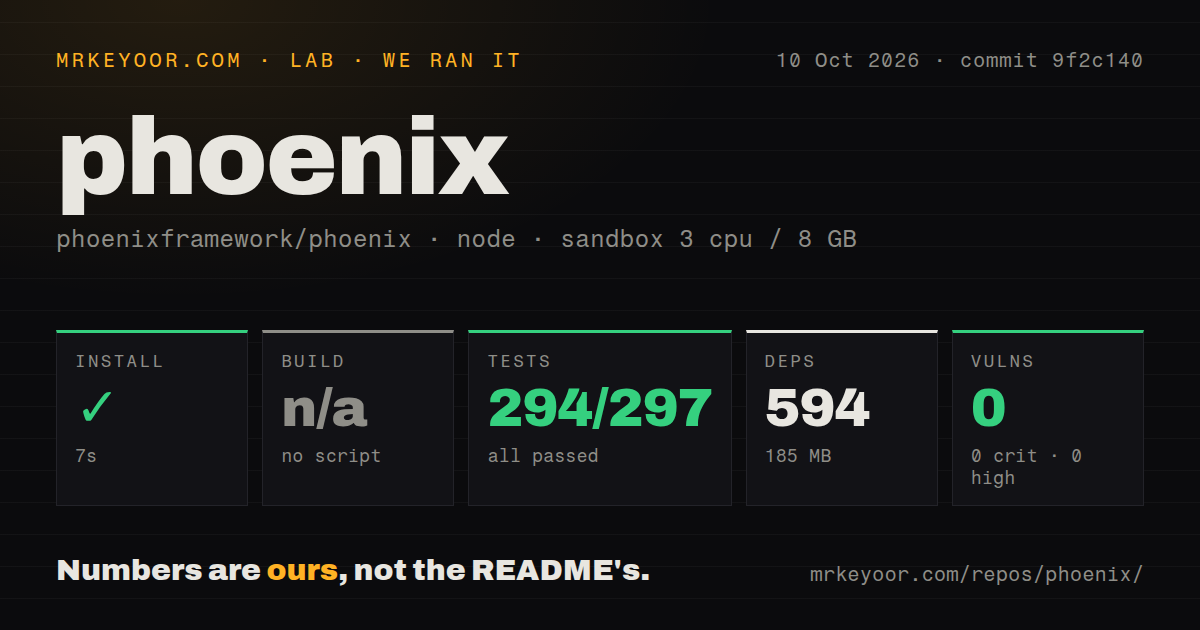
Our run installed 594 npm packages in 7 seconds, occupying 185 MB on disk. Jest finished successfully in 2 seconds: 294 tests passed, 0 failed, and 3 were skipped out of 297. We cloned commit 9f2c140 on October 10, 2026, in a fresh Debian container with 3 CPUs, 8 GB of RAM, and the lab-node:22 image. The sandbox had no secrets or elevated privileges.
The lab skipped build because it found no build script or target on the selected npm path. That isn't a successful build, and it doesn't mean Phoenix lacks a build process: the README documents Mix commands for the framework and its assets. The run also reported 5 CI workflow files, no Dockerfile, and a tests directory. Those signals describe the checkout examined by the harness, rather than the deployment files your generated application might acquire.
Npm audit returned 0 known vulnerabilities, including 0 critical, high, moderate, and low findings. That is the audit outcome for our npm environment at that snapshot. It doesn't assess Elixir dependencies or establish that a deployed web app is secure. The 294 passing tests provide useful client evidence, with 3 skipped cases left outside the passing set. Our testing method keeps those limits attached to the result.
Running the framework requires Elixir and Erlang
The installation guide for released Phoenix v1.8.15 requires Elixir 1.17 or later and Erlang 25 or later. The current source guide raises those requirements, so match instructions to the version you select. The README separates building the framework with Mix from building Phoenix.js assets. A developer who reads the npm result as a ready-to-run Node backend would be buying into the wrong runtime.
The 185 MB npm footprint covers the installed JavaScript environment we measured, without pricing the server setup. The documented application route uses the Phoenix generator. PostgreSQL is the default database, with alternatives available and --no-ecto for applications that don't need database integration. Linux live reload also requires inotify-tools. Those prerequisites are stated in the guide, so they're planning inputs rather than surprises established by our sandbox.
Deployment needs runtime secrets and an explicit migration step
The release deployment guide names SECRET_KEY_BASE and DATABASE_URL for a database-backed application. It describes packaging the runtime with the application and generating scripts for server startup and database migrations. That is a practical route for a team operating its own service. It also leaves the team responsible for supplying secrets and choosing when migrations run during a release.
Our 7-second npm install didn't exercise that route. Elixir releases must match the deployment machine's operating system and architecture, according to the guide. A zipped application directory therefore needs an appropriate build environment. The documentation also discusses clustering for long-poll transport. If your deployment platform only accepts Node processes, these are concrete reasons to choose a framework already supported there rather than attempt to fit Phoenix into it.
Channels make connection recovery part of application behavior
Release v1.8.15, published September 25, 2026, includes a Phoenix.js fix for an asynchronous close event tearing down a replacement transport. That is relevant to any app which should recover after a dropped connection. PR 6867 subsequently describes additional connection races, including channels remaining joined after delayed close events. The browser's visible connection status deserves its own acceptance check when your feature depends on channels.
The 2-second Jest result establishes success for the available client cases, without measuring reconnection behavior in your network or browser. Exercise the actual application through a dropped connection and resumed activity before relying on live updates for an operational dashboard. A message delivered twice or a screen that stops updating is an application problem even if ordinary page loading still works. Phoenix supplies the channel machinery, while you define what recovery must preserve.
Current pushes and transport work show active maintenance
The last push was October 10, 2026. GitHub returned 23,175 stars and 49 open issues and PRs, alongside recent work on transport behavior and development workflows. The September release addresses a specific client defect rather than merely updating a tag. Together, current commits and concrete issue activity support an active-maintenance judgment. Neither a star count nor the size of that queue measures how quickly your own report will receive a fix.
A team can use the 294 passing client tests as a reason to investigate further, rather than as a framework-wide approval. Compare Django if your existing application and deployment expertise are Python, or Rails if they're Ruby. I'd choose Phoenix when Elixir and channels solve an actual application requirement and the team can operate the release. Make the next checkpoint a generated app with its database and connection-recovery behavior, because our npm run did not test those.