Python 3.10+ code drives a Rust streaming engine
Pathway supports Python 3.10 or newer for describing reads, filters, joins, windows, reductions, and outputs while a Rust engine executes the graph. The same program can read a static batch during development and then stay alive as new records arrive. That is the useful idea here: you do not maintain separate batch and streaming versions of the pipeline. Late or out-of-order records can update prior results instead of being ignored.
The repository extends that model into live search and RAG. Its connectors cover systems including Kafka, PostgreSQL, Google Drive, and SharePoint, while the LLM package includes parsers, embedders, splitters, and an in-memory vector index. The README also points to an Airbyte connection for more than 300 sources. Pathway is most convincing when changing source data should flow into analytics or retrieval without a scheduled full rebuild.
A 2,457-file checkout is much heavier than the pip quick start
Our measured checkout contained 2,457 files, about 345,578 lines of source, and occupied 218.8 MB before the installed environment. It combines Python bindings with a Rust engine through Maturin. The README's user path is one command, pip install -U pathway, followed by an ordinary Python script or pathway spawn. Working on the repository itself is a different job.
That distinction matters because the top-level contribution guide explains issue and pull-request etiquette but does not provide a source build recipe. The repository has 5 CI workflow files and a tests directory, yet no Dockerfile in the measured checkout. The README does provide Docker snippets and points to a published pathwaycom/pathway image. Users therefore have a packaged route, while contributors need to reconstruct more of the development environment from project files and CI.
What happened when we ran it
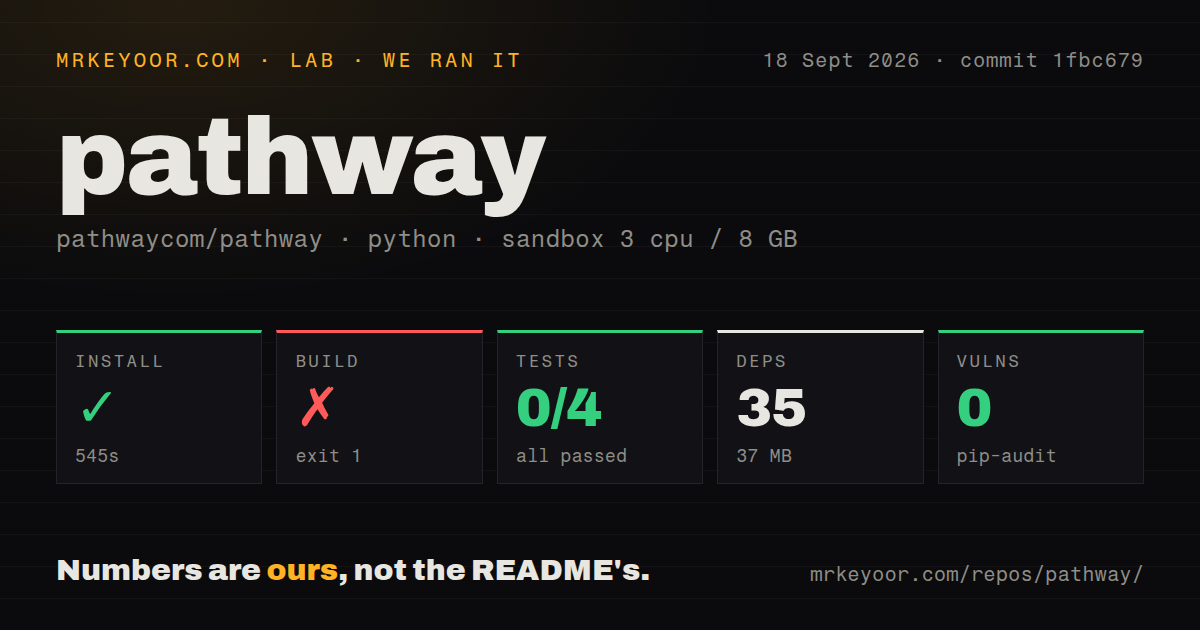
Our sandbox install took 545 seconds, added 35 Python packages, and used 37 MB on disk. The build failed with exit code 1 after 1 second. The supplied build result contains no diagnostic tail, so it supports a narrow conclusion: commit 1fbc679 did not build in the stated clean Debian container. It does not tell us which build requirement was responsible.
Pytest failed after 1 second, before any test completed. The result was 0 passed, 0 failed, and 4 collection or setup errors out of 4 discovered groups. The log shows ModuleNotFoundError: No module named 'numpy' while importing Pathway and No module named 'boto3' in integration tests. SharePoint and Twitter example tests also stopped during collection. We cannot tell from that log why the modules were absent.
Pip-audit reported 0 known vulnerabilities among the installed Python packages. That is useful, but it does not turn the run into a pass. The checkout had tests and 5 CI workflows, while both our build and test commands exited 1. Anyone evaluating source adoption should reproduce the project's intended developer install before treating a successful package import as proof that the repository is ready to change.
BSL 1.1 limits the free production shape
Pathway's license is BSL 1.1 rather than an OSI open-source license today. Its additional grant permits production use on one physical or virtual machine, subject to worker limits and exclusions. It bars offering a Stream Data Processing Service as defined in the license, and production use of modified code is limited mainly to indispensable bug or vulnerability fixes. Each version later changes to Apache 2.0 under the stated timing rules.
The product boundary follows a similar line. The README says the free edition provides at-least-once consistency, while exactly-once consistency belongs to the enterprise edition. Distributed Kubernetes deployment and external persistence are also described as enterprise capabilities. A single-node application can still be serious production work, but teams buying Pathway for horizontal scale or strict delivery guarantees should price the commercial path before building around it.
September 2026 activity is current, while contributions are selective
GitHub recorded 62,272 stars, 37 combined open issues and pull requests, and a last push on September 18, 2026. A separate issue search returned 29 open issues, and pull request 275 was updated on September 16. Tag v0.33.0 also appeared on September 18, while GitHub's latest Release object still pointed to v0.32.1 from August 1. The dates show active maintenance despite that publishing mismatch.
The contribution policy is more controlled than the star count suggests. Maintainers ask outsiders to open an issue before a substantial change and may close large unapproved pull requests without detailed review. Small fixes are welcome, and the guide asks substantial contributors to explain how they produced and checked the work. That is candid, but it means Pathway suits users better than developers looking for a community project where unsolicited architectural changes are routinely adopted.
Pathway earns a trial when one live Python graph replaces several jobs
The 545-second install and immediate source-check failures make a cautious evaluation appropriate. Start with the published package or container, connect one representative source and sink, and test restart behavior, late records, memory use, and the delivery guarantee you actually need. The framework has a clear job when one Python graph can replace a batch loader, a stream processor, and a separate retrieval refresh.
Apache Flink is the stronger default for an Apache-licensed distributed engine. Bytewax is easier to consider when the need is narrower Python stream processing, while RisingWave fits teams that want continuously maintained results through SQL. Choose Pathway when its Python API, connectors, and live RAG pieces remove enough glue to justify the BSL terms and the source setup work our 3-CPU, 8 GB sandbox exposed.