Flink handles event time and state in one distributed engine
Apache Flink processes unbounded streams and bounded data sets with the same streaming-first runtime. Its core ideas are more specific than generic distributed computation: event time, out-of-order records, stateful operators, windows, back-pressure, and exactly-once fault tolerance. Those features suit payment events, telemetry, operational joins, and other flows where records arrive late or a worker can fail after changing state. The Java API is the direct route. PyFlink adds Table and DataStream APIs for teams writing the job logic in Python.
The abstraction choice matters. Table API gives Python users relational operations that resemble SQL or tabular work, while DataStream exposes state and time for lower-level pipelines. Flink can run batch work by setting a bounded runtime mode, so a team does not need a separate engine solely because one input ends. That flexibility carries operating cost: even a Python job belongs to a distributed system with sources, sinks, checkpoints, deployment settings, and a JVM runtime behind it.
The 182.2 MB checkout is an engine source tree, not a Python library
Our measured checkout contained 24,726 files, about 2,520,543 lines of source, and occupied 182.2 MB before installation. The Python project lives in flink-python, one part of a much larger Java-led repository. That explains why a quick pip result answers only a small setup question. It does not prove that a cluster starts, a checkpoint recovers, or a connector works with your data system. Evaluate PyFlink as an entry point into Flink, not as an independent dataframe package.
The root README lists Git, a Unix-like environment, Maven 3.8.6 through the wrapper, and Java 11, 17, or 21 for a full source build. Its example Maven command skips tests. PyFlink has its own development path and test script, plus dependencies on Py4J, CloudPickle, Apache Beam, Python date handling, Arrow, and dataframe packages. Those layers are normal for a cross-language engine, but they make environment parity important when a contributor tries to reproduce CI locally.
What happened when we ran it
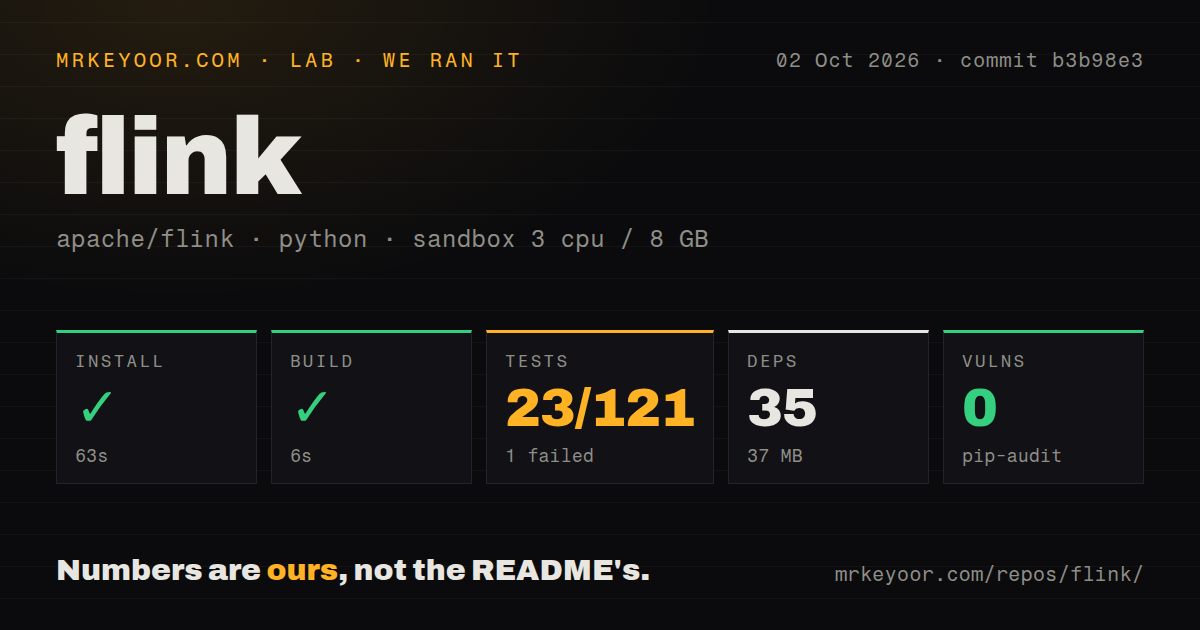
Our sandbox installed the flink-python project in 64 seconds, adding 35 packages and consuming 37 MB on disk. Its build then succeeded in 8 seconds. We used commit 5265908 in a fresh unprivileged Debian container with Python 3.12, 3 CPUs, and 8 GB of RAM. Those are encouraging packaging results: the selected Python subproject could resolve dependencies and produce its build artifact without credentials or privileged container access.
Pytest failed after 7 seconds during collection and setup. It reported 0 passed, 0 failed, and 87 errors out of 87, which means no test body ran. The log tail names Table API cases such as pipeline, schema, types, UDAF, UDF, UDTF, and window tests, then ends at pyflink/testing/test_case_utils.py. The supplied tail does not contain the exception that triggered them, so blaming Java, a system package, or Python 3.12 would be guesswork.
Pip-audit found 0 known vulnerabilities among the installed dependencies. That result covers the 35-package Python environment we measured, not Flink's Java dependency graph, external connectors, cluster images, or later commits. Our scan also found 10 CI workflow files and no Dockerfile. The missing passing test signal matters more than the successful 8-second build for anyone changing PyFlink: packaging works in this container, while behavior remains unverified because collection never completed.
External connectors make version choice a deployment decision
The main README lists Kafka, JDBC, Cassandra, Elasticsearch, MongoDB, OpenSearch, Pulsar, RabbitMQ, and cloud connectors in separate Apache repositories. This keeps the 24,726-file core from absorbing every integration's release cycle, but adopters must choose compatible artifacts and track more than one project. A useful pilot should exercise the exact source, sink, schema, checkpoint store, and failure mode intended for production. A word-count example proves API shape; it says little about upgrade or recovery behavior.
Flink itself does not require a hosted API key. Real pipelines still need credentials for databases, object stores, queues, or cluster control planes, and those secrets belong outside source. Deployment may be local for learning or attached to a cluster environment for sustained work. Teams should test restarts and late data before choosing it, because the reasons to accept Flink's complexity are its state and time semantics. If those semantics are irrelevant, Spark, Beam, or Ray may fit the staff and workload better.
August 28 activity is strong, while support lives outside GitHub Issues
GitHub recorded 26,298 stars, 368 open issues and pull requests, and a last push on August 28, 2026. The repository has GitHub Issues disabled, so that combined count should not be read as 368 reported bugs; current GitHub activity is dominated by pull requests, while the README sends bug reports to Apache Jira and support questions to mailing lists. The GitHub latest-release endpoint returned 404, although repository tags include release-2.3.0. Release discovery therefore differs from projects that publish every package through GitHub Releases.
Flink has the maturity signals expected from a large Apache data engine: ongoing pushes, versioned tags, dedicated documentation, and separately maintained connectors. Its Python contributor experience did not pass our clean-container check. The decision is still straightforward. Choose Flink when event time, long-lived state, and recovery semantics are central enough to justify operating it. If the main attraction is that the Python install took 64 seconds, stop there and compare a smaller tool before committing to the cluster.