Bundled data updates have no fixed schedule
ip2region's bundled raw IP data is updated irregularly, according to its README. That matters more to an adoption decision than an attractive lookup-speed claim. A local lookup can return an answer without telling you whether the underlying region assignment is still useful for your application. Before adopting the library, decide who will supply updated data and how you will decide that a new database is ready to replace the old one.
The project combines an offline lookup library with tools for creating xdb databases. That makes it interesting for developers who want to control their own IP-range data, including custom regional fields. The same flexibility creates work: the reader, dataset and update process are separate choices. I would shortlist ip2region for a team that wants those choices. I would hesitate if the team expects the bundled files to provide a maintained data service by themselves.
What happened when we ran it
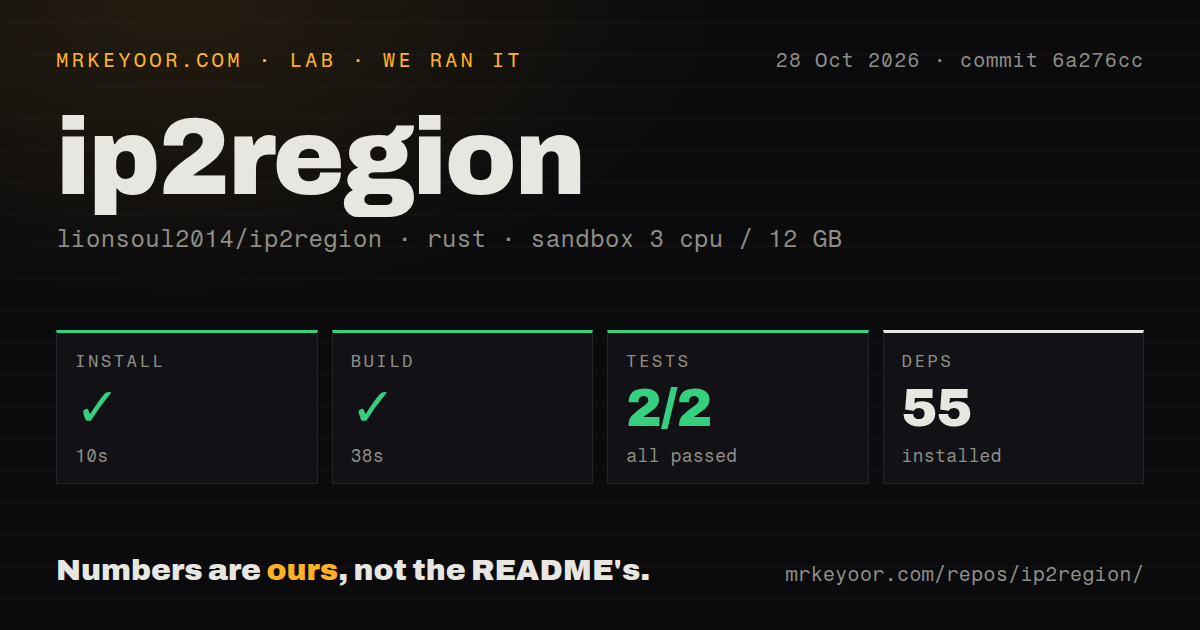
Our run of ip2region at commit 6a276cc on 2026-10-28 completed installation in 10 seconds with 55 dependencies recorded. The Rust project in ./binding/rust/ built successfully in 38 seconds. Its test step succeeded in 25 seconds, with cargo test reporting 2 passed and 0 failed of 2. Those results support trying the measured binding, rather than treating this multilingual repository as uniformly validated.
The sandbox configuration specified 3 CPUs and 12 GB RAM with image lab-rust:1. The image label does not establish actual runtime or operating-system versions. The repository checkout contained 375 files, about 22,708 source lines and 163.5 MB of files. The scan recorded one CI workflow file, no Dockerfile and no standalone tests directory. The passing cargo result demonstrates why the absence of a directory named tests should not be mistaken for an absence of tests.
We did not measure lookup latency, caching memory or geographic accuracy. The root and Rust READMEs publish their own query-performance figures, which are outside this run's evidence. Nor do two passing tests establish database completeness across regions. For a reader choosing software, the useful conclusion is that the recorded Rust setup worked. A claim about how well the bundled database describes your traffic needs a separate evaluation with a known reference.
The Rust binding opens database files you must ship
The Rust README documents IPv4 and IPv6 searchers that open local xdb files. Those files need valid deployment paths, independently of whether the application itself compiles. Treat the file revision as part of the deployment record. Otherwise, two copies of the same application could return different region labels because they loaded different data, even though their code revisions match.
The Rust client documents no-cache, vector-index and full-data cache modes. Full caching loads the database into memory, while the other modes read file information as needed. Select the policy against the actual files you will deploy and the memory available to the process. Our repository checkout size is neither a resident-memory measurement nor a promise about how much memory a running searcher will use. A source build cannot settle that choice.
English documentation does not mean English labels everywhere
ip2region has English and Simplified Chinese documentation, and the bundled China-region labels are Chinese while labels elsewhere are English. That is a concrete integration issue for an English-language product. Decide whether you will display the returned strings directly, translate them, or use a separate mapping. A log enrichment job may accept mixed-language values more easily than a customer-facing location selector.
The documented default result contains country, province, city, ISP and an ISO country code. GPS information is described as something you can add through custom regional data. If your interface needs coordinates, the standard field list is a reason to reconsider the default dataset. The ability to define a custom field does not establish that the repository already supplies the values your application needs.
Active code maintenance does not promise fresh assignments
The repository's last push was 2026-10-28, and its recent issue and PR feed also shows October 28 activity. That supports a finding of current project activity. It does not replace the README's explicit statement that bundled raw data updates are irregular. Code maintenance and the suitability of a particular location assignment need different evidence.
For requirements involving frequent updates or high data accuracy, the README recommends commercial offline data from its community or another vendor. It also describes editing the source data yourself. Neither route was evaluated in our sandbox. Before relying on either, establish the delivery and correction process, then keep the previous database available while checking a replacement against the traffic patterns and fields your application depends on.
Compare the dataset format with a hosted lookup workflow
Rust MaxMind DB Reader reads MaxMind DB files, including GeoIP2 and GeoLite2 databases. It is a sensible alternative when that is the dataset format you already use. Choosing a reader still leaves data acquisition and refresh to your deployment process. Our ip2region run provides no comparative accuracy, speed or memory result for the two readers.
IPinfo's Rust client calls the hosted IPinfo API and requires an access token. Evaluate that workflow when you prefer service access over shipping local database files. It changes the dependency your application operates with, and we have not evaluated its service quality here. For an ip2region trial, record the code revision and xdb revision together, then check a representative set of addresses before letting returned labels drive application behavior.