Use HowToLiveLonger to find a study, then check whether its population and comparison fit your question. The collection offers research summaries with practical takeaways and links to original studies. That makes it a starting point for reading, provided you keep the study's limitations attached to the takeaway.
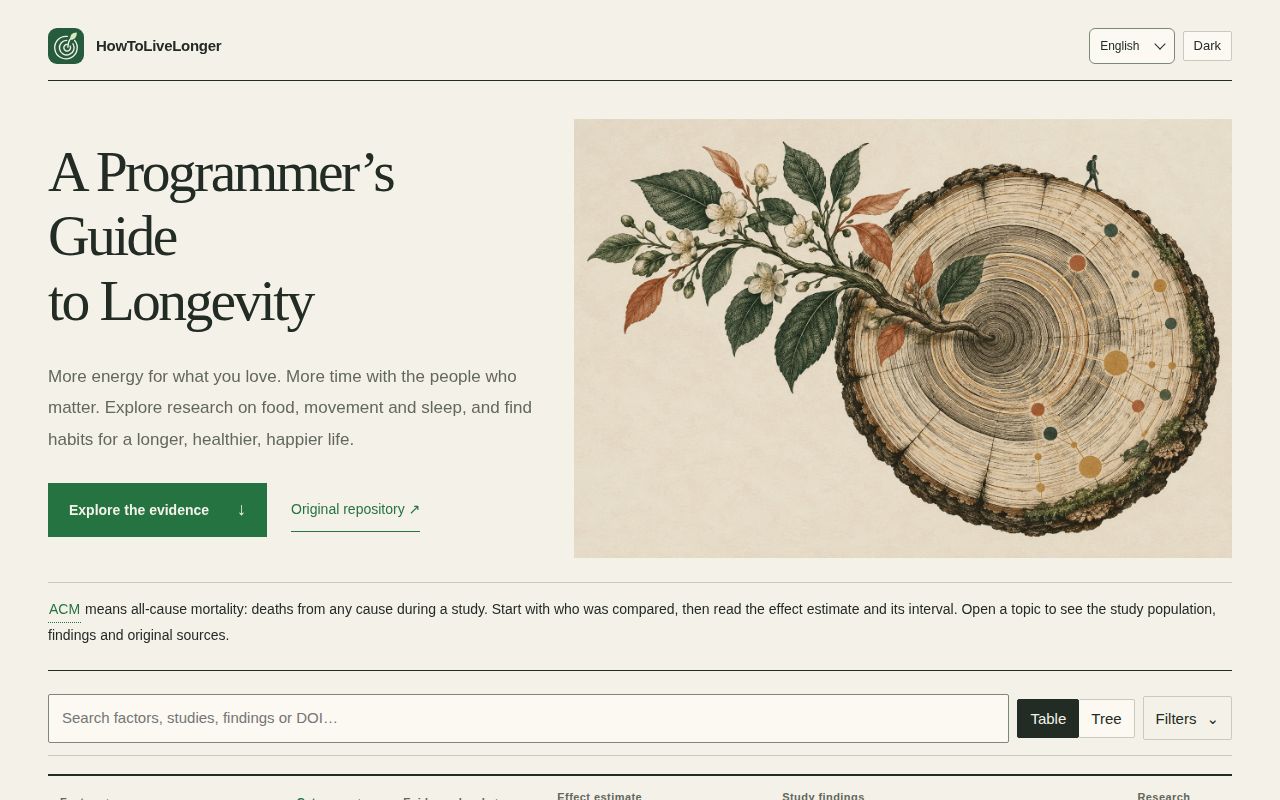
HowToLiveLonger is a collection of research summaries on food, exercise, sleep and everyday habits, with links to original studies. The project calls itself A Programmer’s Guide to Longevity. This review assesses its documented reading role and the supplied software setup results, without adjudicating its health conclusions.
Reading online or offline
The README offers an online site and an offline route: download the repository, unzip it and open index.html. The documented offline route does not require deploying an application server. It is separate from the development setup measured below.
The contribution guide describes English records, six additional translation locales and retained Chinese material. It requires medical changes to update all eight languages together and preserve estimates, comparisons, populations and limitations. These are documented requirements. The supplied run did not compare translated findings sentence by sentence or verify equivalent meaning across the interface.
What happened when we ran it
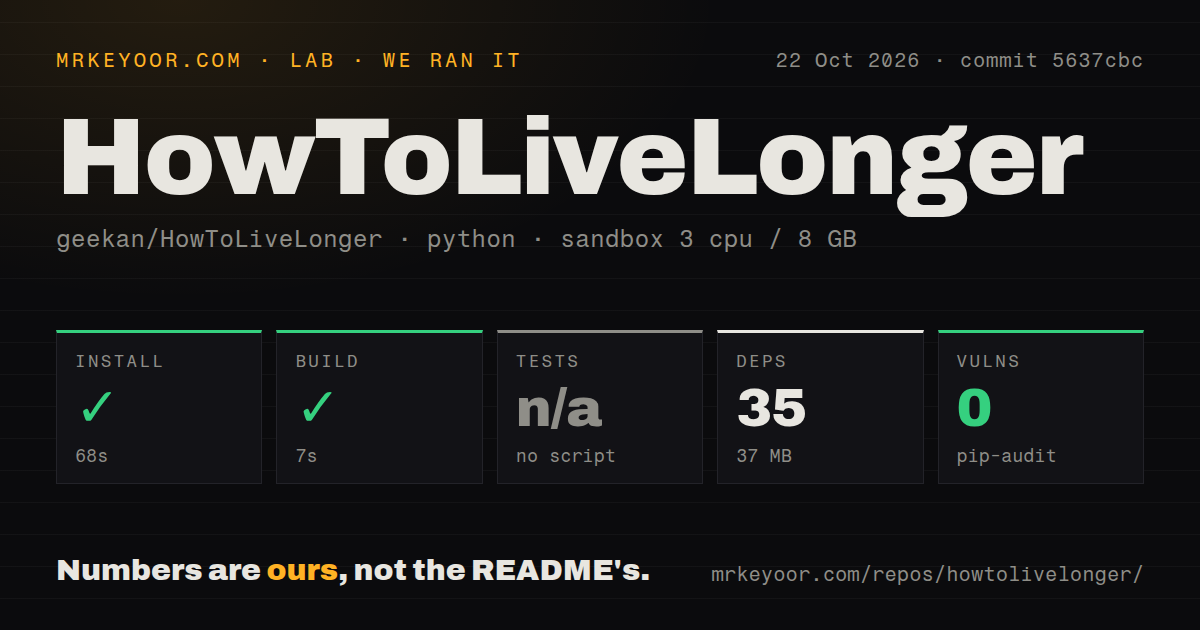
Our sandbox installed HowToLiveLonger commit 5637cbc in 68 seconds on October 22, 2026. It recorded 35 dependencies and 37 MB on disk. The build succeeded in 7 seconds. Tests were skipped because no test script or target was found.
The supplied pip-audit result reports 0 known vulnerabilities. The checkout contained 47 files, approximately 339 source lines and 9.8 MB. The inventory found 0 CI workflow files, no Dockerfile and no tests directory. These observations describe the supplied checkout and run; they do not establish research quality.
The configured sandbox had 3 CPUs, 8 GB RAM and image ghcr.io/astral-sh/uv:python3.12-bookworm. Actual runtime and operating-system versions require raw toolchain logs. No reader interaction, translation review or agent-answer evaluation was measured.
Check what a summary can support
The contribution guide asks for the original paper, study design, population, comparison, outcome, estimate and interval. Contributors must also state what they actually read, whether relevant full-text sections, an abstract, metadata or nothing. That disclosure helps a reader distinguish a checked passage from a source that has only been listed.
The project explicitly says its grades are not a full GRADE review. Its rules distinguish associations, causal interventions, indirect endpoints and insufficient evidence. They also prohibit turning disease-treatment evidence into recommendations for healthy people. These rules set expectations; they do not prove that every record complies.
For a practical reading check, choose one summary and open its original paper. Record the population and comparison before copying the takeaway. If an interval or absolute risk is unavailable, keep that gap visible. A result from a different population may not answer your question.
Evaluate the optional agent separately
The README offers an installable agent skill that reads the research JSON and answers with study sources. The skill instructions distinguish historical originalClaim text from the current finding. They also tell the agent to describe the study population and evidence strength, link original studies and acknowledge questions outside the dataset.
Before relying on this route, ask one covered question and one uncovered question. Check whether the answer preserves the population and limitations, links the study and admits the coverage gap. These are proposed checks, not tests performed in the supplied sandbox.
The repository validator has a narrower role. According to the contribution guide, it checks structure, source fields, translations, numeric tokens and reproducible output. It cannot establish clinical validity, translation nuance, URL availability or visual quality. A successful build therefore leaves those questions open.
Choose the tool for your next task
Zotero helps collect, organize, cite and share research sources. Consider it when your next task is maintaining your own library of papers. Its documented role differs from browsing HowToLiveLonger's selected summaries.
wger is a workout and fitness manager. Consider it when your next task is managing workouts or fitness information. No comparative setup or health-outcome measurement is supplied for either alternative.
The supplied GitHub metadata records a last push on October 22, 2026. It does not establish review quality or support responsiveness. Those dimensions remain unassessed.
Start with one summary relevant to a decision you are considering. Follow the original study and keep its population, comparison and unresolved limits in your notes. If those details remain unclear, the summary is not enough to support that decision.