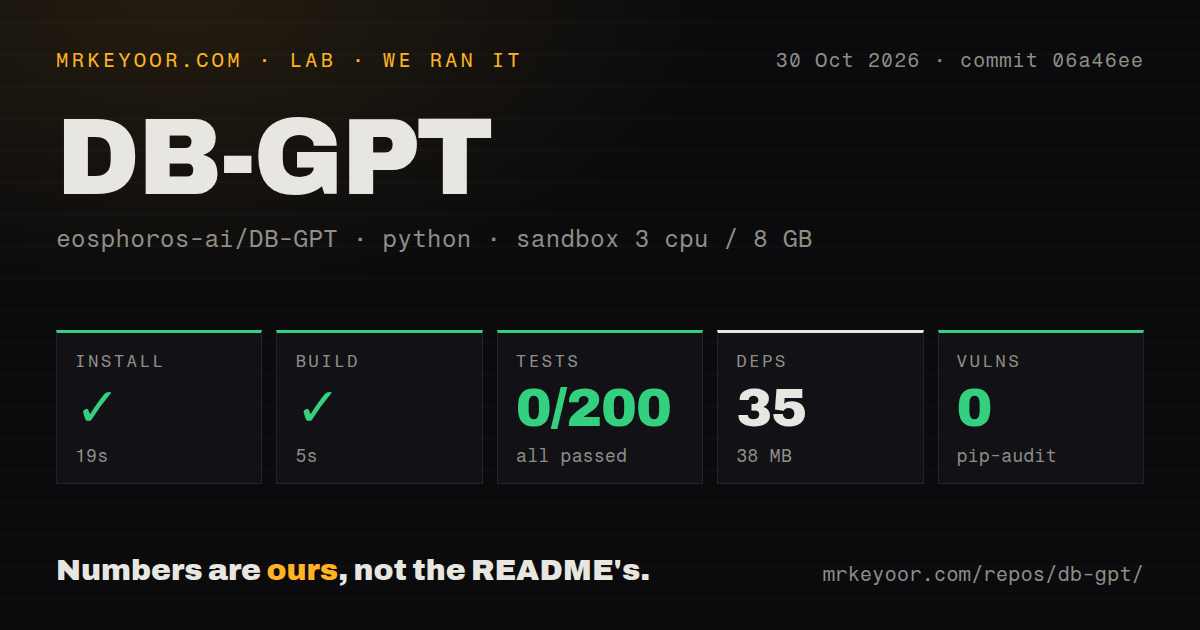
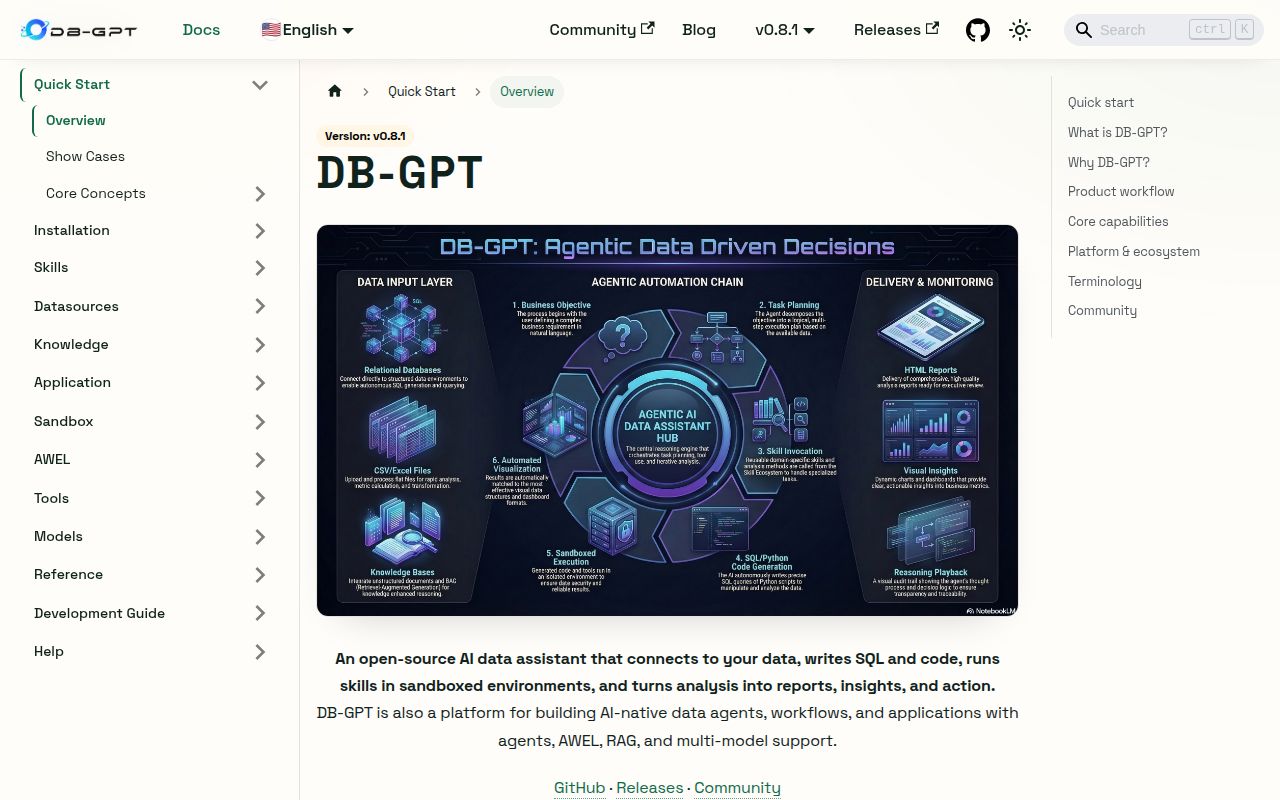
DB-GPT asks you to let an assistant write SQL and execute code against your data. That's a bigger adoption decision than adding a chat box to a dashboard. The project documents a workspace for connecting data, running analysis and producing reports. Our sandbox installed and built the repository, but its test command stopped with collection/setup errors before any test passed or failed.
DB-GPT combines generated SQL with executable analysis
The DB-GPT README describes connections to databases, CSV and Excel files, warehouses and knowledge bases. It also documents Python-driven analysis and reusable skills. That combination suits a team building an assistant that needs to query records and then do something with the result, such as calculate a metric or generate a report. We did not exercise those workflows.
DB-GPT also describes agents, retrieval and AWEL, its workflow layer, as components for building applications. The decision is whether you need that application framework around the analysis. If your immediate job is asking questions of a dataframe inside an existing Python program, the broader workspace deserves scrutiny before you adopt it. More available components mean more choices to evaluate, even when the first question looks simple.
The README calls its execution environment sandboxed and describes private-model deployment as a privacy mechanism. Those are upstream capability claims. Our checks contain no isolation assessment or evidence about which data reaches a selected model provider. For a trial, use non-sensitive sample data and a database account limited to the permissions the exercise needs. Inspect the generated SQL and code against an answer you can calculate independently.
What happened when we ran it
Our DB-GPT install succeeded in 19 seconds and the build succeeded in 5 seconds at commit 06a46ee on October 30, 2026. The record lists 35 dependencies and 38 MB on disk. These results establish completion of the recorded repository steps. They don't establish a working web service, a connected database, a downloaded local model or a completed analysis request.
The test step exited 1 after 12 seconds. Pytest reported 0 passed, 0 failed, 2 skipped and 200 collection/setup errors. Its own summary reports 13 warnings and 5.44 seconds. The step duration and pytest duration cover different scopes. Calling this 200 failed test cases would misrepresent the result: the command encountered errors before it produced ordinary pass/fail outcomes.
The supplied tail names modules under dbgpt_serve, including file, flow and libro endpoint, model and service modules. It then says execution stopped after 200 failures. The underlying exceptions are absent from this excerpt. We cannot identify a missing package, an incorrect setting or a runtime incompatibility from those filenames. The result leaves the test environment unresolved without proving that the application itself is broken.
Pip-audit reported 0 known vulnerabilities in our run. That is the audit's reported result, without evidence here of complete package coverage or an application-security review. The scan recorded 10 CI workflow files, a Compose file and a tests directory, with no Dockerfile detected. None of those observations demonstrates that a deployed assistant protects database credentials or executes generated code safely.
Our sandbox configuration recorded 3 CPUs, 8 GB RAM and image ghcr.io/astral-sh/uv:python3.12-bookworm. That image name doesn't establish the actual Python or operating-system version. There is no SQL-accuracy, report-quality or inference-performance measurement in this run. The next useful evidence is a completed request against known data, followed by checking both the query and the returned answer.
The quick start still requires a model-provider choice
The current README's one-line installer targets macOS and Linux, with named profiles for OpenAI, Kimi and MiniMax. Its examples supply the corresponding API keys. Those instructions describe current options, while our October measurements concern the recorded commit. A short repository install does not measure provider configuration or the full path through the application's first request.
A separate PyPI route documents Python 3.10+ and an interactive wizard for selecting a provider and entering a key. The README points to advanced documentation for local GPU models and Docker deployment. Choose the model route before judging whether the project meets your data policy. A local web interface alone doesn't tell you where inference runs, and our sandbox did not validate either a hosted-provider or local-model configuration.
The documented web interface uses localhost:5670. Reaching that address is a useful milestone for a trial, but it doesn't establish that the selected database connector or analysis skill works. Start with a small table and a question with a known answer. Check what query ran, whether it respected the intended permissions and whether the generated report preserves the result's meaning.
Release fixes deserve attention alongside current activity
The v0.8.2 release notes list multi-file analysis and fixes involving file-upload path traversal, command injection and an unsandboxed Jinja2 execution problem. These are upstream reports of fixes, not vulnerabilities found by our audit. They are a reason to inspect the exact revision and execution paths you deploy, without assuming those historical defects remain present.
The public pull-request page shows activity on November 2, 2026, including a merged change to agentic completion budgets. The anonymous metadata API was rate-limited, leaving the last-push timestamp unverified here. Recent development is visible, but neither that activity nor the release page establishes support response times. Community support and production reliability remain unassessed.
Vanna and PandasAI may fit a narrower job
Vanna documents natural-language SQL answers and a web chat component, along with user-aware permissions. Evaluate it when embedding database question answering in an existing application is the main requirement. PandasAI is a Python library for asking questions of data in natural language. Evaluate it when analysis belongs inside a Python program. We have no comparative accuracy or operating-cost result for either. For DB-GPT, make the first acceptance condition a verified answer from your own representative data before adding reusable skills or more sources.