Short answer: budget for a reusable chapter
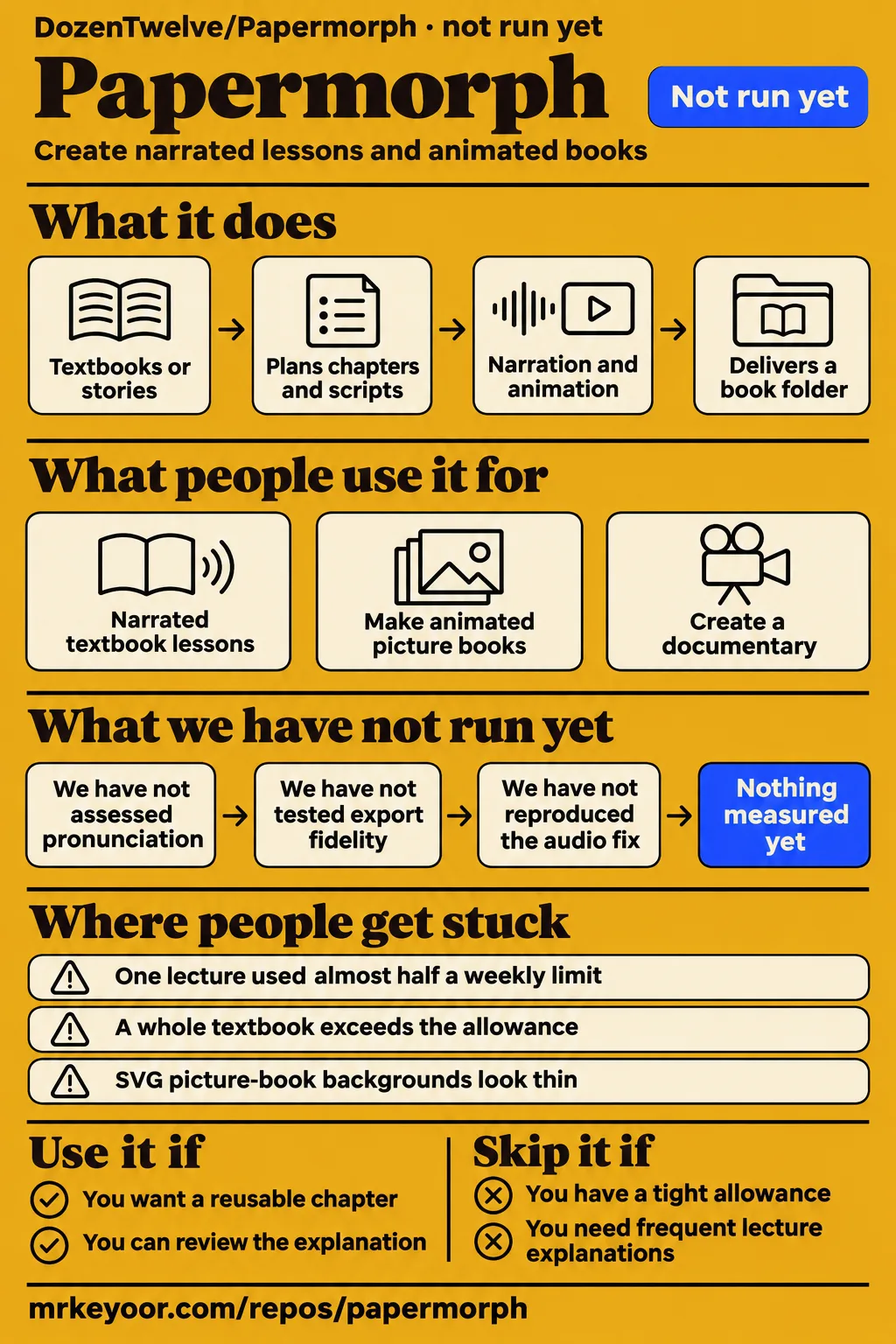
GitHub user CompleWin reports that explaining one university machine-learning lecture used almost half a weekly Claude Code limit. That makes Papermorph easier to justify for a reusable teaching chapter than for an explanation a student needs once. Papermorph is DozenTwelve's MIT-licensed agent skill for producing narrated, interactive web lessons and animated books. Educators and developers should choose a first chapter whose animation has a clear explanatory purpose and whose finished explanation they can review. Issue #9: lecture token consumption supplies the practical budget warning.
A changing diagram beside a calculation is a more specific authoring goal than converting a whole course. The project's chapter workflow supports that smaller starting point, while the student's allowance report explains why its size matters. Decide what the chapter should teach, what expenditure is acceptable and who will check its explanations and exercises. The decision to continue should follow that review. A chapter reused by a class and a lecture explanation needed before one exam have different opportunities to repay the production work.
What people use Papermorph for
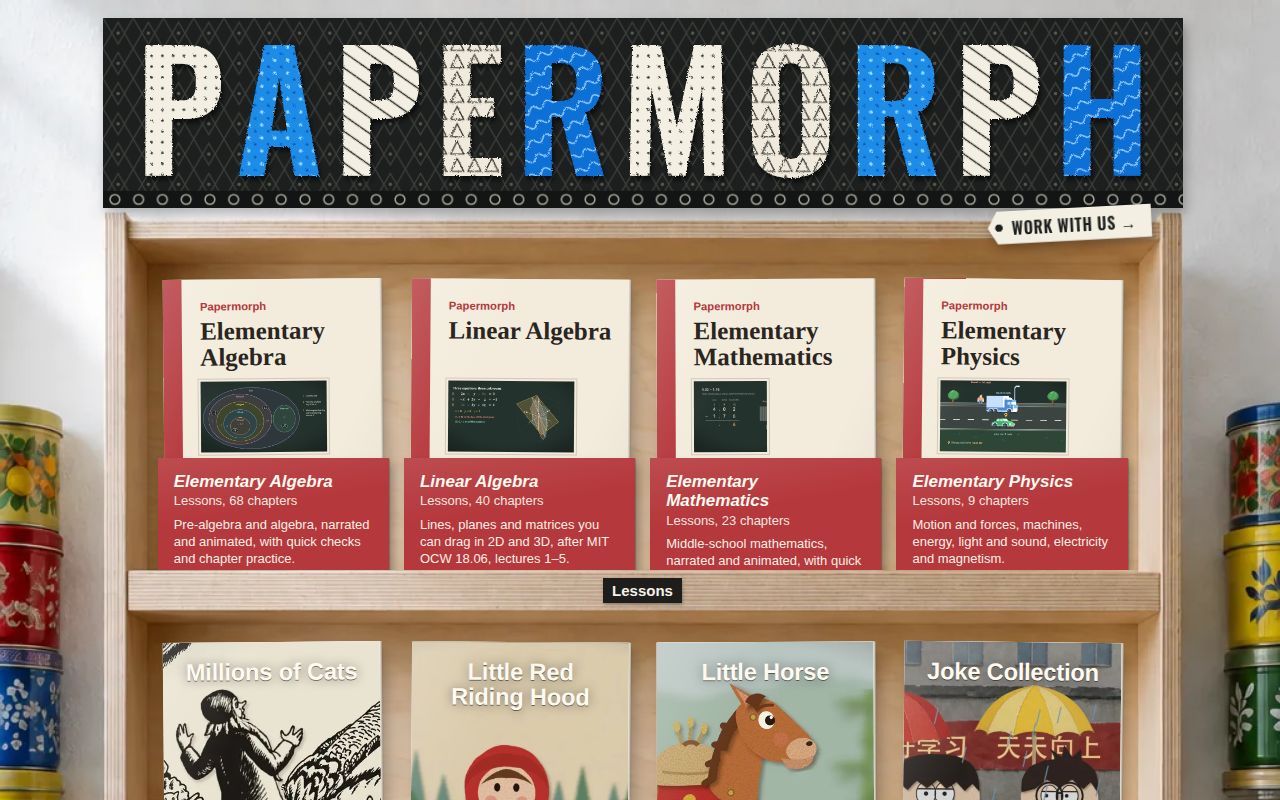
Papermorph's documented uses include narrated textbook lessons, puppet-style picture books and documentaries; a student also reports using it for university lecture explanations. The student report concerns allowance consumption, while the creator's accounts describe production choices and examples. Together they show several distinct jobs for the workflow: explaining a technical concept, staging a story and adapting a book into a narrated film. These are attributed uses rather than interchangeable evidence of classroom effectiveness.
| Who used it | What they made or attempted | Reported outcome |
|---|---|---|
| GitHub user CompleWin | Explanations of complex university machine-learning lectures | Said one lecture consumed almost half a weekly allowance. Lecture report |
| Creator u/AccountlKiller | Animated physics textbook chapters | Reported uploading several chapters with more complex animation and using public, copyright-free assets. Physics account |
| Creator u/AccountlKiller | Animated picture books | Preferred a cutout-puppet look and described a local shadow-puppet experiment absent from the site. Picture-book account |
| Creator u/AccountlKiller | A documentary adaptation of Madness and Civilization | Said the bookshelf example existed before its documentary skill was ready. Documentary account |
The Papermorph README describes planning chapters or scenes, writing a script and storyboard, then timing animation to narration. Its lesson path includes changing formulas and diagrams, quick checks and chapter practice. For teaching material, an appropriate acceptance task is to follow the diagram against the source and inspect the exercises. That gives the reviewer something concrete to assess beyond whether the animation looks finished or the player opens.
What happened when we ran it
Our run recorded NOT RUN for Papermorph at commit 618aeea on 2026-11-13: the harness found no supported ecosystem for JavaScript and no Dockerfile. The configured sandbox had 3 CPUs and 8 GB RAM, with image n/a. A separate hands-on safety step failed because its admission rule required a Compose file. Another hands-on record claims a Docker Compose deployment on the same date. Those records conflict; teardown was recorded as ok.
| Recorded stage | Result | Interpretation |
|---|---|---|
| Sandbox execution | NOT RUN: no supported ecosystem, JavaScript; no Dockerfile | The harness stopped before installation, build or tests. |
| Separate hands-on safety step | FAILED: none of compose.yaml, compose.yml, docker-compose.yaml or docker-compose.yml exists | The lab required a Compose file. |
| Hands-on run summary | Says deployment used the repository's own Docker Compose on 2026-11-13, with every port bound to 127.0.0.1 | This conflicts with the missing-Compose safety result. |
| Teardown | ok | Cleanup was recorded. |
The safety record uses the label "unsafe repo" and immediately gives its reason: none of the four accepted Compose filenames exists. The documented installation route instead installs an agent skill and supporting tools. These are different routes into the repository. The concrete lab outcome is a harness stop and a failed Compose admission check, accompanied by the contradictory deployment summary above. The setup instructions below describe the project's authoring route rather than a completed lab installation.
Where people get stuck: token allowance limits the job
Issue #9 describes one lecture consuming almost half a student's weekly Claude Code limit. The author acknowledges the consumption problem and reports experiments splitting work between models, including a 50% reduction in token usage while production remained costly. The issue is listed as open. For weekly study, the consequence is straightforward: producing an animated explanation competes with the other work that uses the same allowance. Read the token discussion.
Issue #10 records a whole-textbook request stopping when the author ran out of tokens. The author said an entire English picture textbook exceeded the available allowance and estimated that even one chapter would consume half a week's allowance. The closing comment says the author had run out of tokens. The exchange also raises a separate source-handling problem: the author declined to include the requested PDF in the repository because of copyright concerns. Read the textbook request.
| Problem in the record | Practical response | Recorded status |
|---|---|---|
| A lecture consumes a large share of an allowance | Set an allowance for the explanation before production | Issue #9 is open; the author reports model-splitting experiments. |
| A whole textbook exceeds the author's allowance | Agree on the scope and expenditure before requesting the book | Issue #10 closed after the author ran out of tokens. |
| Earlier model splitting required manual skill changes | Follow the later documented per-step model selection | The later README describes selecting models for individual steps. |
| SVG-only picture-book backgrounds look thin to the creator | Consider the documented painted-set option | The creator introduced an image model; the README lists optional paid services. |
Model choices change the production budget
The README reports about $10 to $18 of model usage for an illustrated physics chapter and names Opus 5.5, GPT-6.1-Sol and Sonnet 5.5 for bookshelf examples. That project estimate gives a monetary reference alongside the subscription-allowance reports in issues #9 and #10. Keep those units separate: dollars of model usage and a share of a weekly subscription limit describe different budgets. Read the production description.
The issue discussion assigns Opus the core JavaScript animation logic and Sonnet review work, with Haiku discussed for simpler components. The creator's Reddit account separately describes Sonnet checking frames alongside Opus. Later documentation makes model selection part of individual production steps and saves style choices for subsequent chapters. For a course, the useful planning question is which work requires a new animation and which decisions can carry forward from an approved chapter, rather than assuming every chapter has the same cost.
Setup uses an agent and supporting tools
The README's installation route targets Claude Code or OpenCode and requires uv, ffmpeg and Playwright browsers. After installation, the documented /papermorph command finds the project PDF or asks for a story, suggests an initial chapter and offers choices saved in style.json. OpenCode has additional command-file instructions for a global installation. These details identify the authoring environment a developer needs to prepare. Read the setup instructions.
Narration uses online Edge TTS or local Kokoro. Optional paid steps include acted ElevenLabs voices, clips made from still images and painted picture-book sets using the listed image services. Decide which services may receive the material before requesting those steps, especially for institutional documents. The final static folder is the distribution format; creating it involves the selected agent, narration tools and any optional services used to make its assets. The choice of output format and the choice of production services are separate decisions.
Keep reference PDFs outside the delivered folder
The supplied skill instructions say to keep source PDFs, page images and extracted text outside the static output folder and out of version control. They also instruct the agent to recreate explanations, examples and drawings and deliver a self-contained book folder with local preview instructions. For an educator handing material to a colleague or host, the concrete check is the delivered folder's contents. Read the private-source instructions.
The README states that the MIT license covers code, while pictures, recordings and data keep their own licenses. Its contribution guidance also asks people not to submit copyrighted books, PDFs or lessons made from them. Review the actual media and accompanying credits before distribution. Keeping private reference material outside the handoff addresses where source files go; reviewing the resulting assets addresses a separate question about what the finished book contains and the permissions attached to it.
The player lists five interface languages
The README lists English, Russian, Chinese, Japanese and Arabic, including right-to-left Arabic, for the player interface. It also describes captions, keyboard shortcuts, playback speed, stepping backward and forward, and saved progress per book. These are specific documented player features a reader can put on an acceptance checklist. The source identifies the interface as the localized part. Read the player description.
For classroom use, make that checklist match the lesson and intended devices: follow the captions, use the playback controls and listen to symbols and technical terms while watching the diagram. Reviewing the voice alongside the explanation gives a more relevant task than listening to a standalone voice sample. Record the chosen narration language and interface language separately, so approval of the controls does not silently stand in for approval of the lesson's wording or spoken explanation.
Papermorph vs Manim, narration tools and ECC
Manim Community is an animation engine for explanatory math videos, while Papermorph documents a workflow for making narrated books and lessons. Manim's README describes precise animations created programmatically and shows a Python scene. Choose Manim when writing the scene yourself is the work you want to do; consider Papermorph when the job also includes chapter planning, narration and a common book player. Read the Manim Community README.
| Choice | What it addresses | When to consider it |
|---|---|---|
| Papermorph | Agent-led chapter planning, animation and narration | You want a reusable chapter and can review the generated explanation. |
| Manim Community | Programmatically controlled mathematical animation | You want to write the scene yourself. Manim README |
| Kokoro | Text-to-speech inference | You already have the text and need narration. Kokoro README |
| Cheaper models within Papermorph | Assignment of production work | The creator reports using Sonnet for frame checking. Model account |
| epubTTS or KokoroTTS versus ElevenLabs | Narration choice | The creator considers local options adequate for most people and prefers ElevenLabs when voice budget allows. Voice account |
| Physical books alongside digital explanations | Reading with selected supplementary animation | The creator calls physical books and picture books irreplaceable. Creator's reply |
| ECC | A different agent workflow | The directory comparison concerns popularity signals and workflow fit. ECC comparison |
Kokoro's README identifies it as an inference library for Kokoro-82M, an open-weight TTS model with 82 million parameters. That makes it a narration component rather than a chapter-authoring substitute. The ECC directory comparison explicitly says popularity signals indicate community interest rather than which skill is objectively better. These comparisons answer different purchasing questions: whether to write a controlled scene, generate speech from existing text or adopt a broader book-production process.
What the other reviews get wrong
The SkillsLLM ECC comparison says neither project includes a SKILL.md file, while the supplied TypingMind listing presents Papermorph's skill instructions. Other descriptions concern an earlier feature state: the October 4 X post says Opus-only, whereas the later README names multiple models. The distinction matters because incorrect metadata and dated descriptions call for different corrections. Read the ECC comparison and Papermorph skill listing.
| Source | Description to examine | Correction or narrower reading |
|---|---|---|
| RoundtableSpace's October X post | Uses only Opus | Later documentation names Opus 5.5, GPT-6.1-Sol and Sonnet 5.5. October post |
| Pinoyfreecoder | Images and music unavailable; picture books and documentaries planned | Later documentation describes painted sets, music and documentary examples. Earlier coverage |
| Pinoyfreecoder and LinkedIn | Broad multilingual-support wording and an English-content focus, respectively | The later README specifically lists five player-interface languages. Pinoyfreecoder, LinkedIn overview |
| Automated r/ClaudeWorkflows summary | Describes a custom script | The installation and skill text identify a SKILL.md-based skill with supporting scripts. Workflow summary, skill listing |
| JavaScript Made Easy Facebook post | Clean Markdown conversion in seconds | The documented workflow plans and produces animated books through chapter stages. Facebook description |
Questions people ask
Papermorph's code is MIT licensed; generating books consumes model allowance and may involve paid services. That distinction answers the access-and-cost question behind the first FAQ. Readers also asked for the repository, the author's workflow, other projects the author investigated and ways to reduce lecture-explanation costs. The answers below distinguish installation instructions from the creator's production reports and keep allowance figures separate from monetary estimates.
Is Papermorph free?
Papermorph's code is MIT licensed, and the README lists free Edge TTS or Kokoro narration alongside optional paid services. Authoring also consumes the model allowance or usage budget of the agent doing the work. Issue #9 gives a student's example: one lecture took almost half a weekly limit. Obtaining the code, generating the chapter and buying optional assets are separate budget items. Papermorph README, student cost report.
Where can I find the Papermorph repository link?
The repository is DozenTwelve/Papermorph on GitHub, and its README links the live bookshelf at papermorph.diamonddoge.org. Use that repository identity for the documented project and setup instructions. Issue #13's domain exchange concerns an offered papermorph.com domain and the author's refusal. The repository's own links provide a direct route to its examples without requiring readers to interpret that domain offer.
What workflow does the author use with Papermorph?
The author describes Opus for core JavaScript animation logic, Sonnet for review and Haiku experiments for simpler components. Later documentation plans a book before drawing it, then produces a script, storyboard, narration and timed animation. It saves style choices for subsequent chapters and describes contact sheets and other review activities. These details explain the division of production work. Author's model split, documented workflow.
Which other projects did the Papermorph author investigate?
A Reddit commenter asks which other projects the author investigated; the supplied discussion provides no list in reply. The same thread names models and narration tools as production choices. Those names answer a different question from which projects informed Papermorph. The alternatives above therefore use Manim's and Kokoro's own documentation to explain their roles, rather than attributing that shortlist to the creator. Read the reader's question.
How can I reduce Papermorph's token consumption for university lecture explanations?
The author's reported approach splits work between models and reserves Opus for core animation logic. Issue #9 reports an experimental 50% reduction in token usage while saying production remained costly. It also describes Sonnet reviewing parts of the output and difficulties assigning some seemingly simple tasks to Haiku. The practical choice is which production tasks to assign to each model within the expenditure set for the explanation. Read the token experiment.
Documentation earns 4/5 under a visible rubric
Documentation earns 4/5 for covering the chapter workflow and its operating choices: agent setup, saved style, per-step models, narration options, review activities and static delivery. The rubric assigns 1 to a missing usable path, 2 to fragments, 3 to a core workflow, 4 to a workflow with operating choices and boundaries, and 5 to that coverage corroborated by independent reproduction. This score assesses instructional coverage. README, skill instructions.
The README describes contact sheets, overlap checks, blank-frame checks, end-to-end tests and a director's review as production activities. These instructions give an author concrete things to inspect while making a chapter. Setup ease, community support and operational maturity receive N/A, with their evidence gaps collected below. The documentation score concerns what the instructions cover; the execution table records what happened when the lab attempted its separate route into the repository.
What we have not tested yet
Our lab completed no Papermorph installation, generated chapter, export test or playback task at commit 618aeea. The sandbox configuration is not a measurement of generation requirements, and actual runtime or operating-system versions require raw toolchain logs. The missing-Compose safety result is not evidence of malicious code or a product security defect. The contradictory deployment summary prevents a coherent successful-deployment account. The pack contains no successful hands-on Q&A or lab screenshot records.
Five player-interface languages do not establish multilingual generated content or narration, and they do not disprove LinkedIn's English-content description. We have not assessed pronunciation, translated content, browser accessibility, export fidelity, security or end-to-end compatibility across the advertised agents and models. The records contain no controlled learning-outcome study. Setup ease lacks an installation result; support quality lacks evidence of support capacity; operational maturity lacks a completed application task. Rendered layout, actual visuals and template recommendation elements also fall outside these observations.
Production time, total conversion cost, generation memory and repeatability across models remain unmeasured here. The author's 50% token reduction, the README's physics-chapter estimate and the creator's model and voice preferences are attributed reports rather than our benchmarks. Published bookshelf examples do not supply a success rate for new material. The README's static-delivery and review descriptions explain the intended workflow rather than lab-passed checks or guaranteed output quality.
The supplied latest release is engine-v2.11, published on 2026-11-07. Its notes describe fixing iPhone and iPad narration that went silent after the first beat because the engine created a new Audio element for each beat. The notes describe using a fixed pair of media elements readied inside the first tap. We have not reproduced that audio fix or determined which other bugs remain. Read the Engine v2.11 release notes.
The next useful result is one chapter made from material you are allowed to use, checked against its source and played on the intended devices. Record the allowance consumed and inspect the explanation, exercises, narration and delivered assets together. That result would answer the decision left open by these records: whether producing another chapter is worth the expenditure for your class, story or study task.