A desktop wrapper with a deliberately narrow job
Pake packages a URL or local web build as a desktop application. The resulting app gets its own window, icon, shortcuts, menus, and installer while the original website remains the interface. That is useful when a service works well in a browser but users still want a dock icon, a dedicated window, predictable keyboard controls, or an app that launches at login. It is also a practical way to distribute an internal web tool without designing a second interface.
The implementation uses Tauri and the operating system's webview. Pake's README positions that choice against Electron, which normally ships Chromium with each app. The trade is straightforward: Pake can produce a smaller wrapper, while the webpage still lives within the behavior and limits of each platform webview. Developers who need a heavily customized desktop product may outgrow the abstraction. For a dashboard, music service, reader, or focused AI client, the abstraction is often the point.
The CLI covers more than a bare URL
The basic command accepts a web address and a name, then fetches an icon automatically. Options control dimensions, title-bar treatment, window decorations, and custom icons. Advanced documentation covers injected CSS and JavaScript, ad removal, drag and drop, container communication, user agents, proxies, and navigation behavior. A local directory can be packaged as well, which makes Pake relevant to teams shipping a compiled web application rather than only public websites.
There are useful paths for different skill levels. People who do not want a local toolchain can download maintained example packages or use a GitHub Actions build. Developers get the global pake-cli command. Contributors can clone the Rust and Node source. That separation keeps the first experiment approachable without pretending that desktop compilation has no prerequisites.
Agent use is unusually explicit. The CLI has --json for machine-readable results, accepts a declarative configuration file with a published schema, and provides an llms.txt contract. Pake also publishes an official Claude Code plugin and skill. Those pieces matter because desktop builders can emit noisy subprocess output and create target-specific files. A single JSON result gives an agent a much safer success signal than scraping a colorful terminal log.
What happened when we ran it
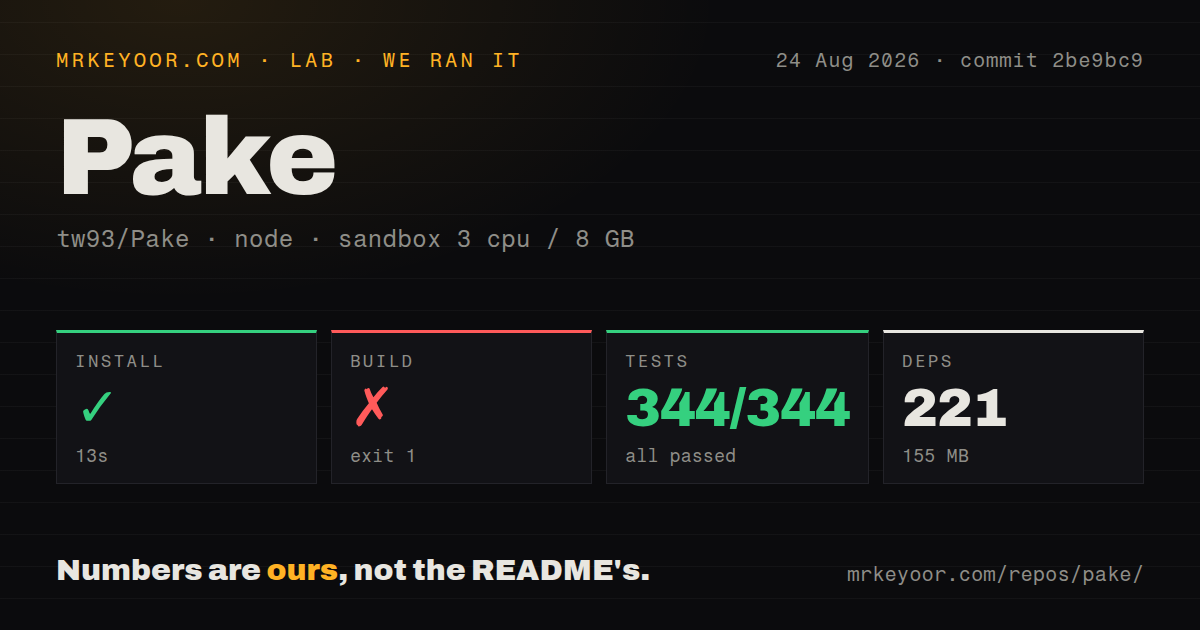
We cloned commit 2be9bc9 into a fresh unprivileged Debian container with three CPUs, 8 GB of memory, Node 22, and no secrets. The pnpm install succeeded in 13 seconds. It installed 221 packages and occupied 155 MB on disk. That part was as uneventful as a modern JavaScript workspace can reasonably be.
The build failed after 21 seconds. tauri build tried to execute cargo metadata, and the operating system returned No such file or directory. The log establishes that Cargo was unavailable. It does not prove that adding one executable would satisfy every Tauri prerequisite or produce packages for all three supported operating systems. A fresh source contributor has to follow the Tauri platform setup in addition to installing the JavaScript dependencies.
The test command ran for 30 seconds and ended with exit code 1. Vitest itself was clean: 41 files passed and all 344 unit tests passed. Pake's wider suite also performs a real GitHub.com application build. That check returned code 4, so the top-level result was 15 of 16 checks passing. This is a helpful distinction. The JavaScript behavior passed; the end-to-end packaging check did not.
Where the wrapper starts to show
A packaged website is still a website. Authentication flows, downloads, popups, certificate handling, custom user agents, navigation boundaries, and links that want to open elsewhere all meet desktop webview rules. The latest release notes are instructive: maintainers fixed links mistaken for downloads, menu commands that stopped working on blank error pages, Windows tray restoration, startup window timing, and certificate-error handling on macOS. These are ordinary wrapper problems, and they require testing on the actual platform.
Pake supplies many controls around that webview. The shortcut list covers navigation, zoom, cache clearing, developer tools, fullscreen, and copying the current URL. Tray behavior, autostart, hide-on-close, multiple windows, and custom style injection push it beyond a one-line demo. Still, teams should decide whether they are distributing a convenient shell or promising a fully native application. The latter promise creates expectations Pake cannot settle on its own.
Licensing also deserves a deliberate read. Pake is GPL-3.0 and includes an output exception stating that apps built with Pake are yours to use and distribute. That is friendly for generated apps, but it is different from taking Pake's own source into a closed product. The README asks forks to use another name and credit the project.
Health and the buying decision
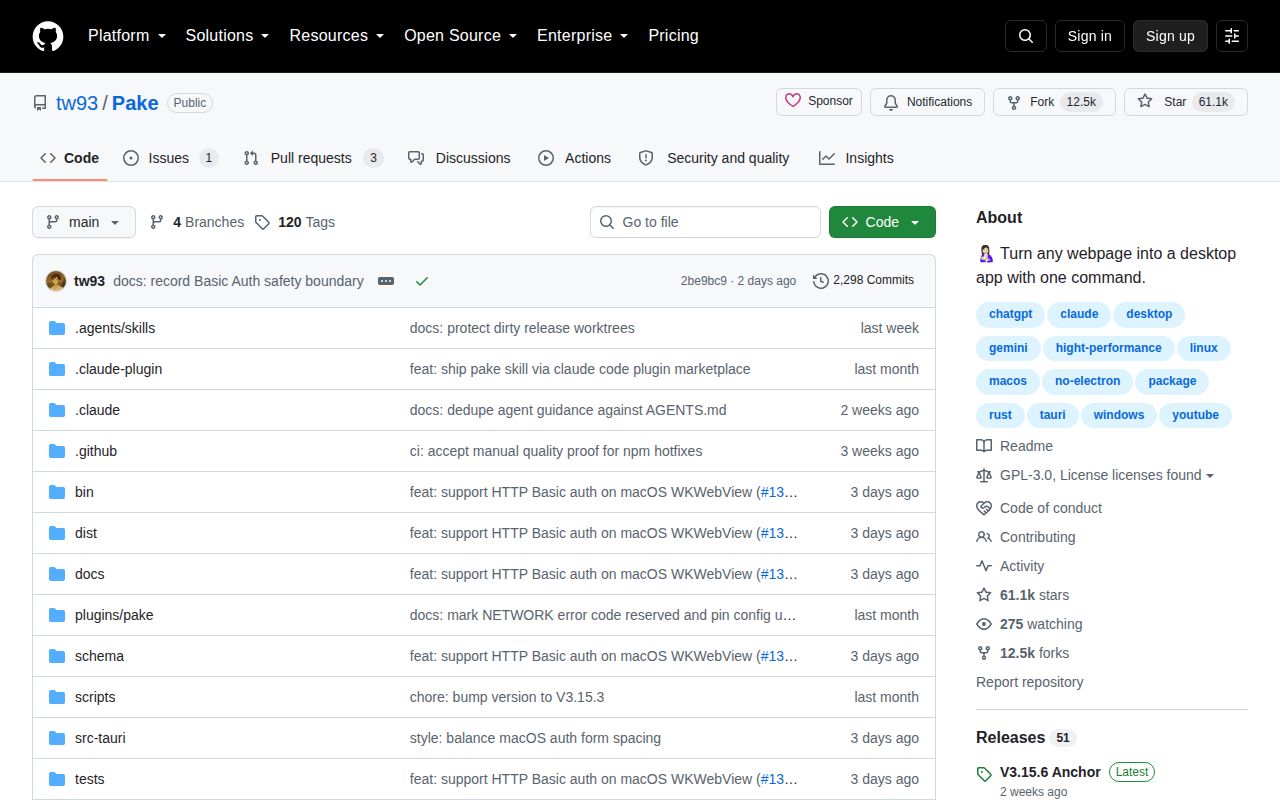
The repository was pushed on August 23, 2026. Its latest release, V3.15.6, arrived on August 8 with concrete Windows and macOS fixes plus dependency updates. GitHub reported four open issues and pull requests combined, which is a small queue beside the project's large user interest. Recent code, release work, and platform-specific fixes point to active maintenance rather than a wrapper left behind after its first launch.
Choose Pake when the website already solves the product problem and a focused desktop shell would make it easier to reach. Start with the published CLI or online builder because those are the routes the README designs for ordinary users. Move into the repository only when you need custom behavior and are prepared to own Rust, Tauri prerequisites, code signing, and target testing. If the desktop layer itself is the product, begin with Tauri or Electron instead.