Paddle 3.3 spans training, inference, compilers, and custom chips
PaddlePaddle 3.3 is a full deep-learning framework rather than a thin model runner. Its README describes dynamic and static graphs, automatic parallelism, large-model training and inference, higher-order differentiation, a neural-network compiler, and adapters for several chip families. Python is the user-facing route, while GitHub identifies C++ as the main repository language. This breadth makes sense for organizations already invested in PaddleOCR, PaddleX, distributed training, or supported nonstandard accelerators.
Our checkout makes that scale tangible: 137,166 files, about 20,029,255 source lines, and 2,087.2 MB before the dependency step. The tree contains Python APIs, C++ kernels, compiler code, tests, 51 CI workflow files, and a large third_party directory. A framework this large needs owners for build images, wheel selection, accelerator compatibility, model conversion, and regressions that may sit far below application code.
The 18-second dependency install is a poor proxy for source setup
Our 18-second install added 35 packages and occupied only 37 MB, which looks light beside the 2,087.2 MB checkout. That step did not produce a working source build. Paddle's README points ordinary users toward release or nightly wheels through its quick-install site. Contributors face a different route built around CMake, native code, generated bindings, external projects, and optional device backends. The repository's contribution guide recommends Docker to unify that environment, a sensible admission that local compilers and libraries are part of the product.
The checked-out repository had no Dockerfile even though its contribution guide links to a Docker-based build page in the repo. That linked path returned 404 when fetched. A .dockerignore and extensive CI remain, but neither gives a new contributor the promised local image recipe. Our build exited after 21 seconds, so the missing path is more than untidy documentation.
What happened when we ran it
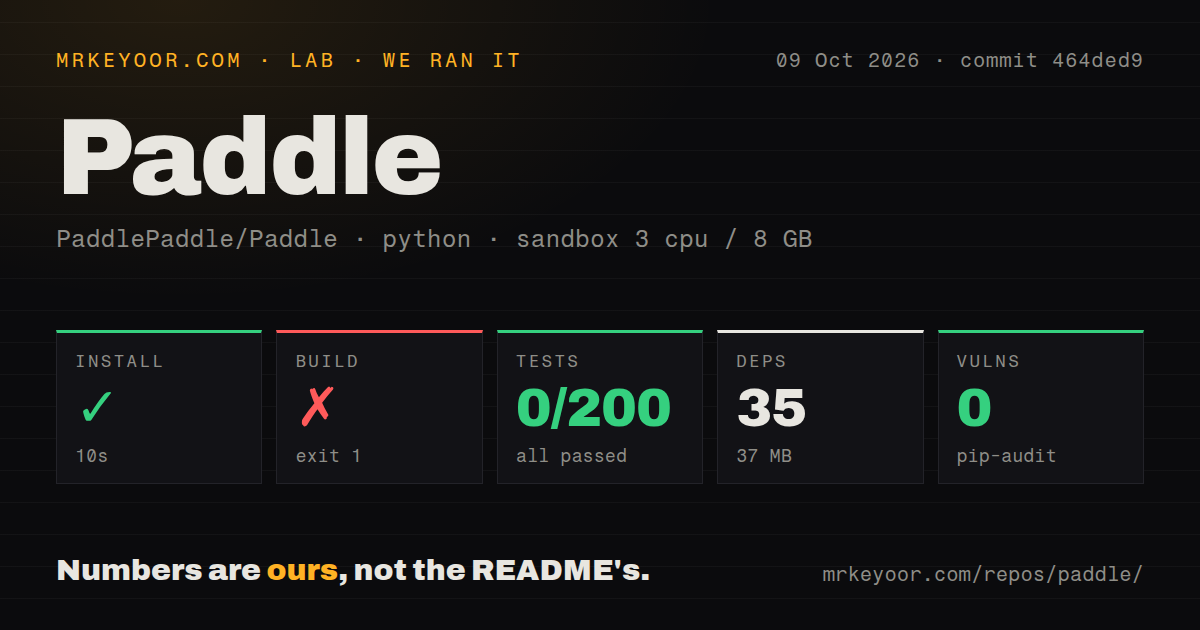
Our sandbox installed Paddle's 35 dependencies in 18 seconds, then the build failed with exit code 1 after 21 seconds. The final log lines contain SyntaxWarning notices about invalid escape sequences in Python files under vendored RocksDB and yaml-cpp tests. Those warnings are all the supplied tail shows. It does not display the fatal line, so we cannot say whether the warnings caused the exit or merely appeared near it. The build command did not complete in our stated container.
Pytest failed after 8 seconds during collection or setup. It ran 0 tests, recorded 0 passes and 0 test failures, and stopped after 200 errors. Paddle's code was not exercised by that command. Pip-audit found 0 known vulnerabilities among the 35 installed Python packages, which does not audit the 20,029,255-line source tree or verify model-loading safety. The sandbox used 3 CPUs, 8 GB of RAM, Python 3.12, no secrets, and an unprivileged Debian base.
Paddle 3.3 has current CPU and TensorRT problem reports
Open issue 77340 reports a NotImplementedError in PaddlePaddle 3.3.0 when one specific exported model reaches the oneDNN PIR conversion path on CPU. The reporter names 3.2.2 as a workaround. That does not prove all CPU inference is broken, and teams should resist broadening one reproduction into a framework-wide claim. It does show why an upgrade test must load the exact exported models, enable the same backend, and run representative inputs instead of stopping after import paddle succeeds.
Issue 79449 is narrower and heavier: its reporter says PP-OCRv5 and PP-StructureV3 models failed across tested PIR-to-TensorRT configurations on 3.3.1 and a July development build. The report contains several conversion failures and says locally patched engines produced empty outputs. We did not reproduce those GPU results in our 3-CPU sandbox. Anyone adopting Paddle specifically for OCR acceleration should follow that issue, then run output comparisons on the intended TensorRT, CUDA, architecture, and model versions before buying around a claimed fast path.
Distributed execution belongs on a trusted network
Paddle's security guide states that paddle.distributed RPC has no encryption or authentication, sends messages in plain text, and accepts connections from any source. The project explicitly limits those features to secure, trusted environments. That rules out pointing distributed ports at the public internet and makes network segmentation part of a correct deployment. A 51-workflow repository can test code paths, but CI cannot supply the trust boundary around a training cluster. Operators need firewall rules and process privileges that limit the damage of a mistaken connection.
The same guide says paddle.load uses pickle implicitly and tells users to inspect and sandbox untrusted models. That warning should extend procurement checks to model files, cached datasets, and mirrors. Our package audit found 0 known dependency vulnerabilities, yet it cannot certify a serialized artifact as safe. Open issue 79490 separately alleges code execution through a user-supplied CIFAR archive in version 3.3.0. We treat that as a public report, not a confirmed advisory, while following the project's own instruction to isolate untrusted inputs.
September activity sits beside 1,499 open issues and pull requests
Paddle had 24,068 stars and a repository count of 1,499 open issues and pull requests when fetched. An issue-only search returned 1,000 open results. The last push was September 3, 2026, and recent issues had updates on September 4, so this is an active queue rather than an abandoned one. GitHub's latest-release endpoint returned v3.3.0, published January 31. The README is in English and links English guides, while Chinese and Japanese README versions are maintained alongside it; many current issue titles and release notes are Chinese.
Paddle is easiest to justify when the surrounding models, deployment targets, or accelerator support already require it. The 18-second dependency install makes a wheel trial cheap, but our source result was poor: a 21-second build failure followed by 200 collection errors in 8 seconds. New framework choices should compare PyTorch, TensorFlow, and JAX using the same models and target hardware. Existing Paddle teams should keep their pinned build environment, isolate distributed traffic and untrusted artifacts, and make backend-specific output checks part of every upgrade.