6 million lines make TensorFlow a platform, not a small library
TensorFlow covers model construction, training, tensor operations, and deployment through stable Python and C++ APIs. The README also points users toward GPU support, device plugins, official models, examples, and separate device-oriented tooling. That breadth is the reason to choose it. A company with working TensorFlow models can keep a familiar API while supporting several hardware targets. A small team solving one inference problem may inherit far more framework than it needs.
Our checkout at commit fdf964b contained 37,022 files, about 6,080,869 lines of source, and occupied 493.7 MB before a build. Those figures change the meaning of "open the source and patch it." You are entering a large C++ project with generated code, platform configuration, and its own build system. Most application developers should treat the published package as the product boundary. Engineers modifying TensorFlow itself need time for the repository's build instructions and CI conventions.
The pip path is shorter than the source path
The README's first install command is a pip install, followed by a tiny tensor addition in Python. It also offers a CPU-only package and links out to dedicated instructions for CUDA, Docker, source builds, and device plugins. No TensorFlow account or hosted service is required for that local package route. The choice that matters is which package and platform combination matches the machine that will run the code.
TensorFlow 2.21.0 was released on March 6, 2026. Its notes remove Python 3.9 support and the TensorBoard dependency, add JPEG XL decoding under tf.image, and extend several low-bit operations under tf.lite. An upgrade can therefore change interpreter support, dependencies, and device behavior even when your model code stays untouched. Pin the release, read its notes, and verify the exact operators and hardware path your application uses.
What happened when we ran it
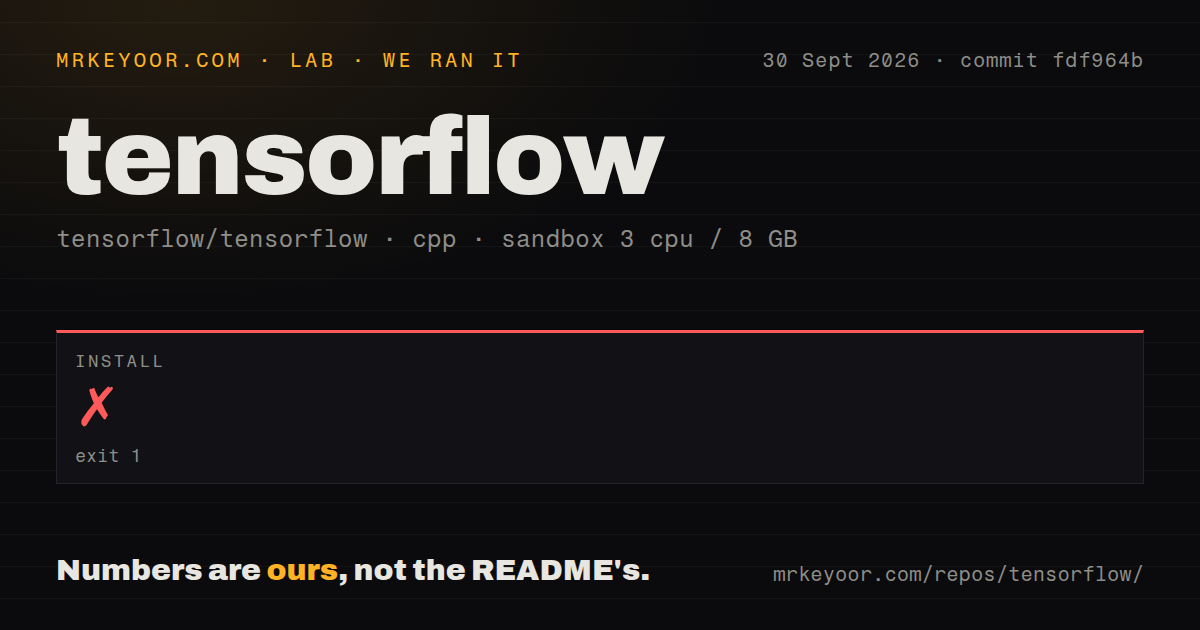
Our sandbox install of commit fdf964b failed in 6 seconds on 3 CPUs with 8 GB of RAM. The container was unprivileged, held no secrets, and used the lab-cpp:1 image. The last log line said: Cannot find bazel. Please install bazel/bazelisk. That is the full proven cause from this run. The log does not support a claim about a compiler, memory pressure, or TensorFlow source defect.
Because installation stopped at that missing tool, no build or test step began. We have no compilation time, test count, or runtime benchmark to report. The repository scan did find 17 CI workflow files, no Dockerfile, and no top-level directory named tests. TensorFlow has testing machinery elsewhere in its tree, but this checkout does not hand a new contributor one obvious root-level container recipe and test folder.
The source guide confirms what the failure exposed. TensorFlow requires Bazel, and it recommends Bazelisk because Bazelisk selects the version recorded by the repository. The Linux path also calls for Python development packages and recommends Clang. Then ./configure asks about Python locations, CUDA or ROCm, the compiler path, optimization flags, and optional Android configuration. A published wheel hides most of those decisions. A source build makes you own them.
Current GPU support depends on the operating system
The current pip guide draws hard platform lines. macOS has no official GPU support in the main package. Native Windows GPU support ended with TensorFlow 2.10, and newer GPU users are directed to WSL2. Linux users can install the CUDA extra, while unsupported GPU architectures or custom library requirements can push a team back toward a source build. These are deployment constraints, not details to postpone until release week.
TensorFlow's README says only the Python and C++ APIs are stable. Bindings for other languages do not receive the same backward-compatibility promise. That distinction matters for teams wrapping the framework from another runtime. A proof of concept can work today while still carrying more upgrade risk than the two primary interfaces. Check the guarantee for the API you call, not just the TensorFlow version in an architecture document.
A same-day push matters more than the March release date
GitHub showed 200,718 stars and 3,250 open issues and pull requests on October 7, 2026. The repository was pushed that same day, and recently updated pull requests covered TensorFlow Lite conversions, bounds validation, dependency updates, and Python runtime work. The combined queue is not a count of confirmed bugs. It does show the volume attached to a framework with many operators, devices, and supported configurations.
The latest tagged release was 2.21.0 from March 6, while development continued in October. That gap does not make the project stale; the push and pull-request activity say otherwise. It does mean production users should separate the latest repository state from the latest packaged release. Search the issue and pull-request history for your exact operator, device, and version instead of treating the overall queue as a health score.
Existing TensorFlow systems have the clearest reason to stay
TensorFlow is easiest to recommend when compatibility already has value: trained models, saved artifacts, deployment code, or staff experience. Stable Python and C++ APIs plus the Apache-2.0 license make continued use a defensible engineering choice. Rewriting a working system for fashion alone buys risk without proving a product benefit.
A greenfield team should demand a sharper reason. PyTorch may better suit Python-led experimentation, JAX focuses on transformed numerical programs, and ONNX Runtime has a narrower inference job. TensorFlow should win because its APIs, device reach, or existing artifacts remove a concrete migration cost. Our 6-second stop is the useful warning: installing TensorFlow for an app and developing TensorFlow from source are two different commitments.