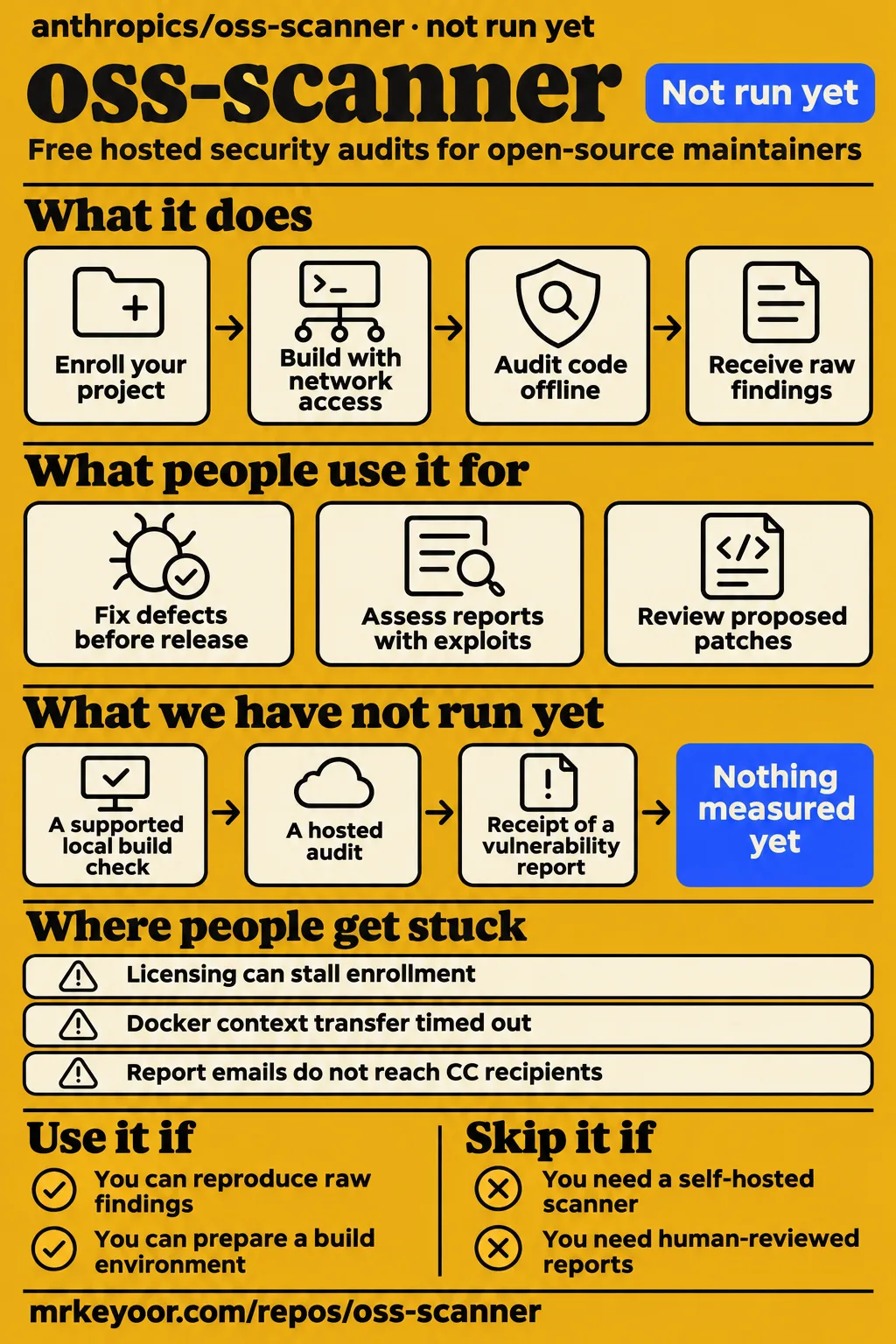
Anthropic OSS Scanner gives accepted open-source maintainers free hosted security audits and raw findings to investigate. Apply if someone on your team can reproduce a report, judge its severity and review the proposed fix. Skip it if you need a scanner you control locally or already struggle to handle confirmed security reports. Our sandbox attempt stopped before execution, so the recommendation rests on the documented workflow and attributed maintainer experience.
Enroll a project for hosted code audits
You enroll your project for Anthropic to audit its code, while the public repository supplies configuration and local build checks. The README describes an isolated VM that builds the target with network access, then moves into an offline audit. Reports include reproduction instructions and a proposed patch where available. The service sends model-generated reports without human review. Someone in your project still owns the decision to accept the bug and merge the fix.
The useful preparation happens in your own repository: make its build work without fetching anything during the audit, explain which inputs are hostile, and tell the scanner how your project rates severity. An optional threat model can distinguish a genuinely dangerous permissions failure from behavior your administrators are already allowed to perform. That matters because Anthropic's launch post acknowledges reports that exaggerate severity or misunderstand a project's threat model. Official workflow.
What people use oss-scanner for
Named maintainers describe useful fixes and easier report assessment in testimonials published by Anthropic. These are concrete accounts of receiving findings, with the vendor choosing which feedback appears in its launch post. They help explain the appeal better than repository stars: a maintainer wants a defect they can investigate, preferably with a reproducer that makes the disputed behavior visible.
| Who used the findings | What they reported | Source |
|---|---|---|
| Noah Misch, PostgreSQL | Fast-track reports helped address defects before a general release, with fixes usable nearly as supplied. | Anthropic's PostgreSQL testimonial |
| Anton Arapov, OpenSSL Corporation | Raw model reports compared well with human submissions, and attached exploits made assessment straightforward. | Anthropic's OpenSSL testimonial |
| Todd Ouska, wolfSSL | Reports and attached patches fitted the team's existing process for checking and fixing security issues. | Anthropic's wolfSSL testimonial |
| Eddie Kohler, HotCRP | Reports showed a strong understanding of the project's permission model and prioritized bugs well. | Anthropic's HotCRP testimonial |
| Daniel Stenberg, curl | The findings included multiple issues worth addressing and a particularly serious curl vulnerability. | Anthropic's curl testimonial |
PostgreSQL's account is the strongest reason to consider enrollment: a proposed fix arrived early enough to keep a defect out of a general release. OpenSSL's account describes the other half of the bargain. A real exploit lets an engineer examine what happened instead of debating a plausible-sounding paragraph. Both stories favor teams with an existing security process. The scanner supplies leads and sometimes useful patches, while the maintainer supplies context and authority to change the code.
What happened when we ran it
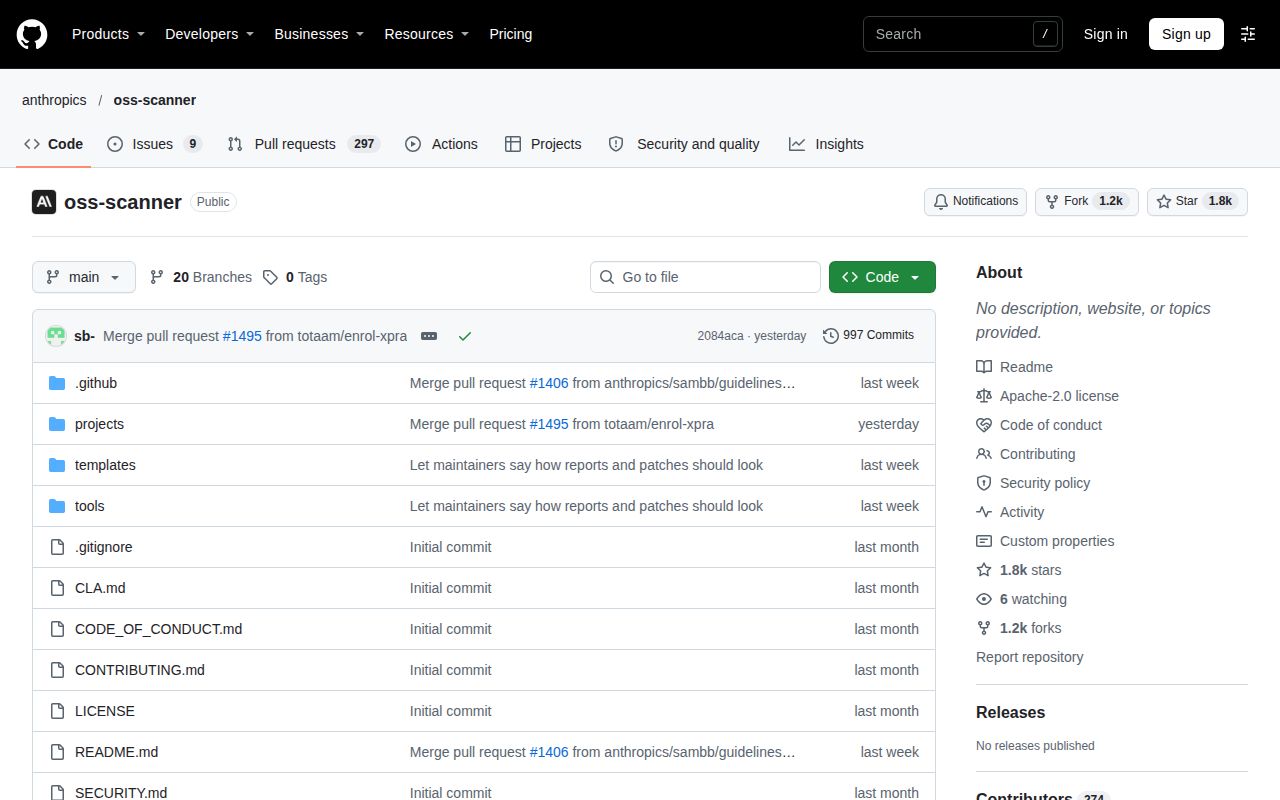
Our 2026-11-14 sandbox attempt at commit 2084aca did not run OSS Scanner: the harness recorded no supported ecosystem, language Dockerfile, and no Dockerfile. The recorded sandbox configuration was 3 CPUs and 8 GB RAM, with image listed as n/a. Those are configuration facts, not a hardware requirement for using the hosted service. The result is a skipped execution, not a failed vulnerability audit.
| Recorded check | Result | Meaning for this review |
|---|---|---|
| Source checkout | commit 2084aca on 2026-11-14 | Identifies the checkout covered by our harness record. |
| Configured sandbox | 3 CPUs, 8 GB RAM, image n/a | Records the intended environment, without establishing runtime versions. |
| Execution eligibility | No supported ecosystem; language Dockerfile; no Dockerfile | Install, build and tests were not run. |
| Separate hands-on safety step | FAILED: none of compose.yaml, compose.yml, docker-compose.yaml, docker-compose.yml exists | The runner required a Compose file and stopped at its safety rule. |
| Separate cleanup record | teardown: ok | Cleanup was recorded, without a completed task result. |
The hands-on safety record calls this an unsafe repo because a Compose file is required by that runner. That wording describes the runner's rule. It is no evidence of a security defect in OSS Scanner. The cleanup record simply records successful teardown. A separate run entry says it was deployed with Docker Compose and ports bound to loopback, but that conflicts with the failed prerequisite. We therefore treat the authoritative harness result as not run and make no deployment claim.
This is also the wrong repository to treat as a standalone security appliance. Its README asks you to provide a Dockerfile for the project being audited. The absence recorded by our generic harness must not be confused with an enrolled project's ability to supply its own recipe. Our setup assessment stays N/A because execution stopped before any supported installation was reproduced.
Where people get stuck: acceptance, build context and closed PRs
Enrollment can stall on licensing and review workflow even after a maintainer has prepared the requested files. In issue #870, Frontaliere's applicants added Dockerfiles and documented security contacts, but their repositories retained reserved-rights or missing licenses. They asked whether a code-only scope would qualify. The thread records replacement enrollment PRs and further build trouble, rather than a completed acceptance decision.
| Problem in the supplied issue record | Practical response | Recorded status |
|---|---|---|
| Frontaliere's mixed-content licensing, #870 | Explain the actual license and ask whether a separately licensed code repository is required. | Eligibility question open. |
| Applicant cannot reopen a closed enrollment PR, #622 | Add the requested information in a comment and ask the maintainer to reconsider. | Anthropic says it reviews closed-PR comments and can reopen after review. |
| Large clone and oversized Git metadata context, #870 | Inspect cloning separately from context transfer and narrow the Docker ignore rules. | Applicant opened a project change to reduce metadata in the context. |
| Local checks differ from backend resource controls, #467 | Treat a local pass as build preparation, then read the backend failure if enrollment stalls. | Maintainer closed the request to duplicate backend limits locally. |
The Frontaliere report is useful because it separates two expensive activities that often get called "the build." The applicant described cloning consuming the available budget, followed by Docker transferring an oversized context containing Git metadata and then timing out. They proposed narrowing the metadata included by the ignore file. That is a troubleshooting lead from an applicant's logs, not a diagnosis of every timeout. An earlier failed job in the same thread had lost its logs, so its cause cannot be recovered from this record.
For closed PRs, issue #622 supplies a less obvious recovery path: Anthropic says comments on closed submissions stay in its review queue. Frontaliere instead submitted replacements, but that experience does not turn replacement PRs into an official requirement. Keep the original submission's evidence together and ask for reconsideration there first.
The backend difference is explicit in issue #467. A maintainer confirms resource controls on Anthropic's infrastructure and explains why local scripts do not reproduce all of them. The README's wording is correspondingly cautious: passing in the local container means the scanner will likely work with your project. Treat the check as useful preparation, not a promise of identical machines.
Report delivery needs its own check
A report can reach the primary contact while never reaching the people copied on it. In issue #1223, fiber-contrib's reporter said exactly that happened. A recipient attributed the failure to Proton Mail blocking Anthropic messages and planned to move back to Gmail. The issue is closed, but the supplied exchange stops before a successful delivery to that replacement address.
Keep that separate from Anthropic's broader encrypted-delivery mitigation. In the supplied October delivery thread, the project PM said early proof-of-concept attachments appeared to trigger malware filters and that reports had moved to encrypted delivery. A mail provider blocking a sender can still be a different problem. For a confirmed recovery, issue #1020 records WordPress.org's reporter saying the mailing issue was fixed and the CC address received the message, without explaining the mechanism.
GitHub reporting is now documented in the repository. Issue #540 records the feature request and a follow-up identifying PR #1154 as its implementation. The current README requires private vulnerability reporting to be enabled and the Anthropic-operated oss-scanner account to be added as a trusted reporter. Its channel defaults send email from low severity upward and disable GitHub reports until configured. Choose the channel deliberately instead of assuming enrollment enables both.
Security defaults leave the maintainer in charge of triage
The README makes contact addresses public and warns that local build checks execute a project's Dockerfile with network access. Use a public security alias for enrollment and run checks only for projects you trust. The VM option keeps the build away from your files, but the documentation still warns about access to services on your machine and local network. Offline auditing begins after setup, so it does not remove the risks of the preparation step. README security considerations.
Report privacy and report correctness are separate responsibilities. Anthropic's FAQ describes restricted storage and human checks on maintainer identity and project scope. It also says raw findings carry no automatic disclosure deadline. A report later validated through the separate coordinated disclosure process can acquire that process's deadline after notification. The absence of a deadline for raw reports gives maintainers room to triage, rather than turning every model allegation into an emergency. Official FAQ.
An open sanitization proposal is also easy to overread. In issue #466, a contributor recommends stricter URL and branch handling, and a maintainer asks for details of the alleged shell-execution problem. The reply describes what would be dangerous if inputs were concatenated into a shell command. It supplies no demonstrated exploit path through this implementation. Calling that exchange a confirmed command-injection vulnerability would outrun its evidence.
oss-scanner vs OSS-Fuzz, CodeQL and other audit routes
Anthropic's human-reviewed disclosure route is the most relevant alternative when your constraint is triage capacity. Its launch post explicitly retains that route for projects without resources to review raw findings. Claude Security serves a different audience, enterprises seeking scanning and patching for their own systems. Neither comparison requires pretending that one approach catches more defects: the immediate choice is who does the review and whether your project fits the service. Anthropic's product distinction.
| Option | What distinguishes the workflow | Choose it when |
|---|---|---|
| Anthropic OSS Scanner | Accepted projects receive hosted model audits and raw reports. | Your maintainers want additional leads and can assess them. |
| Anthropic's human-reviewed CVD route | Anthropic retains human validation before disclosure. | Your team needs the review filter rather than a larger raw inbox. |
| Claude Security | Anthropic positions it for enterprise scanning and patching. | You are evaluating security review for an organization's own systems. |
| OSS-Fuzz | Google's project uses fuzzers to find vulnerabilities in open-source software. | You want an execution-based fuzzing route alongside code audits. |
| CodeQL and Semgrep | The supplied independent comparison positions them around queries or rules in CI. | You need checks that fit your development pipeline. |
| Independent ossscanner.org | Its operator describes static audits using public Claude models without building the target. | You want to evaluate that separate service's lighter enrollment path. |
The CodeQL, Semgrep and ossscanner.org rows reflect the independent operator's comparison page, not a controlled contest. That page also calls Anthropic's output email-only, which the current README has overtaken. Keep its distinction between fuzzing, rules and model audits, while taking current channel configuration from upstream. Google's OSV-Scanner and OSSScan are separate products too: a bug report about OSV-Scanner's offline cache says nothing about this Anthropic service.
What the other reviews get wrong
Several supplied guides misdescribe the delivery workflow or turn a narrow validation result into a general accuracy claim. SecTools.dev tells readers to install a local dependency scanner and point it at manifests. Anthropic's documented workflow instead enrolls a target project for hosted audits and checks findings against that project's code rather than its dependencies. The public repository's local utilities validate configuration and check builds. SecTools.dev's description conflicts with the official README.
MarkTechPost's comparison table labels 88% as precision, but Anthropic says 85 of 97 reviewed critical/high findings met its disclosure bar. The same launch post says 11 other findings were real duplicates and one was invalid. Meeting the disclosure bar, being a real defect and contributing a new finding answer different questions. None tells a maintainer how many vulnerabilities a scan missed. MarkTechPost's table, Anthropic's sample.
The independent ossscanner.org enrollment generator also emits an uppercase Dockerfile configuration key, while the repository template uses lowercase dockerfile. Start from the current upstream template and run its validator before submitting copied configuration. The teardown's suggestion that local checking reproduces the service environment needs the qualification from issue #467: backend resource controls and machine differences still apply. These are practical corrections, because a guide can explain the service well and still hand you a stale configuration detail. Generator, current template in README, local-parity claim.
Questions people ask
The official FAQ answers most enrollment questions, while the issue tracker exposes the cases that still need a maintainer's decision. Follow the repository template for executable configuration: the overview FAQ and older guides have not all kept pace with reporting-channel and field-name details. The answers below distinguish an explicit service rule from an applicant's unresolved request.
What is Anthropic's OSS Scanner?
Anthropic OSS Scanner is a free hosted vulnerability-auditing service for accepted open-source projects. Its public repository is the enrollment and configuration interface. Reports are generated by models without human review, and proposed patches accompany findings where available. That makes the maintainer's review capacity part of the decision to join. Official README.
Which projects qualify, and is OSS Scanner free?
Accepted projects receive scans at no cost, with eligibility decided case by case around established, security-critical open-source software. Anthropic considers licensing, usage, project activity and exposure to attacks among its factors. Brand-new projects and ordinary forks typically do not qualify. Explain why your project matters to infrastructure or user security in the application. Eligibility FAQ.
How does a maintainer enroll a project?
A core maintainer submits a PR adding projects/<name>/project.yaml, a build Dockerfile and a security contact, using the current template. The README recommends configuration validation and a local build check before submission. Prepare dependencies during the network-enabled build so the audit can operate offline. A threat model is optional and strongly recommended. Enrollment README.
Can a project hosted outside GitHub enroll?
Yes: Anthropic says GitHub hosting is unnecessary if the repository is public, cloneable and meets the remaining requirements. The enrollment request still goes through the GitHub repository. In issue #331, an Anthropic maintainer confirms this after contributors distinguish repository transport from the separate question of authenticating the applicant. Hosting clarification.
How is maintainer authorization verified for projects without a GitHub presence?
Anthropic's FAQ says humans review the applicant's account or email, check the project's security contact and use other contact routes or independent data when needed. It says eligibility is checked again before results are sent. Issue #331 asks for clearer instructions for projects with no GitHub presence. Prepare evidence of your role and a documented security contact rather than assuming repository access proves authorization. Authorization FAQ, the follow-up question.
Can someone enroll a public repository without its maintainers' consent?
A public clone URL alone does not satisfy Anthropic's stated enrollment process: requests must come from core maintainers and the security contact is checked. Issue #331 raises the possibility of an unauthorized third-party submission. The FAQ's human review and repeated contact checks describe the intended protection against sending findings to the wrong person. Official authorization process.
Can OSS Scanner audit only a Linux kernel driver or another subproject?
Partial-repository auditing was not easily supported in the maintainer's response to issue #230, which remains open pending a decision. The reply considers possible future work without promising delivery. A Dockerfile or threat model that names a subsystem should therefore prompt a scope discussion with Anthropic before you treat that subsystem as an accepted independent target. Subsystem request.
Can a mixed-content repository qualify with a code-only scan scope?
The Frontaliere thread supplies no approval for code-only enrollment within its mixed-content repositories. Applicants explicitly retained their existing licenses while asking whether a separately licensed repository was required. Adding a Dockerfile and a security policy did not answer that licensing question. Describe the actual license and requested scope, then obtain an eligibility decision. Mixed-content enrollment request.
Can reports arrive through GitHub security advisories instead of email?
Yes: the current README documents GitHub private vulnerability reporting after you enable it and add oss-scanner as a trusted reporter. The channel must also be enabled in the configuration because its default minimum severity is none. Issue #540 records the request and identifies its implementation, replacing older email-only descriptions. README reporting settings, implementation follow-up.
What we have not tested yet
We did not complete enrollment, a supported local build check, a hosted audit or receipt of an actual vulnerability report. Our sandbox record provides no install duration, build result, test count, memory measurement or scanner-accuracy result. The conflicting Compose deployment entry supplies none of those outcomes either. There are no screenshots or known-answer security tasks in this pack, and the recorded image label establishes no operating-system or runtime version.
We have not independently reproduced the vendor-published PostgreSQL, OpenSSL, wolfSSL, HotCRP or curl results, nor measured missed vulnerabilities, remediation time or comparative accuracy against fuzzers and rule-based tools. Anthropic's early critical/high sample cannot answer those questions. The Frontaliere record lacks a successful rerun after its proposed context reduction, and the fiber-contrib exchange lacks a confirmed recovery after the proposed email-provider change. Detailed authorization handling for projects with no GitHub presence also needs a concrete worked example.
Setup ease, support quality and production maturity remain unscored because this evidence cannot carry numerical ratings for them. Documentation is described through the specific instructions and inconsistencies above rather than a number. Before applying, name the person who will assess the first report, choose a working private delivery channel and settle the project's license. Those decisions are prerequisites your team can actually control.