One desktop client connects hosted and local models
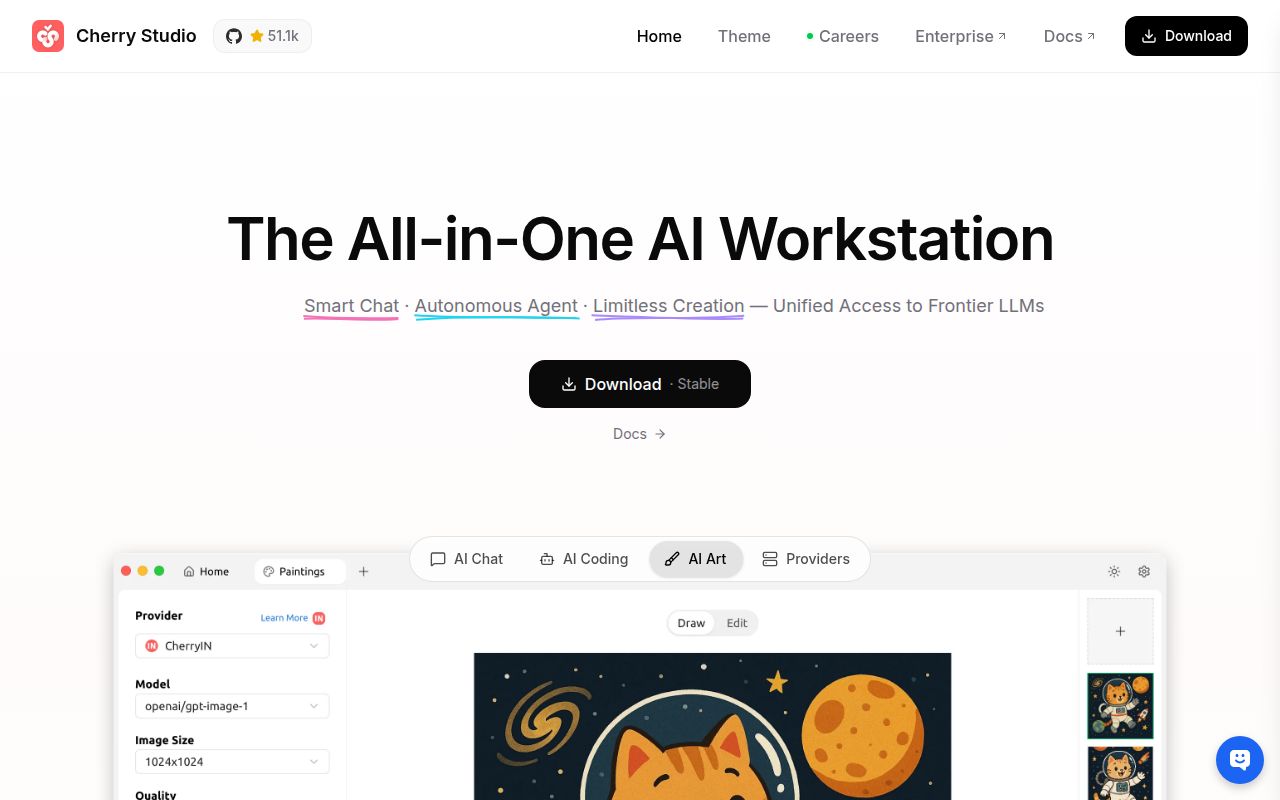
Cherry Studio gives Windows, macOS, and Linux users one interface for OpenAI, Gemini, Anthropic, other web services, Ollama, and LM Studio. The app supports custom assistants, simultaneous conversations with multiple models, topic organization, search, translation, document inputs, WebDAV backup, and Markdown rendering. That is a useful bundle for someone whose current workflow is a row of provider tabs plus a separate local-model client.
The README claims more than 300 configured assistants and lists text, images, Office files, and PDFs among accepted material. MCP server support lets the client reach tools outside ordinary chat. Each connection still has its own data policy and credential model. A local Ollama conversation and a hosted provider request do not have the same privacy boundary merely because they appear in adjacent panels.
The source checkout became a 3,552 MB workspace
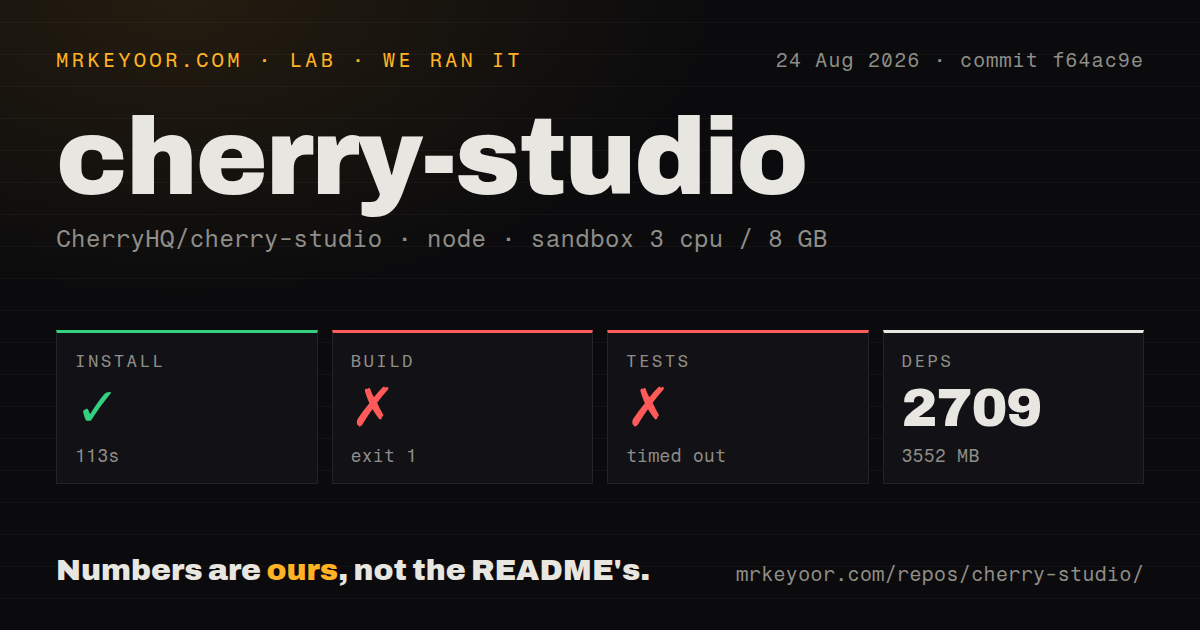
Our clean container installed commit f64ac9e in 113 seconds. Pnpm added 2,709 packages and used 3,552 MB on disk. Before dependencies, the repository held 8,561 files, roughly 1,237,248 lines of source, and occupied 80.2 MB. This is a large Electron monorepo, so source contributors should budget storage, install time, and a current Node toolchain rather than expecting the downloadable app's one-click experience.
The repository had 17 CI workflow files, a tests directory, and workspace packages, while our scan found no Dockerfile. That structure fits a cross-platform desktop product with shared packages and many integrations. It also means a change can cross renderer, main process, provider adapters, data migration, and packaging code. Targeted commands help during development, but release confidence still depends on the full workspace checks.
What happened when we ran it
Our build started after the 113-second install and failed 38 seconds later with exit code 1. The node typecheck repeatedly reported that it could not find @cherrystudio/dsh-bridge or its type declarations. Affected paths included the DSH bridge tool, runtime connection, child flow, composition builder, and related tests. Pnpm then stopped the lifecycle command with code 1.
The supplied log does not say why that workspace dependency was unavailable. It may be tempting to blame package ordering or an unpublished module, but the evidence only supports a narrower finding: the documented source tree at commit f64ac9e did not build in our fresh Node 22 environment after a successful workspace install. Contributors should reproduce that exact typecheck before investing in a feature branch.
Tests ran until our 900-second cap and were terminated without a final total. The tail contains passing TopicService cases for reordering, active-node validation, deletion checks, and placeholder reuse. It also shows 67 ScreenshotOverlayService tests completing in one file. Those passing lines demonstrate progress, but they cannot be converted into a suite pass rate because the command never printed a final summary.
Community desktop and enterprise controls are different products
The community edition is a personal desktop client under AGPL-3.0. The README permits commercial use subject to that license and offers a commercial license for organizations that need different terms. Anyone distributing a modified build or offering modified network functionality should have counsel review the obligations instead of treating open-source availability as permission without conditions.
Central model administration, employee accounts, role-based permissions, shared knowledge bases, and managed backup appear in the enterprise comparison, not the community column. That distinction matters for procurement. Cherry Studio may be a good individual front end without being the team control plane a security department expects. The enterprise edition is described as partly released to customers and sold by quote or subscription.
MCP and document access widen the trust boundary
MCP support can turn the client from a chat window into a tool runner. That is useful for files, search, and task-specific services, but every server gets some combination of prompts, data, and local or network access. Review the server package, command, environment, allowed directories, and confirmation behavior before adding it. A marketplace appears on the roadmap, so the README does not establish that a vetted catalog exists today.
Document handling has similar limits. Office files, PDFs, images, and WebDAV backup reduce app switching, while also moving sensitive material through parsers, storage, and the selected model provider. Keep provider-specific retention rules visible to users and test backup restoration before relying on it. The open August issue queue includes a request for trustworthy migration and restore between version 1 and version 2, which is a reason to test your own data path.
Version 2.0.9 is active, while the build failure remains local evidence
GitHub showed 51,116 stars, 1,453 combined issues and pull requests, and a last push on August 27, 2026. Release v2.0.9 arrived three days earlier. The release notes contain provider fixes, data migration work, agent changes, MCP updates, platform fixes, and many interface adjustments. Same-day pushes and issue updates show active maintenance; the combined count should not be read as 1,453 confirmed bugs.
For an end user, the sensible trial is a signed release on a noncritical profile with one provider and a disposable conversation set. For a contributor or downstream packager, our failed 38-second build and unfinished 900-second test run are blocking evidence until reproduced and explained. Cherry Studio offers broad desktop convenience, but its source tree demands more patience than the download page suggests.