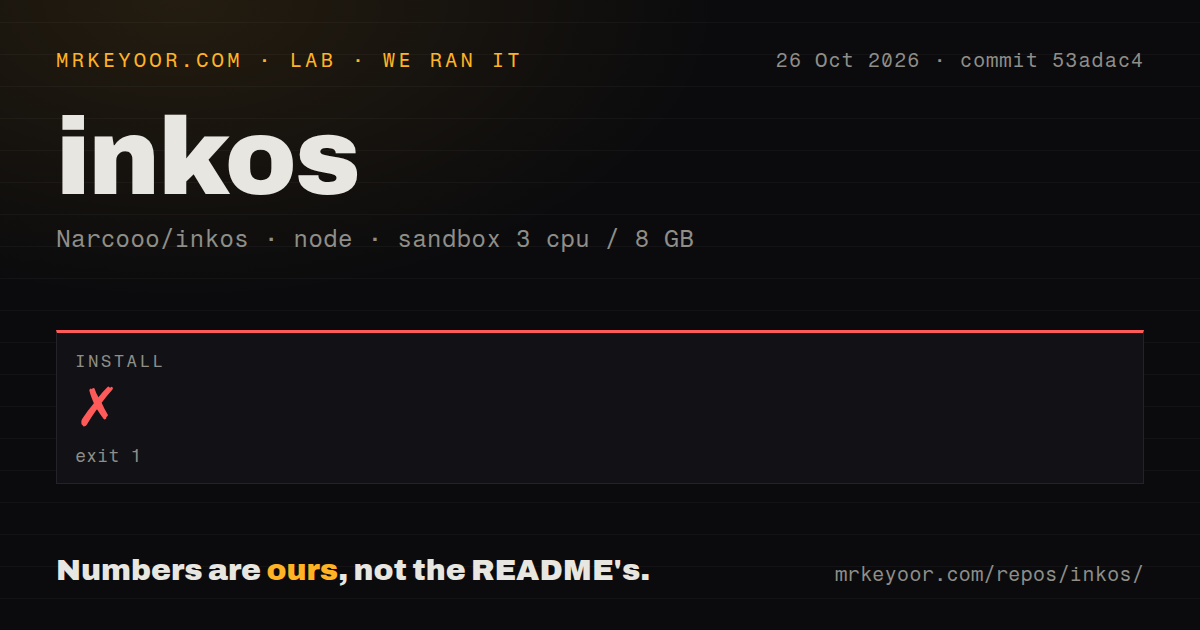
InkOS never reached a writing session in our sandbox: dependency installation stopped after 18 seconds. This review answers whether its documented chapter and story-state workflow warrants a further evaluation. The failed dependency step says nothing about the quality of its fiction.
The project's primary README is Chinese, and a separate English README documents English creation. InkOS describes a shared browser workbench and terminal workflow for generating chapters, retaining story state and recording review observations. Those records may interest technical authors maintaining a serial, but their behavior still needs a completed evaluation.
What happened when we ran it
Our InkOS installation failed after 18 seconds with exit 1 at commit 53adac4 on October 26, 2026. The configured sandbox had 3 CPUs, 8 GB RAM and image label lab-node:22. The label does not verify the actual runtime or operating-system version, including whether it met the README's requirements.
The log reports ERR_PNPM_IGNORED_BUILDS. It lists ignored dependency scripts for esbuild@0.25.12, esbuild@0.27.3, msw@2.12.13 and protobufjs@7.5.4, and suggests pnpm approve-builds to choose which dependencies may run scripts. This establishes a package-manager policy blocker. It does not establish that the packages are defective or that InkOS cannot run.
A separate warning says the pnpm field in package.json is no longer read and that pnpm.overrides was ignored. The supplied log does not establish that changing an override would resolve the ignored-script error.
The checkout scan recorded 793 files, about 111,420 source lines and 17.1 MB. It found monorepo workspaces, a tests directory and 2 CI workflow files, with no Dockerfile detected. No build or test result accompanies the installation failure. Directory and workflow counts are not executed checks.
No generated chapter, continuity evaluation or writing-cost measurement is supplied. Before retrying, inspect the blocked dependency scripts and the applicable execution policy, and record the actual tooling versions. This run did not evaluate the global npm package route described in the README.
Check Studio and CLI configuration separately
The English README requires Node.js 22.16 or later. It describes selecting a service and model in Studio, supplying the service's API key and testing connectivity before writing. These are documented setup instructions, not steps our stopped checkout completed.
Studio uses project service settings and stored service secrets. CLI execution starts with project settings and layers environment and command-line overrides on top. If output differs between the terminal and browser, check which service, model and protocol each selected before judging the writing.
The primary README calls its branch a 2.0 development version. That documentation label does not replace the measured checkout identifier, 53adac4. The README describes a migration preview and says migration retains original directories while projects missing runtime state require reconstruction. Keep a separate manuscript copy and inspect the preview before applying a migration. This run did not test those preservation or reconstruction claims.
Review observations leave revision explicit
The English README says review produces evidence-backed observations, while revision is an explicit action. Authors can use that documented separation to inspect feedback before requesting changes. A saved chapter should not be treated as proof that a literary quality check approved it.
The word option sets a target band rather than an exact word count. The documentation says prose outside the hard range is still saved with telemetry and an observation. If a delivery contract requires an exact limit, check and edit the result yourself.
For a first evaluation, give a disposable story a fact that a later chapter must preserve. Inspect the prose, saved state and review observations separately, then request a revision and compare the saved versions. This is a proposed acceptance exercise, not one our sandbox completed. Include persistence and recovery in that evaluation before importing a manuscript.
Alternatives address different writing interactions
Novel documents a visual editor with AI autocompletions. Consider it when editing a manuscript with completion help is your main requirement.
SillyTavern is a locally installed interface for text generation, image generation and TTS models. Consider it when interacting with models is your main requirement, and evaluate manuscript organization separately.
Neither alternative received a comparative run. These descriptions do not establish equivalent story-state behavior, easier setup or better writing quality.
What remains unassessed
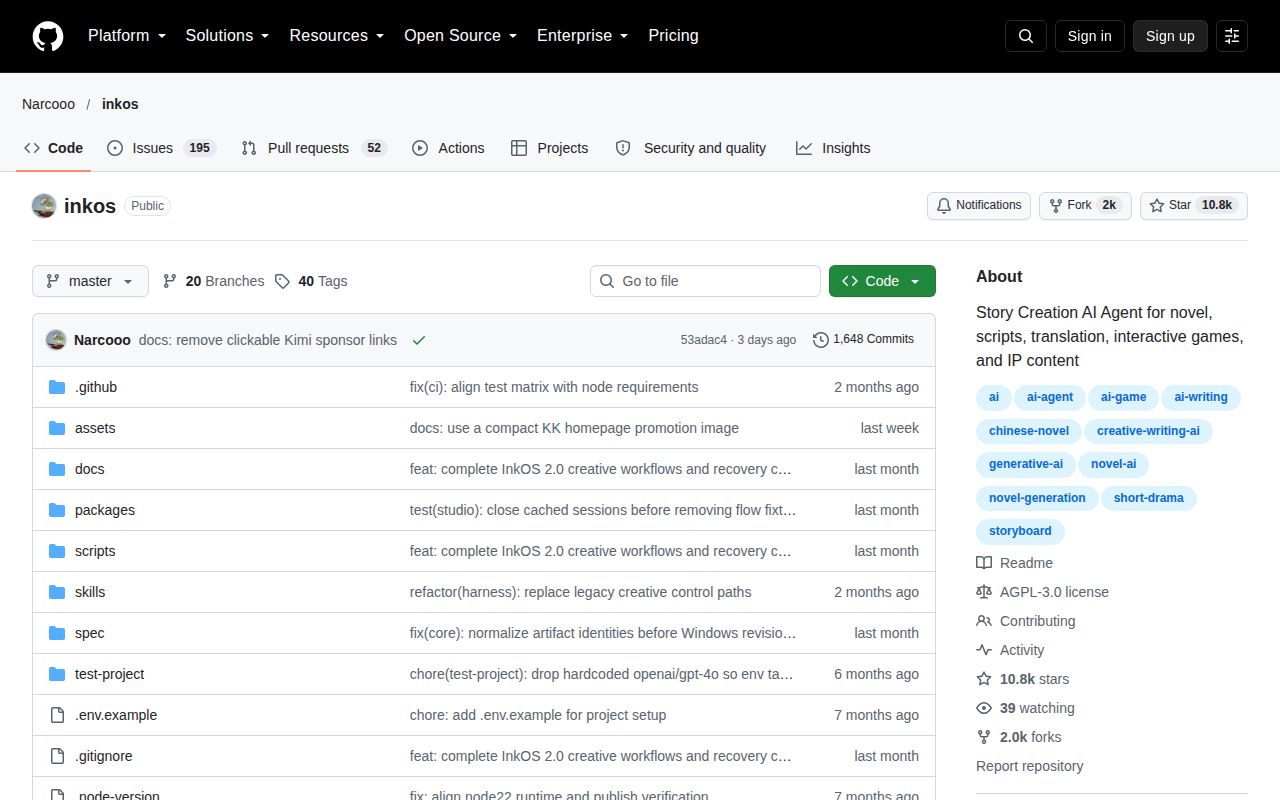
The supplied repository metadata records a last push at 2026-10-24T05:30:14Z and 247 open issues and pull requests combined, observed on October 27, 2026. These are repository snapshots. Support responsiveness and issue activity were not evaluated, and the combined count does not establish how many items are bugs or how quickly maintainers respond.
Our run also leaves chapter generation, revision, persistence and recovery unverified. Use a disposable project to assess those behaviors before relying on InkOS for an existing manuscript.