Orca supervises existing coding agents instead of replacing them
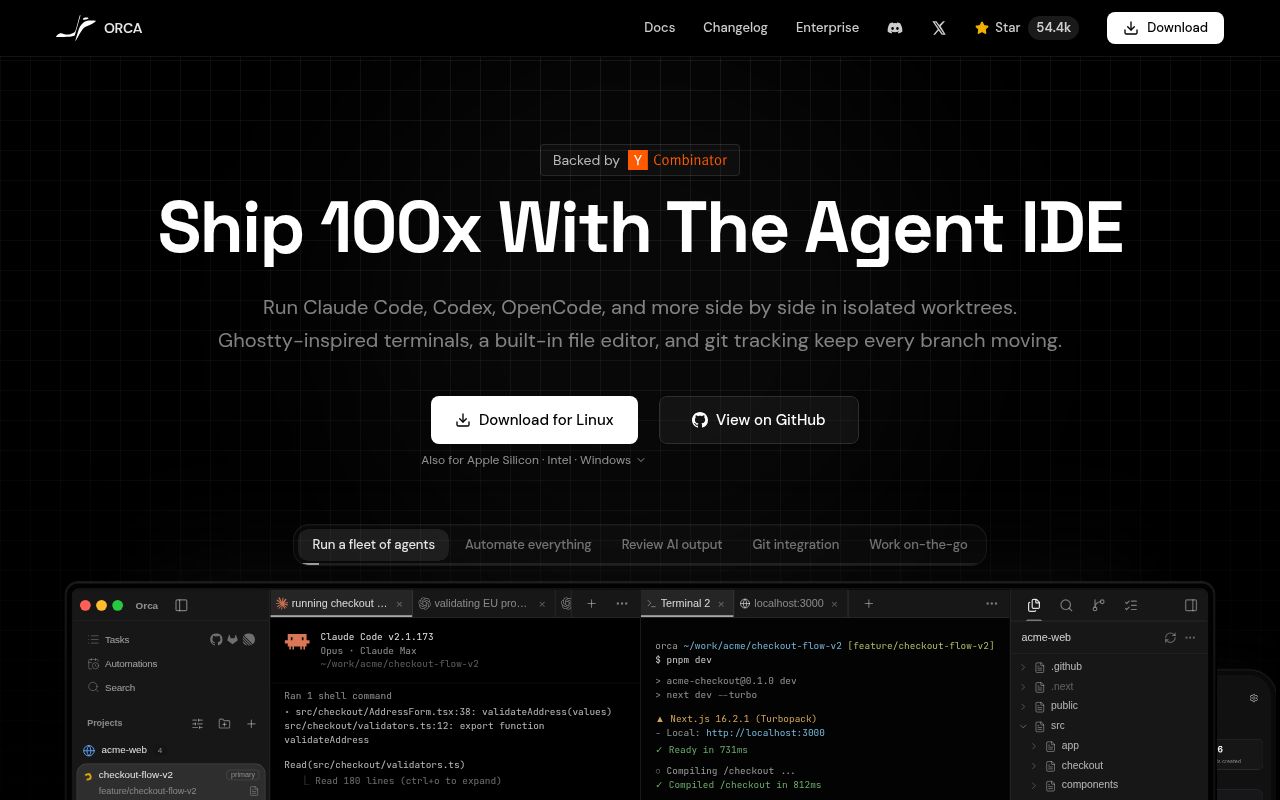
Orca wraps command-line agents in a desktop workspace. Codex, Claude Code, OpenCode, Pi, and many other CLIs run in terminals while Orca tracks their sessions, worktrees, diffs, and attention state. A developer can fan one prompt across 5 worktrees, compare the changes, annotate a diff, and merge the chosen result. That is a specific workflow for people who already use several agents.
The application does not include the model subscriptions. Its README says users bring their own CLI agents and accounts. Orca adds orchestration around them: terminal splits, a file editor, GitHub and Linear views, an embedded Chromium browser, SSH workspaces, automation, and a mobile companion. Each integration saves context switching, while also placing more developer authority inside one Electron application.
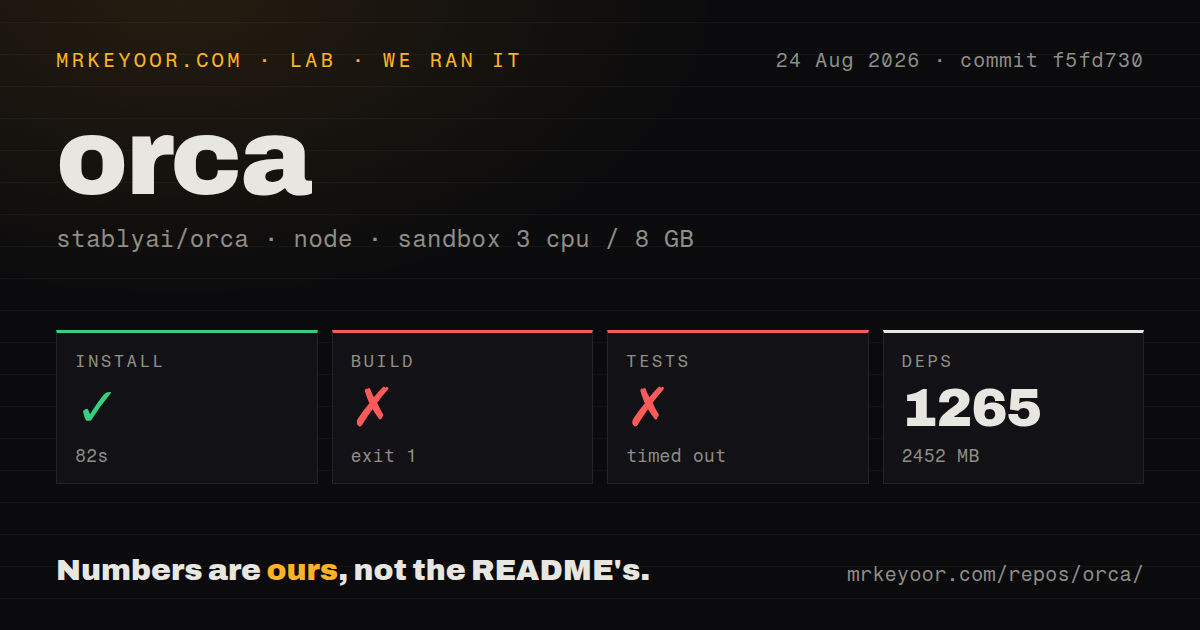
The 2,452 MB install ended in a killed type-check process
Our sandbox installed 1,265 pnpm packages in 82 seconds and used 2,452 MB on disk. The checkout at commit f5fd730 already contained 16,815 files, about 3,251,138 source lines, and 183.7 MB. This is a large desktop and runtime monorepo before agent CLIs, repositories, worktrees, caches, or build output join the machine.
The build ran for 108 seconds and exited with code 1. Its script started desktop and native build stages, then ran parallel type-check projects. The final concrete line said tsc tsconfig.tc.web.json exited with signal SIGKILL. SIGKILL tells us the process was forcibly ended; it does not tell us whether memory pressure, an external limit, or another actor caused it. Any stronger explanation would be a guess.
What happened when we ran it
Our tests reached the 900-second timeout without a final suite summary. The tail was still showing individual passing files, including tests around browser guest lifecycle, worktree metadata, tab focus, and workspace cleanup. Because the command did not finish, we cannot state a pass count or call the suite clean. The evidence is a long-running test command that made visible progress until the cap.
Two stderr messages said the telemetry-cohort classifier returned undefined because the store was not initialized. They appeared alongside passing worktree tests, so the tail does not show those warnings failing the cases. Our scan found 30 CI workflow files, a tests directory, workspaces, and no Dockerfile. The source path needs the project's targeted checks and likely more capacity or time than our 3-CPU, 8 GB container allowed.
Worktrees isolate files, while Git state still needs supervision
Parallel worktrees are Orca's strongest differentiator. Each agent gets its own working tree, which reduces direct file collisions and lets a reviewer compare alternatives. Isolation does not decide which branch is correct, prevent two agents from making the same conceptual mistake, or clean up abandoned trees. The human still owns branch naming, base revisions, merge order, conflicts, tests, and removal of unused worktrees.
Release v1.4.190 includes several fixes around absolute WSL paths, fork remotes, Windows long paths, and stale base branches. That list shows active attention to real Git edge cases. It also tells buyers to test their exact layout: local versus SSH, forks versus origin branches, Windows versus WSL, sparse checkouts, and repositories using older Git. One incorrect target branch can turn parallel speed into cleanup work.
Terminal, browser, and SSH access create one large trust boundary
Orca can run terminal commands, edit files, operate a visible browser through Computer Use, connect to remote workspaces, and expose scripted CLI actions such as click and fill. Those powers are useful because coding agents need to act. They also mean a compromised agent, plugin, session, or dependency may reach source code, credentials, local applications, or remote hosts available to the user.
Use separate development credentials, narrow SSH keys, protected branches, and agent approval settings. Keep production secrets outside agent worktrees. Review diffs before commit and run trusted tests after generation. Mobile steering and automation deserve the same controls as the desktop because a remote follow-up can cause new terminal work. Orca's interface makes parallel action easier; it cannot decide which command your organization is willing to authorize.
Version 1.4.190 improves recovery but current reports remain
The August 26, 2026 release focuses on session recovery, terminals, Windows, WSL, worktrees, skills, and automations. GitHub recorded a last push on August 27, 54,400 stars, and 4,618 combined issues and pull requests. This is intense current activity, and the combined queue should not be described as thousands of bugs. It does show an unusually busy product and contribution surface.
Open issue 16238 reports repeated Orca Relay connection failure. Issue 16095 documents an agent-stall case where a fixed 5-second confirmation window meets a roughly 20-second first hook event. Two reports opened against v1.4.190 describe Windows CLI arguments being parsed incorrectly. These reports are specific, recent reasons to test remote access, Codex or Kimi startup, and Windows automation before relying on unattended work.
The desktop build is the sensible trial
Orca publishes signed desktop downloads for macOS, Windows, and Linux, plus Homebrew and AUR routes. A headless Linux server mode and mobile companion extend the same workspace. For evaluation, the packaged build avoids the 1,265-package source install and the type-check failure we saw. Pin the release, verify its signature or checksum where available, and connect one disposable repository first.
OpenHands is a better match for teams that want a single task-running agent environment. Roo Code or Continue stays closer to an existing editor and one agent workflow. Orca is worth the added surface when a developer is genuinely comparing parallel agents and needs worktrees, terminals, diffs, and remote steering together. Without that parallel workload, the control room costs more attention than it saves.