One desktop app covers dictation, meetings, and notes
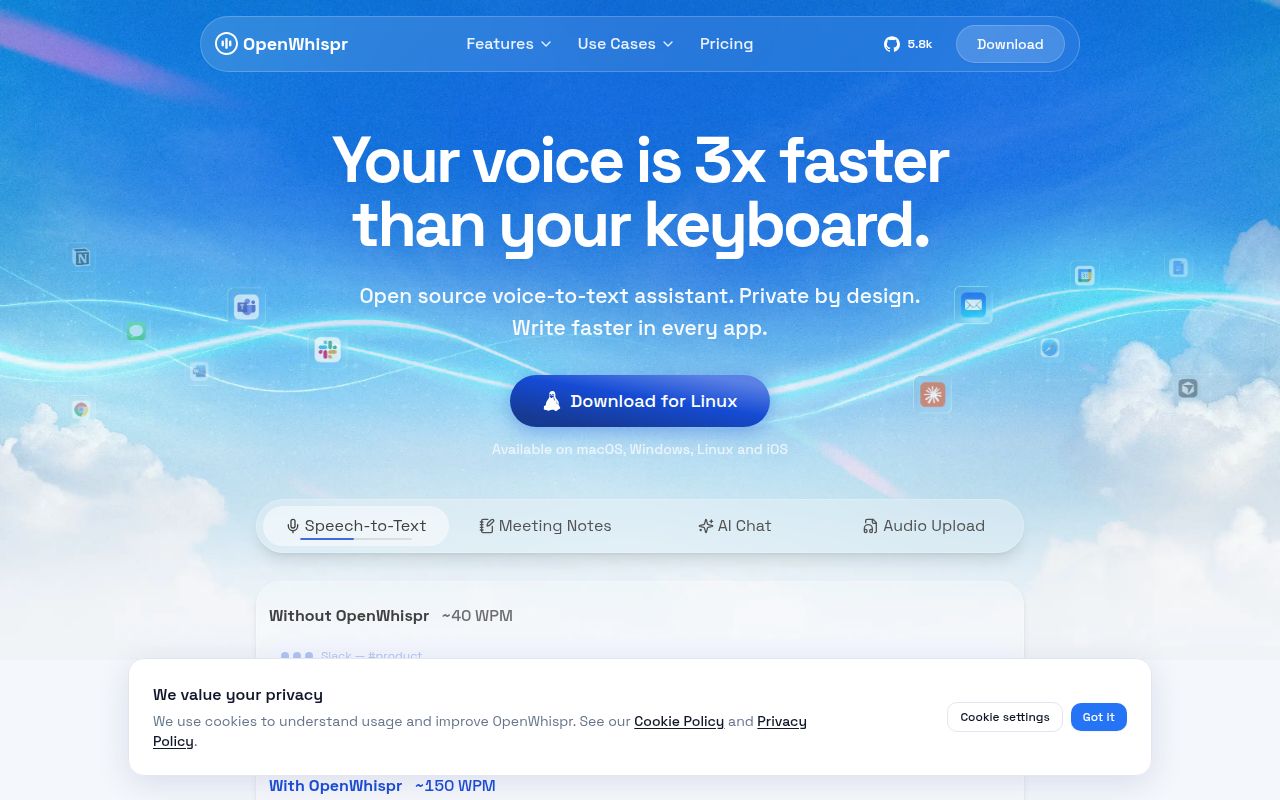
OpenWhispr starts with a useful everyday action: press a global hotkey, speak, and paste the transcription into the focused application. It also imports media, records meetings, labels speakers, stores notes, and sends spoken requests to an AI model. The README lists macOS, Windows, and Linux packages. The client combines Electron 41, React 19, SQLite, Whisper, Parakeet, and local language-model components.
The scope is closer to a desktop work hub than a small Whisper wrapper. Meeting detection covers Zoom, Teams, and FaceTime, with calendar connections for Google, Microsoft, or Apple. Notes support folders, semantic search, cloud sync, and team sharing. A public API and MCP server expose notes and transcriptions to other software. Each feature adds another account, model, permission, or background process to understand.
Local processing is available, while collaboration uses services
Core speech work can stay on the device. OpenWhispr supports local Whisper and NVIDIA Parakeet, speaker diarization, semantic search, and local language models. After the model files are downloaded, offline transcription does not need an API key. GPU paths cover Metal, CUDA, and Vulkan, with CPU fallback documented when an accelerated server cannot start.
The app also accepts provider keys for OpenAI, Claude, Gemini, Groq, Tinfoil, OpenRouter, and other configured services. Calendar integrations need authorization, and signed-in users get cloud sync, shared notes, and team spaces. Voice-assistant requests can include selected text and, by opt-in, a screenshot. Decide feature by feature which material may leave the machine.
What happened when we ran it
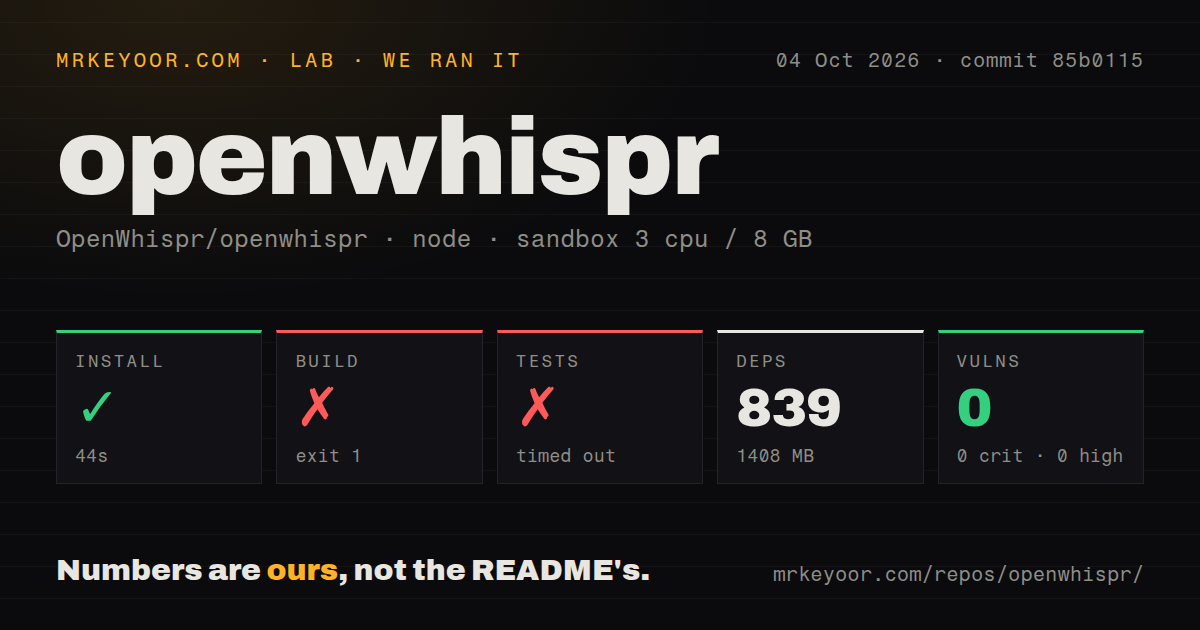
Our sandbox installed commit 313ba03 in 47 seconds, adding 815 npm packages and consuming 1,374 MB on disk. The repository contained 1,343 files and about 253,968 lines of source. It had 15 CI workflow files and a tests directory, but no Dockerfile. Npm audit reported 0 known vulnerabilities across critical, high, moderate, and low severity levels.
The build did not finish within the 900-second limit. Its final log showed electron-builder creating Linux AppImage, tar.gz, and deb packages, downloading packaging tools, and adding update files. It also warned that desktopName was missing for Linux window association. No compiler or packaging error appeared before the timeout, so the full package job simply exceeded 15 minutes on the stated 3-CPU, 8 GB sandbox.
Tests exited with code 1 after 127 seconds. The summary identified denied folder delete rollback reports a name clash instead of failing hard as the failing case. It also showed react-i18next warnings and skipped a case because the better-sqlite3 native binding was unavailable for that Node runtime. The log provides no complete pass count or cause for the rollback assertion.
Version 1.9.2 repaired failures users could not work around
Version 1.9.2 says every Windows sign-in provider button had stopped working in 1.9.1. Calendar connection and Stripe checkout followed the same broken URL-opening path. A separate import mistake broke xAI dictation, retranscription, and bring-your-own-key file uploads in packaged builds across all 3 desktop platforms, while development builds continued to work.
The repair also addressed Windows meetings that captured only the user's microphone, plus prompts that stopped appearing after the first call. These are central workflows. The release shipped on August 29, 2026, so users coming from 1.9.1 should update. Organizations should still stage each package on representative Windows, macOS, and Linux machines before offering it as a daily dictation tool.
Older CPUs and some Windows paths remain poor fits
Issues 793, 1418, and 1613 describe illegal-instruction crashes on an AMD FX-8350 and Intel chips without AVX2. One report says the CPU binary failed even when a working NVIDIA GPU was available, blocking the expected fallback path. Test the bundled engine on older hardware before committing to local transcription.
Windows usernames containing characters such as ö have another reported failure. Issue 1774 traces a Parakeet model path being decoded incorrectly by sherpa-onnx, so the files cannot be found. Issue 1909 reports a broken WinGet upgrade URL for version 1.9.0. These reports identify deployment cases an administrator can check before a wider rollout.
Linux needs desktop-specific paste and audio setup
Wayland users may need wl-clipboard, wtype, a desktop portal, or ydotool for automatic pasting. Electron's X11 clipboard selection is not readable by native Wayland apps in every setup. GNOME and KDE can show a remote-interaction permission dialog on the first automated paste. If automation fails, OpenWhispr leaves the text on the clipboard.
Meeting capture on Linux depends on PipeWire. macOS needs 3 relevant permissions for the full experience: microphone, accessibility for pasting, and screen recording for meeting audio. Intel Macs lose live speaker identification, voice fingerprinting, and semantic note search because the required ONNX Runtime binary is unavailable. Platform behavior differs in material ways.
August activity is intense and the issue queue is large
GitHub recorded a push on August 29, 2026, the same day as v1.9.2. The repository had 5,831 stars and 265 open issues and pull requests when fetched. Recent work includes fixes, features, hardware reports, installer problems, and CI discussion. The combined open count should not be read as 265 confirmed bugs.
OpenWhispr earns a trial when one user wants private dictation, meeting capture, and searchable notes in the same client. The 1,374 MB dependency tree and 900-second build timeout make source work costly, while v1.9.2's repairs argue for cautious updates. Add meetings, sync, and MCP only after the basic hotkey and paste loop is dependable on the target desktop.