It puts local transcription inside software you control
whisper.cpp takes OpenAI's Whisper speech recognition model and packages its inference path as a plain C/C++ project. The design suits private audio, offline operation, and applications that do not want a Python service beside them. Its practical pitch is 1 native implementation for laptops, phones, servers, browsers, and small computers.
The high-level implementation lives in whisper.h and whisper.cpp, while the underlying computation comes from ggml. The README claims zero runtime memory allocations, mixed F16/F32 precision, integer quantization, and a C-style API. Those choices make it attractive as an engine inside another product.
What happened when we ran it
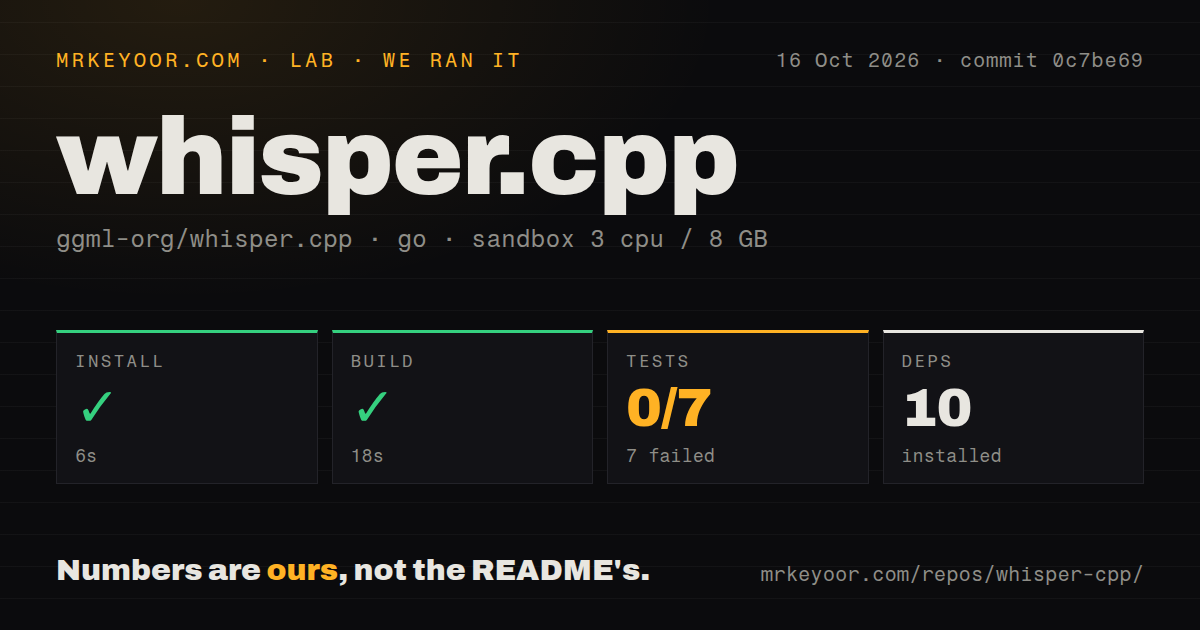
Our run targeted the Go binding in ./bindings/go at commit a2b36eb, not the main C++ quick-start path. In a fresh Debian container, installation succeeded in 6 seconds and installed 10 packages. The build then succeeded in 20 seconds. That is a good first impression, but it did not survive the test step: after 12 seconds, go test reported 0 passed and 7 failed out of 7.
The available failure excerpt ends with compilation terminated and marks github.com/ggerganov/whisper.cpp/bindings/go, examples/go-whisper, and pkg/whisper as build failed. On our box, that means the tests never established working behavior because compilation stopped first. The container had 3 CPUs, 8 GB of RAM, no secrets, and unprivileged execution. We cannot responsibly name the missing header or package from the truncated lines, but a fresh-container compilation failure is setup friction worth budgeting for.
The hardware coverage is the strongest reason to choose it
The README covers CPU-only inference plus several acceleration paths: Metal and Core ML on Apple hardware, CUDA-oriented NVIDIA support, AMD ROCm, Vulkan, OpenVINO, Ascend NPU, Ryzen AI NPU, and POWER VSX. It also calls out AVX for x86 and ARM NEON. Few local transcription engines present this many deployment choices in 1 repository, and the same project reaches macOS, Linux, Windows, FreeBSD, iOS, Android, Raspberry Pi, WebAssembly, and Docker images.
Metal can run inference on the GPU, while Core ML can move encoder work to the Apple Neural Engine; the project says this can exceed a 3x speed-up versus CPU-only execution. That is a project claim, not a result we measured. The Core ML route requires Python tooling, Xcode tools, generated assets, and a WHISPER_COREML=1 build.
Model size and audio preparation are explicit tradeoffs
The README is commendably specific about storage and memory. Its table ranges from the tiny model at 75 MiB on disk and about 273 MB of memory to the large model at 2.9 GiB and about 3.9 GB of memory. Quantization can reduce disk and memory use, and the repository includes a quantize executable with a Q5_0 example. That gives deployers useful knobs for choosing between footprint and the behavior of the selected model, without pretending one configuration fits every device.
The basic path is clone, download a converted ggml model, build with CMake, and run whisper-cli. There is still a notable input constraint: the CLI example accepts only 16-bit WAV, and the README recommends converting other inputs to 16 kHz, mono PCM with ffmpeg. That is manageable in a media pipeline, but it is a rough edge for an end user who expects to drop in an MP3. Model downloads and audio normalization remain your application's responsibility.
The rough edges sit around the core engine
The repository is large, roughly 442,798 source lines and 39 MB in our checkout, because it spans native code, bindings, examples, accelerators, and platforms. That breadth creates choices but also increases the surface area for toolchain mismatches. Our Go result is the clearest warning: a successful install and build did not produce a testable binding in the same 38-second sequence. Teams adopting a less-traveled binding should validate it on their exact base image before committing architecture around it.
There are 22 CI workflow files and a tests directory, but our scan found no Dockerfile in the checkout even though the README links to published Docker images. Consumers may rely on maintained registry artifacts instead of a documented local image recipe. The project is an inference component, not a service with authentication, queues, storage, monitoring, and retention policies.
Current activity is strong, while issue load deserves attention
The repository was pushed on 2026-09-10, just 1 day before this review, and the latest supplied release, b4938, arrived on 2026-08-20. Those dates indicate active development. A single latest-release date is not enough to calculate a release cadence, so we would not claim a predictable schedule. The 343 open issues show both substantial real-world use and a meaningful support queue; the supplied data does not reveal response times or resolution rates.
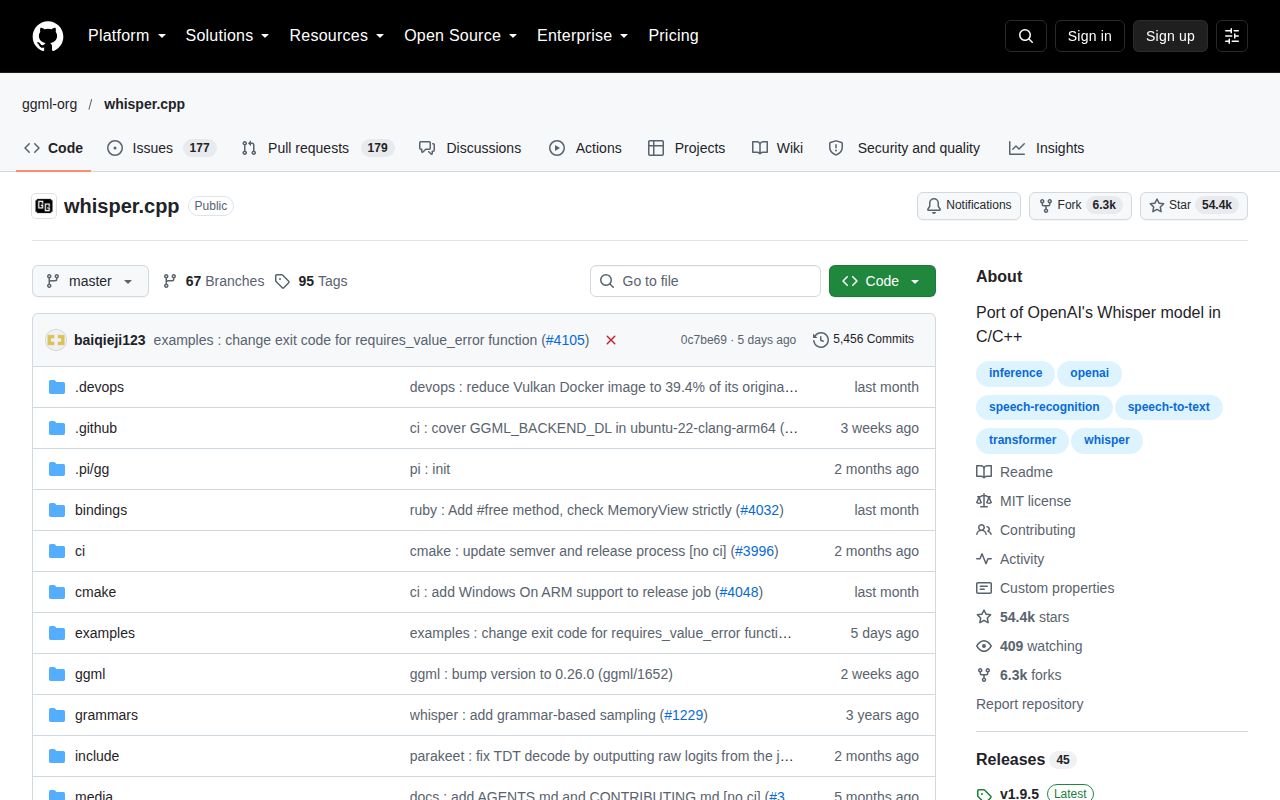
Adoption is plainly high at 53,590 stars, and the README exposes package routes through Conan and npm alongside source builds. The MIT license is permissive for commercial integration. Maturity looks strongest in the central C/C++ engine and platform range, while binding-specific confidence should come from your own CI. Our 7 failed Go test targets are more relevant to a Go buyer than the star count, even though they do not invalidate the main native path.
It fits as an engine behind your product boundary
A sensible stack puts audio conversion before whisper.cpp, stores a ggml model explicitly, then wraps the C API or a validated binding with job control. On a device with hundreds of MB available, the 75 MiB tiny model is a very different choice from a 2.9 GiB large model.
Do not confuse that engine role with a finished transcription platform. Teams still need to segment audio, handle failures, expose progress, secure recordings, store transcripts, and observe resource use. If native control is the priority, the hardware list and quantization tools make whisper.cpp a capable foundation. If you need a one-command service with clean Go tests on Debian, our 12-second failure says to prototype the complete path first.