It is the direct, first-party route from Python to OpenAI
OpenAI Python is the official client for applications calling the OpenAI REST API. It supports Python 3.10+, types request parameters and response fields, and offers synchronous and asynchronous clients powered by HTTPX2. Callers work with documented Python objects while the library handles requests. Generation from OpenAI's OpenAPI specification keeps its surface close to the service rather than adding an independent abstraction.
The README puts the Responses API first and keeps Chat Completions supported. Its direct example constructs OpenAI, reads OPENAI_API_KEY, calls client.responses.create, and prints response.output_text. It uses gpt-5.5, while a second example shows chat messages. A small Python service can reach a recognizable request without first learning a framework.
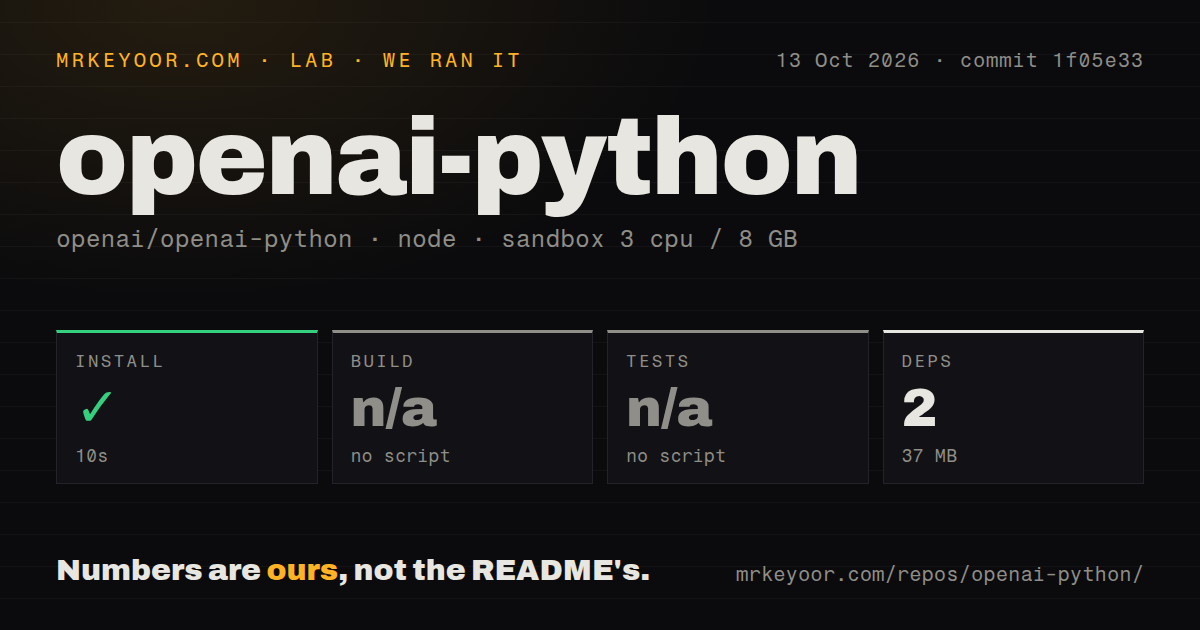
Our install worked, but the harness did not run Python tests
In our run, installation succeeded in 15 seconds. The measured checkout contained 1,953 files, about 252,328 lines of source, and occupied 14.1 MB before installation. The install added 2 packages and used 37 MB on disk. Those are modest setup costs for a large generated SDK. The container was unprivileged, had 3 CPUs and 8 GB of RAM, and contained no secrets, so we did not attempt a real authenticated API request.
The measurement harness classified the repository ecosystem as Node with pnpm and detected monorepo workspaces. It found no build script or target, so build was skipped. It likewise found no test script or target, so tests were skipped, despite the checkout containing a tests directory and 8 CI workflow files. This is not a test failure, but it is not a passing result. Our box proved installation finished; it did not validate the Python suite, network behavior, or authentication flows.
The strongest feature is useful coverage without hiding the API
Both synchronous and asynchronous clients are documented, and typed requests and responses should improve editor help over hand-built dictionaries. Vision input accepts an image URL or a base64-encoded file. The README also links the REST reference and full api.md, providing a short start plus generated details for uncommon fields.
Authentication goes beyond a long-lived key. The README documents workload identity for Kubernetes service-account tokens, Azure managed identity, Google Cloud compute metadata, and a custom JWT provider. Tokens are lazily obtained, cached, and refreshed, with a configurable default buffer of 1,200 seconds. These options reduce the need to distribute static secrets in managed infrastructure.
For X.509 workload identity, the example loads a certificate chain and key into an SSL context passed through DefaultHttpx2Client. The default endpoint is https://mtls.api.openai.com/v1 when no base URL is set. Requests must use HTTPS, remain on the configured origin, and cannot combine certain provider or proxy headers with X.509 authentication.
The rough edges are version surface, scope, and incomplete local proof
The Python 3.10 minimum excludes older runtimes. Generation from an OpenAPI specification can also create a broad surface that teams must review during upgrades. With v3.8.0 current in the supplied data, production users should pin a known-good version and read changes before fleet rollout. That discipline matters when a package follows a fast-moving hosted API.
Advanced authentication carries constraints. X.509 mode covers HTTP APIs but excludes Realtime and WebSockets, and Azure clients do not support that mode. Certificate rotation, trust stores, key handling, passwords, and proxies remain application or transport responsibilities. The SDK provides hooks, but mutual TLS is not a one-line operational setup.
The repository has 627 open issues. That does not prove poor maintenance for a project with 31,607 stars, but buyers should search for their transport, async, authentication, or response-shape edge case before upgrading. A Hacker News discussion about the HTTPX2 migration drew 209 points and 96 comments, evidence of attention but not maintainer response-time data.
Fresh pushes and releases point to an active project
The latest supplied release, v3.8.0, landed on September 3, 2026, and the last push was September 7, 2026. Relative to this September 8 review, that is a release 5 days ago and activity 1 day ago. Together with 8 CI workflow files, those dates show active engineering. The 627-issue backlog tempers the community score because the evidence does not reveal triage speed.
In a real stack, this belongs inside an application or internal service that owns prompts, policy, retries, observability, and business logic. It is not a gateway, model host, or cross-provider control plane. Use HTTPX for exact wire control or LiteLLM when one interface across providers is core. For a Python 3.10+ codebase committed to OpenAI, the official SDK is the sensible default: direct, typed, and current.
The recommendation is straightforward, with one testing caveat
Adopt it for direct OpenAI integrations, especially when sync and async support or workload identity matter. Pin v3.8.0 or another reviewed version, exercise your request paths, and treat our 15-second install as setup evidence only. Because our run skipped build and tests, run Python-specific checks or a focused application suite before deployment. The SDK stays close to the official API, while your application still owns production behavior around it.