The 11B model is research code for GPU teams
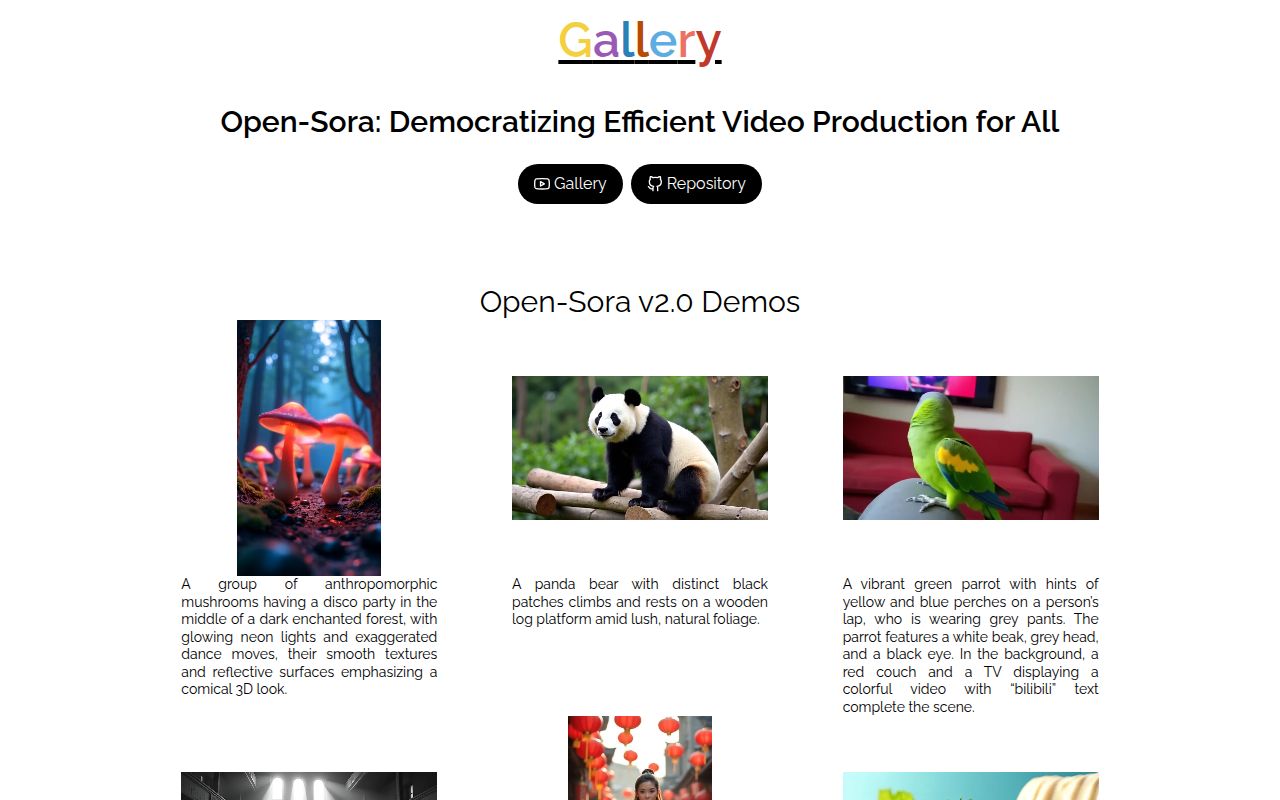
Open-Sora 2.0 is an 11B video model with inference and training code on the main branch. It accepts text or a reference image and publishes configurations for 256px and 768px output. The repository also covers video autoencoders, dataset preparation, fine-tuning, and distributed training. That breadth makes sense for a lab studying the machinery of video generation. A product team still has to supply the API, queue, moderation, storage, and user interface around it.
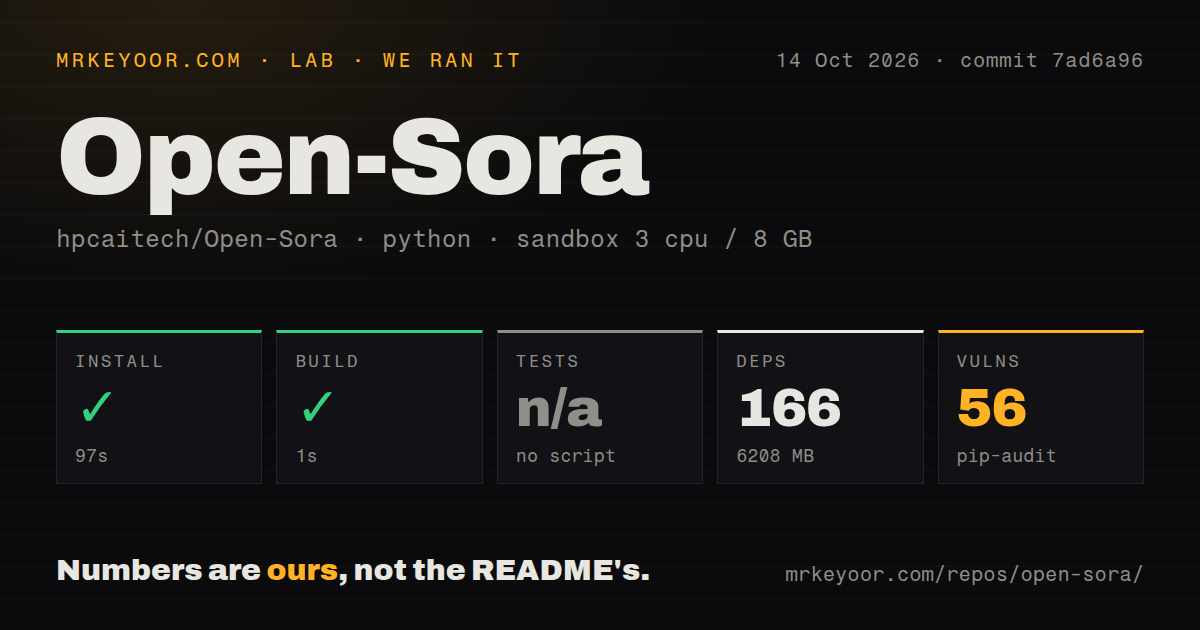
The small checkout gives a misleading first impression. Our commit 7ad6a96 clone contained 119 files and about 18,615 lines of source in 1.6 MB, yet installation expanded the environment to 160 packages and 6,200 MB. The model checkpoint is a separate download, so that disk figure is the starting cost rather than the full footprint. Open-Sora belongs on a machine chosen for ML work, not on a general-purpose application host with spare CPU cycles.
What happened when we ran it
Our sandbox installed Open-Sora in 113 seconds and the package build finished in 5 seconds. Both steps succeeded in a fresh Debian container with 3 CPUs, 8 GB of RAM, Python 3.12, no secrets, and no elevated privileges. Those results show that commit 7ad6a96 can resolve and package its Python environment. They do not establish that the 11B checkpoint can generate video on that CPU-only container.
There was no test script or target, so the lab skipped tests instead of reporting a pass. The checkout also had 2 CI workflow files, no Dockerfile, and no tests directory. Pip-audit found 46 known vulnerabilities in the installed dependency set. The audit count does not tell us whether each finding reaches Open-Sora's runtime path, but it gives an evaluator 46 items to investigate before placing the environment beside sensitive files or public traffic.
The quickstart assumes CUDA before the first clip
The README starts with Python 3.10 and PyTorch 2.4 or newer, then asks for xformers 0.0.27.post2 from the CUDA 12.1 wheel index and a source-style flash-attn install. Flash Attention 3 is another optional build from a pinned upstream commit. None of this is unusual for current video research, but it makes driver, toolkit, compiler, and wheel compatibility part of setup. The successful 113-second package install is only the Python layer.
Model assets come from Hugging Face or ModelScope. The 11B checkpoint supports the project's 256px and 768px configurations, with a single-GPU command at each size and an 8-process example for 768px. No API key is documented for basic local inference. Prompt refinement and dynamic motion scoring call OpenAI and therefore require a separate key, while optional training logs can go to Weights & Biases. Teams should decide which outbound services are permitted before wrapping the scripts in a worker.
Image-to-video gets the clearest path
Open-Sora says its 11B model is optimized for image-to-video. Its preferred high-quality text route first uses a Flux text-to-image model, then turns that image into video. A direct text-to-video command is also documented. Supported aspect-ratio choices include 16:9, 9:16, 1:1, and 2.39:1, while frame counts must follow the stated 4k+1 rule and stay below 129. These are useful controls, though they remain command-line configuration rather than a stable application contract.
Training raises the commitment sharply. The guide's example dataset is a 250 GB download, and its batch-size notes come from H200 GPUs with 140 GB of memory. Stage 2 uses sequence parallelism, multi-node runs need host files, and asynchronous checkpoint saving adds TensorNVMe plus CMake. A demo configuration exists for debugging, but the documented full path is aimed at a research cluster. Fine-tuning is plausible only after storage, checkpoint handling, and multi-GPU failures have owners.
Main says 2.0 while the release page stops at v1.3
The package metadata calls itself version 2.0.0 and the main README leads with the 11B Open-Sora 2.0 model. GitHub's latest formal release is v1.3, published on February 21, 2025. The last push to main was April 9, 2026, and that commit updated the README; the preceding listed commits were from March 2025. Pinning a commit is safer than treating the latest tag or the default branch as an interchangeable stable channel.
GitHub reported 29,690 stars and 14 open issues and pull requests when fetched. All 14 open entries returned by the issues API were pull requests, with updates as recent as September 1, 2026. That is current contributor activity, while the gap between open submissions and the last main-branch push suggests slower integration. A buyer should inspect the specific patches it needs instead of reading the star count as support coverage.
Three alternatives make the model choice easier to test
HunyuanVideo is the closest comparison when another large video framework is the point of the exercise. Wan2.1 gives teams an Apache-2.0 model family to assess, and LTX-Video is a separate official model repository with its own workflows. The choice should follow the output mode, GPU memory, checkpoint terms, and integration path you can test. Open-Sora earns its place in that trial when access to training code and distributed configurations matters more than a short production setup.
Our run leaves a clear adoption gate: resolve the 46 audit findings, define a test command, and generate representative clips on the intended GPU before building a service around commit 7ad6a96. The repository is candid enough about CUDA, checkpoints, and training scale to price that trial. Its 6,200 MB environment, absent upstream test target, and mismatched release surfaces make it a poor shortcut for teams that only want a video endpoint.