Forty catalog entries still depend on one external API
OpenHiggsfield presents 12 image and 28 video model entries in one composer. Each entry declares its own aspect ratios, resolution, duration, output format, audio choices, media roles, and batch behavior. The studio turns the selected model, prompt, inputs, and settings into one request object, then maps that object to the generation API. This catalog-led design is the project's best idea: adding a model changes the picker and settings rail without another hardcoded interface for the same fields.
The repository does not contain those models or an inference engine. Server actions submit POST /{model} requests to the origin set in HF_API_BASE_URL, authenticate with the user's platform key, and poll request status. The README asks users to paste that credential as id:secret. Calling the project self-hosted is accurate for the studio, but incomplete for the workload. Generation availability, price, moderation, speed, and retention still belong to the external platform behind that base URL.
The gallery keeps 60 local records, not a team archive
Finished runs appear in image, video, asset, and favorite views. Users can reopen a result, copy its prompt, restore its settings, download it, mark it as a favorite, or reuse it as input. Selection mode adds range selection and bulk actions. Deletion can be undone for 6 seconds. These details make the interface more useful for repeated creative work than a thin form wrapped around an API endpoint.
History is stored in IndexedDB for the current browser and capped at 60 records. Favorites do not age out, but that exception does not turn local state into shared storage. Result URLs belong to the generation platform, and the README warns that old entries may become gaps after provider CDN links expire. A team needing review, provenance, role-based access, or durable media records would have to build those capabilities elsewhere. This is a personal studio first.
What happened when we ran it
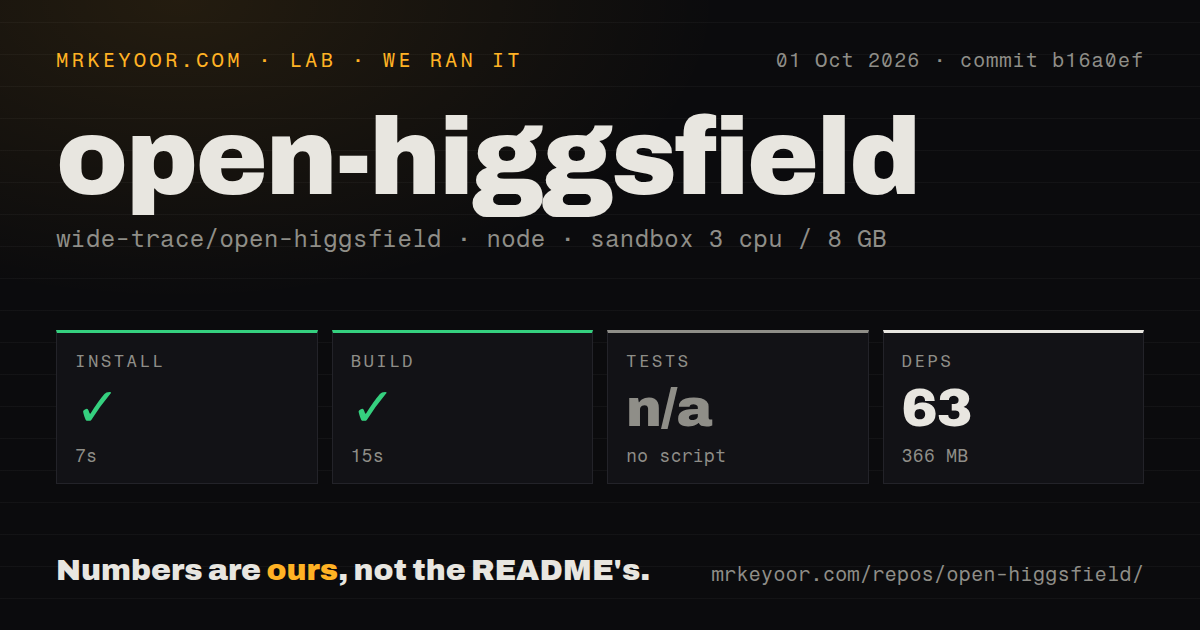
Our commit e123319 checkout installed 63 pnpm packages in 16 seconds on Node 22, consuming 366 MB on disk. The production build succeeded in 21 seconds. The repository was small by application standards: 113 files, about 6,780 source lines, and 0.7 MB checked out. That clean build confirms the Next.js application compiled in our unprivileged container. It does not confirm that any paid or remote generation request completed because the sandbox had no secrets.
There was no test script or target, so we skipped tests. The checkout also had no tests directory, no Dockerfile, and 0 CI workflow files, although it used monorepo workspaces. Those absences matter more than the fast build when changes touch credential handling, upload roles, per-model field mapping, polling, or deletion. All five are places where a type-correct application can still behave incorrectly. A production fork should add checks around catalog parsing, request translation, and status transitions before expanding the model list.
Public upload URLs are part of the generation path
Media inputs can fill roles such as start frame, end frame, reference image, video, or audio. The browser uploads those files directly to Vercel Blob after /api/blob issues a scoped token. The README says the resulting public URLs travel in generation requests, while local blob: URLs are preview-only. That is a reasonable way to make media reachable by an external model service, but it creates a policy question for confidential footage and unreleased assets. Teams should decide what may leave their network before exposing the upload control.
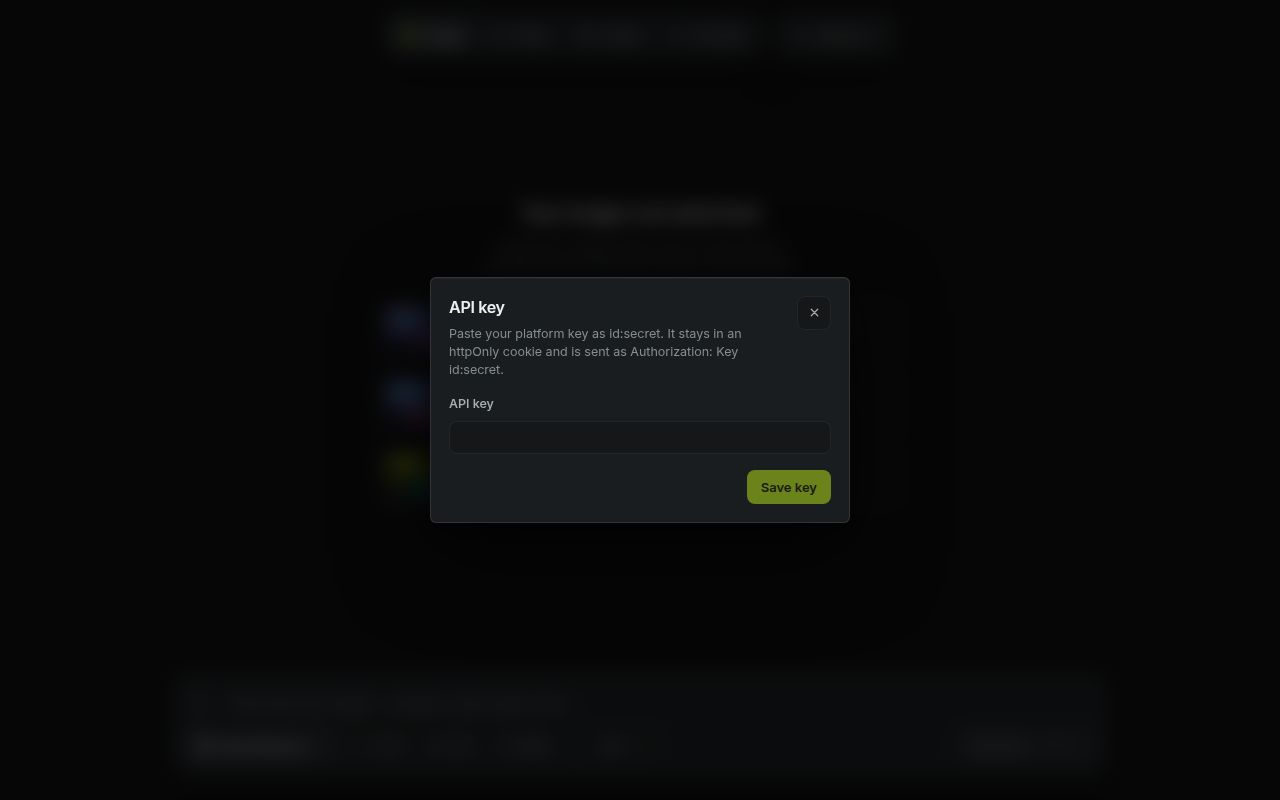
Setup needs three pieces beyond pnpm install: an HF_API_BASE_URL, the user's id:secret platform credential, and OPEN_HIGGSFIELD_READ_WRITE_TOKEN for Vercel Blob. The credential is stored through a server action in an HTTP-only cookie, and the browser does not call the generation API directly. That keeps the key out of client-side requests to the provider. Operators still need normal web security, secret rotation, upload limits, and a clear understanding of who controls the API origin.
No license is a blocker for organizational adoption
The README repeatedly describes OpenHiggsfield as free and open source, yet GitHub reported no detected license and the repository tree contained no license file on August 26, 2026. Publicly readable source code does not by itself grant the permission organizations normally expect to copy, modify, and redistribute it. This is the sharpest reason to pause. Ask the owner to add a recognized license before basing a company product or public fork on the code.
Activity is recent: the repository was pushed on August 26, had 323 stars, and GitHub showed 0 open issues and pull requests. There was no latest GitHub release. A zero queue on a young repository is not evidence that users have found no defects, especially when no automated tests or CI workflows are present. OpenHiggsfield is best evaluated as a compact, interesting studio implementation. Our 21-second build makes it easy to inspect, but the missing license and validation layer keep it out of the dependable-infrastructure category.
ComfyUI is better when inference must stay local
ComfyUI trades the single composer for node graphs and local execution, which suits users who need full control over model loading and workflows. InvokeAI is a stronger comparison for a local image-focused studio with canvas tools. The commercial Higgsfield product is the simpler choice for buyers who want the vendor to own the service. OpenHiggsfield fits between them: it owns the interface while delegating generation to a separate API.
That split can be attractive for one creator with an existing key. The catalog keeps 40 model entries coherent, and the gallery has thoughtful reuse and failure states. The same split is less convincing for a team expecting a complete private generation system. Our run proved that the front end installs and builds; it did not run a model, and the repository offers no automated suite to cover that boundary. Treat it as a starting interface after the license is fixed, not as a finished replacement for a hosted generation platform.