One console joins evidence that usually lives apart
Ongrid combines monitoring views, logs, traces, topology, alerts, runbook search, workflows, chat integrations, remote shells, and specialist agents. A coordinator can send a question to SRE, network, or database tools. Alert-driven investigations can gather evidence and return a cause to chat. Slack, Telegram, Lark, DingTalk, and WeCom give operators access without requiring another dashboard to stay open.
The useful part is evidence access, not a model guessing why a server is slow. Ongrid can query Prometheus, Loki, and Tempo, follow topology to estimate blast radius, search indexed notes or repositories, and record its tool calls. External MCP servers can add more tools, while the knowledge vault stores operational material. Every added source and tool expands the credentials and data an operator must govern.
Edge removes inbound ports but gains host privileges
Managed machines run an Edge service that dials outward, so Ongrid does not require inbound ports 22, 80, or 443 on each host. The reverse tunnel supports a browser shell, and Edge collects host evidence or discovers network neighbors. Per-device enrollment avoids one permanent credential shared across the fleet. This arrangement is convenient across cloud and on-premises networks.
Edge is privileged operations software. It can inspect hosts, carry remote commands, connect exporters, and participate in Kubernetes or network-device work. Review its bash policy, enrollment tokens, tunnel exposure, update process, and effective user. Start with a noncritical segment and deny writes. A clean central server cannot compensate for an Edge policy that grants more command scope than intended.
Open issue 329 also reports a false offline alert caused by the wrong device identifier in a 21-device installation. Every pilot should compare Ongrid's device mapping and alerts with the source inventory. An AI investigation built on a false alert or mismatched topology can sound coherent while pursuing the wrong host.
What happened when we ran it
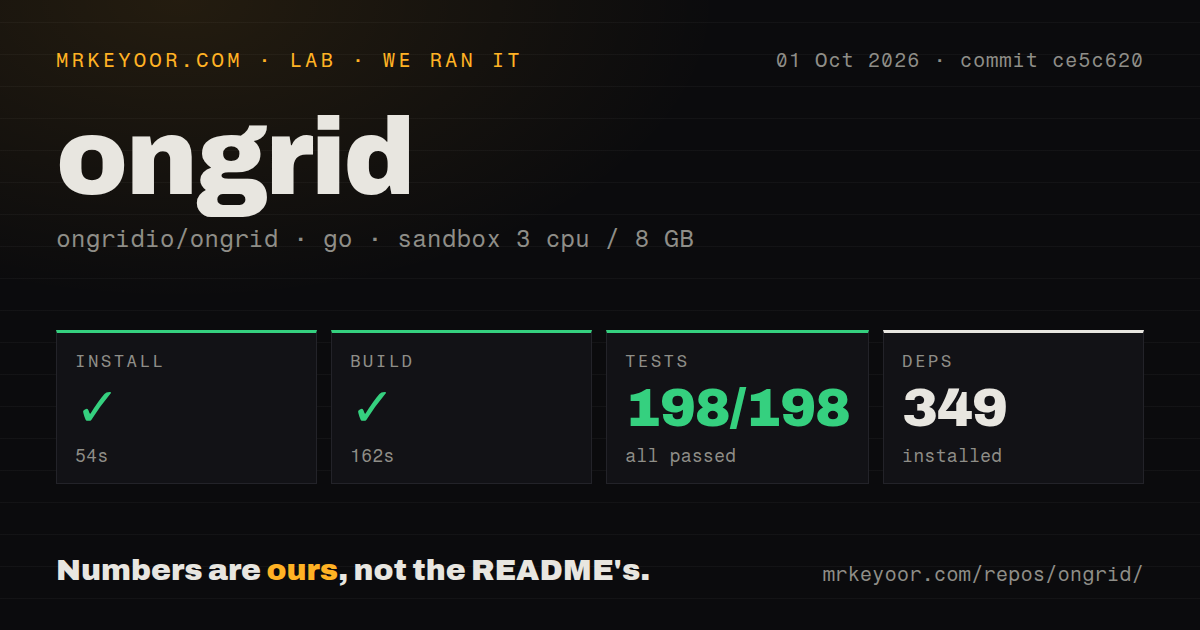
Our sandbox installed 346 Go packages in 69 seconds at commit 2e68893. The build completed in 104 seconds, and the test step passed in 83 seconds with 117 passed and 0 failed out of 117. Among these seven reviewed repositories, that is the clearest measured test result so far for a large backend.
The checkout was also the largest by source count in this batch: 1,475 files, about 312,810 source lines, and 35 MB. Our scan found 4 CI workflow files, a tests directory, and no Dockerfile. The README separately distributes release archives whose installer brings up the required stack, so the absent repository Dockerfile does not mean users must compile every service manually.
We ran install, build, and repository tests in a fresh unprivileged Debian container with 3 CPUs and 8 GB of RAM. We did not connect a model, enroll a live host, ingest production telemetry, or let an agent execute commands. The 117 passing tests justify deeper evaluation; they do not establish incident accuracy or safe write policy in a real shell.
The approval bypass report blocks autonomous writes
The product shows risky commands as proposals for a person to approve. Open issue 337 documents a specific failure of that boundary: with write actions enabled, some host_bash commands containing redirection or compound shell syntax could go directly to Edge instead of entering proposal, confirmation, and execution. The issue identifies command classification and an unrestricted flag as causes, and asks for manager, Edge, race, and real-session tests.
That report should override the attractive automation demo. Keep write actions disabled until the exact deployed version treats redirection, command lists, substitutions, background execution, and pipes as writes, then verify rejection and approval behavior yourself. A label, commit, or closed issue is weaker evidence than an end-to-end test on the binary operating your hosts. Read-only investigation still has value while this boundary is evaluated.
Issue 280 describes the opposite operational failure, where an approved Oracle command lacked the expected Edge authorization even after a user added a policy file. Together, the two reports show how hard it is to make shell policy both restrictive and usable. Expect per-environment tuning rather than one global switch.
One installer still brings an operations platform
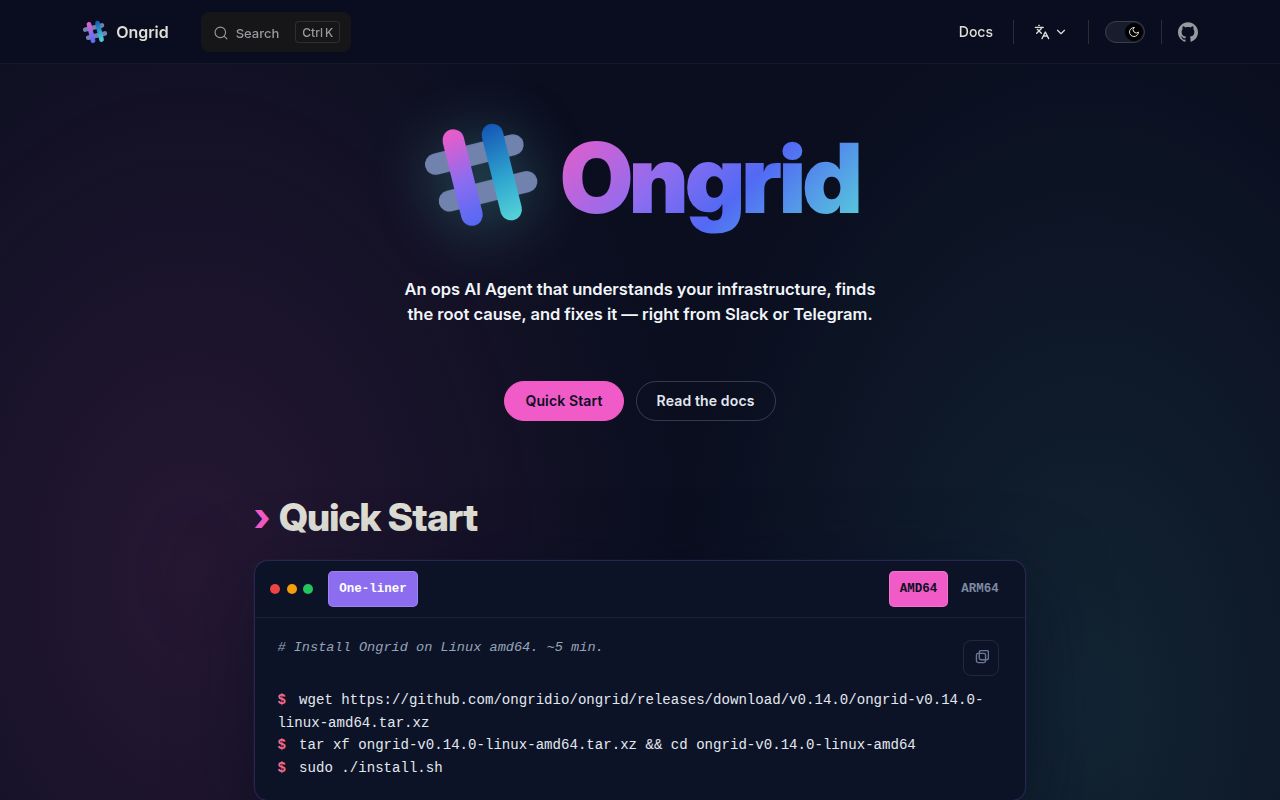
Release v0.14.0 provides AMD64 and ARM64 archives for Ubuntu 22.04 or newer, Debian 12 or newer, and RHEL or Rocky 9. The installer starts a multi-service stack. After first boot, operators still need a model provider, trusted certificates, chat-channel secrets, database and telemetry retention, backup tests, and Edge enrollment. Existing Prometheus, Loki, Tempo, Grafana, OpenTelemetry, and Qdrant services can be connected instead of duplicated.
Kubernetes lifecycle management is a product capability, but issue 278 asks for an official Helm chart to deploy Ongrid itself. Teams with a Kubernetes-only or GitOps-only platform standard should not confuse managing clusters with running the manager natively on one. The released installer path is the documented route today.
Issue 339 reports failed health checks when connecting self-hosted VictoriaLogs v1.49.0 and VictoriaTraces v0.8.0 because those services expose a different health route. Integration names do not prove compatibility with every proxy and version. Test health, queries, timestamps, tenancy, and authentication against the exact services already in your stack.
v0.14.0 is active, capable, and still pre-1.0
GitHub recorded 889 stars, 55 combined issues and pull requests, and a last push on August 26, 2026. Release v0.14.0 shipped one day earlier. The open queue includes fixes, feature work, and multilingual user reports, so 55 is not a bug count. The main README is English and links 8 additional translations.
Ongrid deserves a read-only pilot because 117 tests passed and its integrated evidence path could shorten real investigations. Its AGPLv3 license, large stack, Edge trust boundary, and current approval-bypass report demand more review than a chat bot. Connect one noncritical environment, compare conclusions with experienced operators, and enable no production write until a hostile-shell test suite passes.