Olares turns one machine into a managed personal cloud
Olares combines compute, storage, networking, identity, and applications behind a browser desktop. Files, Vault, Market, Dashboard, and Control Hub arrive as system apps. Other packages come through Olares Market. The platform can expose apps through private, public, or internal entrances and provides VPN-based remote access through Olares ID and LarePass. That is a much broader proposition than a container dashboard.
The base is Kubernetes, with components drawn from K3s, JuiceFS, MinIO, Envoy, Authelia, Infisical, Seafile, Dify, and many other projects. GPU management includes time slicing, memory slicing, and exclusive modes for AI or media jobs. Breadth is the reason to consider Olares and the source of its operating cost. A failure in storage, routing, or identity can affect several apps at once.
The minimum machine is 4 cores, 8 GB, and a 150 GB SSD
The Linux script supports Ubuntu 22.04 through 25.04 and Debian 12 or 13. It requires at least 4 CPU cores, 8 GB of available memory, and 150 GB of free SSD storage; installation fails on an HDD. Windows, macOS, Raspberry Pi, and virtual-machine paths have separate documentation. A GPU is optional, though local image, video, and larger language-model work will quickly make it relevant.
Installation begins with an Olares ID in LarePass, then the README offers curl -fsSL https://olares.sh | bash -. A web wizard or CLI completes activation. The result gets a browser address derived from the Olares ID. This is convenient, but security-conscious users should fetch and inspect an installer before piping it to a shell, then test account recovery and remote access before moving personal files.
What happened when we ran it
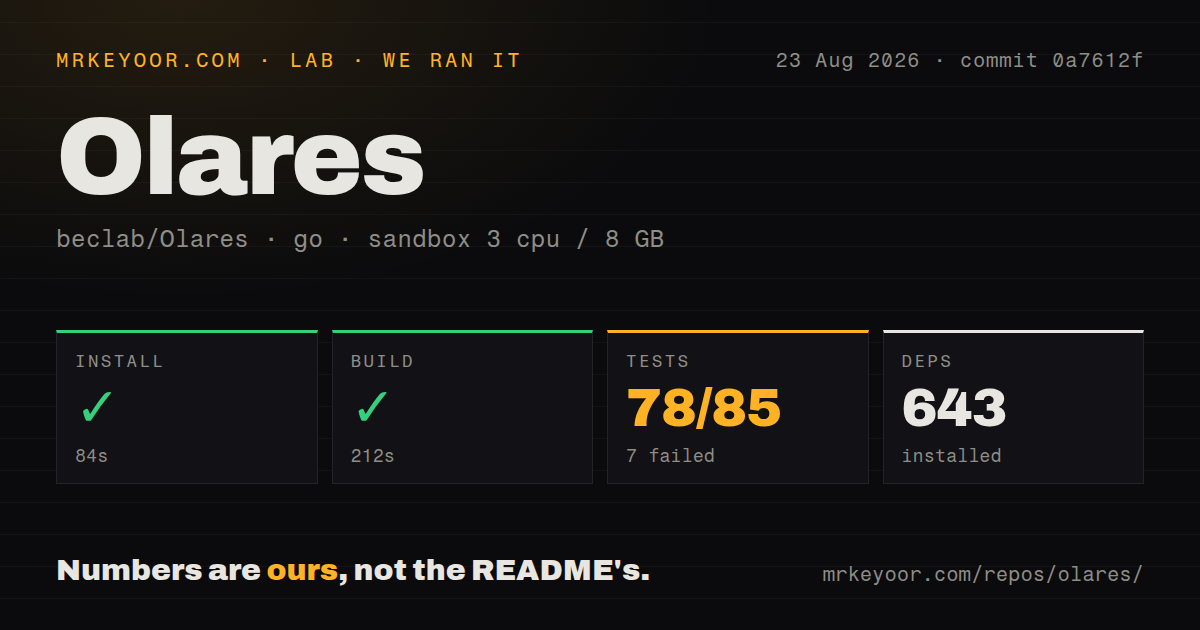
Our commit 0a7612f checkout contained 11,345 files, about 961,017 source lines, and 535.6 MB. The measured Go project lives in ./cli. Installing 643 packages took 84 seconds, and the build succeeded in 212 seconds inside an unprivileged Debian container with 3 CPUs, 8 GB of RAM, and no secrets.
The test command ran for 227 seconds and failed. Its summary counted 78 passing and 7 failing groups out of 85. The provided tail shows the Go test runner stack and ends with failure in github.com/beclab/Olares/cli/pkg/web5/vc; neighboring packages such as whoami, wizard, and skills passed. The initiating error is absent from the supplied lines, so we cannot name a cause. The repository scan found 51 CI workflow files, no Dockerfile, and no tests directory.
A passing CLI build does not validate the installed cloud
Our 212-second build says the measured CLI compiled in a clean container. We did not execute the remote installer, initialize Kubernetes, provision JuiceFS or MinIO, create an Olares ID, attach storage, expose an app, or download a model. Those are the decisions that determine whether Olares is dependable on a particular machine. The failed CLI suite adds a reason to reproduce source checks before contributing or pinning an upgrade.
A serious trial should cover a power loss, disk pressure, backup restoration, identity recovery, certificate renewal, and an app upgrade. GPU users should add model download, device scheduling, and memory contention. Small teams also need to test a second member account. An open August issue reported an empty desktop for a newly created member, which is directly relevant to anyone buying Olares for family or team use.
Integrated storage and access beat a pile of unrelated apps
The appeal is coherence. The Files app can combine local storage, synchronized data, cloud connections, and SMB or NFS shares. Backups are configured from the same environment. Private networking and reverse proxy behavior give applications HTTPS endpoints without a separate port-forwarding ritual for each service. Olares ID and LarePass link login, VPN access, and file sync.
That shared layer can remove repeated setup across 10 or 20 self-hosted apps. It also means the operator must understand which component owns the authoritative copy of data, how a route is authenticated, and what a backup captures. Recent issue reports included control-plane freezes tied to JuiceFS scans and a circular JuiceFS and MinIO dependency during an LLM install. These reports do not prove every deployment fails, but they identify recovery cases worth reproducing before migration.
Local AI is useful when the hardware and models are yours
Olares Market can install AI apps and models, and the platform presents GPUs to workloads through shared or exclusive modes. The README names local chat, image and video generation, audio transcription, agent automation, and app development as target uses. OpenClaw is one documented personal-agent path. Agent Skills also let an AI operate Olares through the CLI.
Privacy claims still depend on configuration. Local inference keeps model requests on owned hardware only when the chosen app, model provider, and integrations do the same. Public entrances, connected cloud storage, remote access, and third-party apps each create their own data paths. Review permissions and outbound traffic per app. The 150 GB minimum also leaves less room than it sounds once model weights, media, snapshots, and backups share a disk.
August activity is strong, while operations remain demanding
GitHub showed a last push on August 26, 2026 and 143 combined issues and pull requests. Release 1.12.6 was published on July 16. Current work covered staged cluster upgrades and documentation for routing and multi-node setups. Open reports included an installation stuck at 94 percent, storage-related control-plane freezes, member desktop errors, and Studio compatibility with 1.12.6.
The project is active, licensed AGPL-3.0, and supported by English, Chinese, and Japanese READMEs plus a larger documentation site, Discord, and forum. That is enough to justify a controlled evaluation. Keep the first system disposable, pin the chosen release, and prove restore and upgrade behavior with your own 150 GB or larger SSD before trusting Olares with the only copy of anything.