What this project is trying to fix
oh-story-claudecode starts from a sensible observation: asking an agent to "write a novel" is not a workflow. Long fiction needs market research, structural analysis, outlines, chapter production, continuity checks, revision, and persistent project state. This repository packages those jobs as 13 skills for long and short Chinese web fiction. The main documentation is Chinese, with an English README available, and its vocabulary is tied to commercial web-fiction practice: hooks, emotional payoff, pacing, popular-title analysis, and reusable plot modules.
The project supports Claude Code, Codex CLI, OpenCode, ZCode, OpenClaw, Reasonix, and generic file-aware agents, but support is not identical. Claude Code and Codex get specialist agents and hooks, while several other environments use solo or direct fallbacks. This is a coordinated set of instructions, state files, guards, and agent roles, not a model or standalone editor.
What happened when we ran it
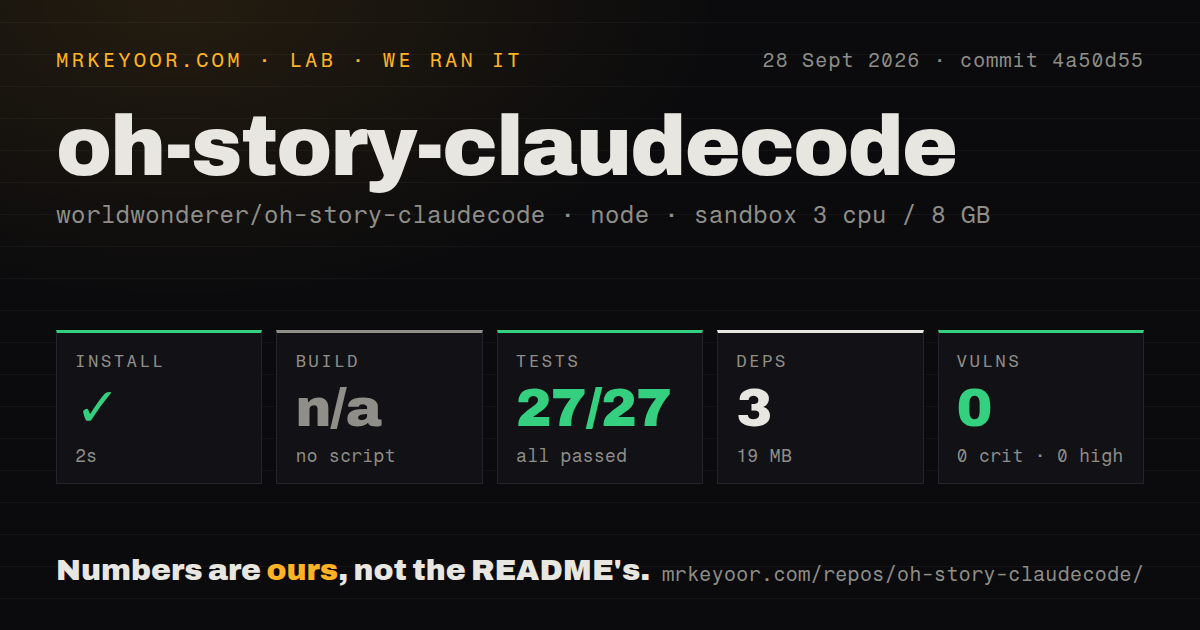
We cloned commit 9d0bd5f into a fresh unprivileged Debian container with 3 CPUs, 8 GB of RAM, Node 22, and no secrets. The repository contained 545 files, about 43,892 lines of source, and occupied 9.8 MB. npm installation succeeded in 10 seconds, installed 3 packages, and used 19 MB on disk. npm audit found zero known vulnerabilities.
There was no build script or build target, so the build was skipped. The test command exited 1 after 35 seconds, while node:test reported 26 passed and 0 failed out of 26. The final log listed Chromium dashboard cases covering CRLF and LF preservation, isolated carriage returns, directory navigation, deep-directory search, permission or mount errors, retry behavior, pagination, and opening an outline on mobile. It also listed the mobile Chromium version of that outline case. The log does not reveal why the overall command failed, so we cannot label it a product defect or missing package. The repository simply did not achieve a clean test-command result in our environment.
Where it is unusually strong
The best feature is domain specificity. Separate skills cover trend scanning, long-form and short-form analysis, writing, importing an existing novel, multi-perspective review, removing common AI-writing patterns, cover generation, and a local dashboard. The recommended sequence, setup, restart, import, then continue a named chapter, gives authors a concrete path instead of leaving them to invent file conventions.
The release notes show maintainers testing the workflow at its failure points. Version 0.7.6 addressed a writer agent that was required to count words without Bash access, a sentence-length report that could not be computed, and child-agent instructions that encouraged mechanical one-beat-per-paragraph prose. It added detection for outlines written too much like finished prose while preserving exact phrases that must recur, such as vows or system text. Those are specific operational problems, not cosmetic announcements.
State and safety receive similar attention. The README describes outline and tracking guards, version gates for deployed agent files, context-size reductions, and fallbacks when custom agents are unavailable. Platform sections cover Windows symlinks, session restarts, hook trust, missing capabilities, and stale skill copies. This is dense documentation, but it acknowledges the awkward edges users will hit.
Weaknesses and rough edges
The setup pitch is simpler than the complete setup reality. The global command may install the package quickly, but existing projects should run story-setup again after upgrades, accept generated configuration, inspect hooks, and open a new session. Some platforms cannot run the specialist agents or all lifecycle hooks. Generic and early-support paths lose parts of the orchestration, so "supports" can mean discovery plus fallback rather than feature parity.
The Chinese-first design is another boundary. English documentation helps, but the skill names, market references, output assumptions, and examples target Chinese web fiction. English-language novelists would need to translate editorial concepts and replace market-specific scanning targets. Nor is this a conventional writing application with a familiar editor, cloud collaboration, or publishing pipeline.
Agentic prose systems can enforce process without guaranteeing taste or consistency. Tracking files, reviewer roles, and pattern checks catch mechanical failures, but cannot decide whether a character feels alive. Authors should review every chapter, use version control, and treat cover generation and web scanning as separate permission concerns.
Community health and maintenance
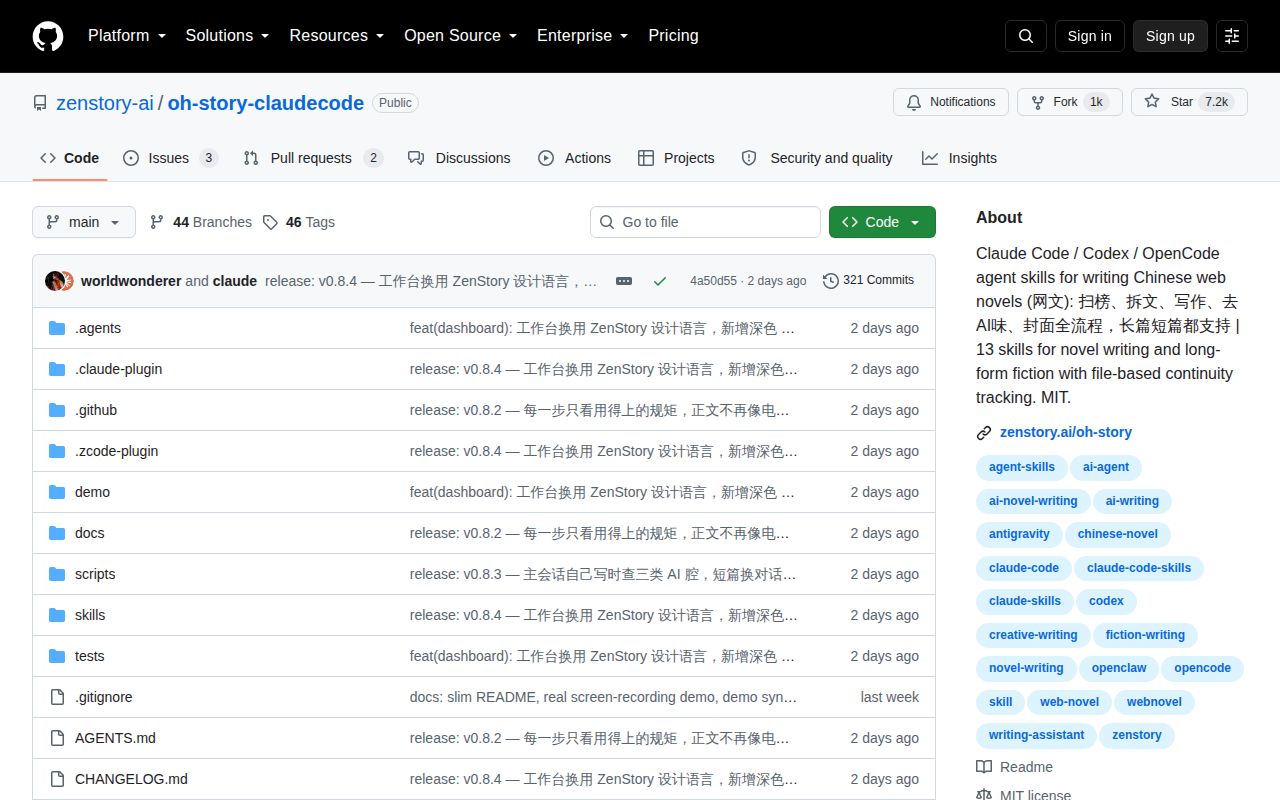
The repository has 5,967 stars and 8 open issues, suggesting substantial interest without an overloaded tracker. Release v0.7.6 arrived on August 13, 2026, and the repository was pushed again on August 22. Five CI workflow files and a tests directory support the impression of active engineering. Stars are not proof of satisfied authors, and the supplied community evidence contains only a GitHub Trending mention, so broad production adoption is unproven. Still, recent activity plus detailed migration notes is healthy.
Where it fits in a real stack
Treat this as the workflow layer between an author and a supported coding agent. Keep the manuscript and project state in a private Git repository, install the skills, run story-setup for the chosen runtime, review generated hooks and configuration, then restart before testing story-review. Use the dashboard and specialist agents for planning and continuity, but keep final editorial decisions, backups, rights management, and publishing outside the system.
For Chinese web-fiction authors already comfortable with file-based agents, the project is worth a controlled pilot on a copy of an existing project or a short new work. For everyone else, its greatest value may be architectural: it demonstrates how to turn a vague creative request into staged, inspectable work. The failed overall test command means we would validate dashboard behavior locally before relying on it for a live manuscript, but the active maintenance and unusually concrete process design justify that effort.