The catalog helps you choose what to investigate
Choosing a security model starts with an awkward question: do you need it to explain a finding, call tools, or simply stop refusing legitimate research questions? Offensive-Security-AI-Models puts those differences into tables. Its English README groups security fine-tunes, general models with refusal behavior altered, and older models, then links to downloads. That's useful preparation for a shortlist. It leaves the actual model evaluation to you.
The catalog records base models, context limits, weight formats, and tool-calling support beside each other. A researcher can discard candidates that lack a needed interface without reading every model card first. The distinction between CyberPal's defensive focus and Cyber-Ornith's agent-oriented description is more useful than the umbrella word "uncensored." Those descriptions remain the catalog's account of upstream projects, rather than capabilities independently established by this review.
What happened when we ran it
We did not run Offensive-Security-AI-Models at commit eb221fb: our sandbox found no supported ecosystem, GitHub reported no language, and there was no Dockerfile. The lab context was an unprivileged Debian container with 3 CPUs and 8 GB of RAM, without secrets. There is no execution result to report. Treating the skipped run as either a successful deployment or a software failure would misrepresent the evidence.
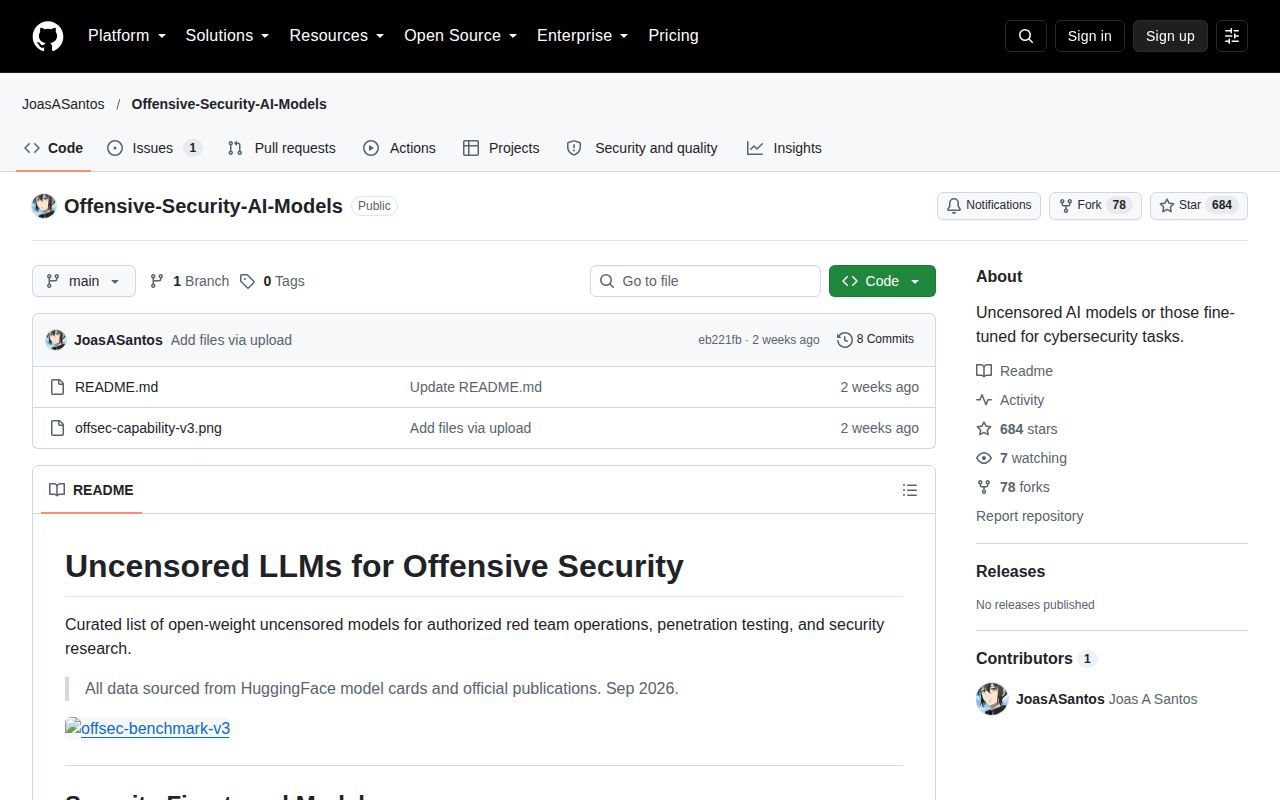
The repository tree explains the result: it contains the README and an accompanying image. There is no application entry point to exercise. Our harness could inspect a catalog, but that inspection cannot establish whether a linked model follows instructions or produces sound security analysis. The review therefore rests on the usefulness and limits of the document. None of the README's performance claims becomes a MrKeyoor benchmark by appearing here.
Tool support is a better filter than the uncensored label
The README explicitly marks tool calling as present for some entries and absent for others. That matters if your workflow needs an assistant to return a structured request for an external program. A model that can discuss a command is not automatically suitable for an agent that must invoke it. Check the linked model card and your chosen runtime's handling of that interface before treating the table's yes as an integration guarantee.
There are also materially different interventions under the catalog's labels. Its glossary distinguishes security-specific training from changes intended to remove refusal behavior. Those approaches answer different questions. Reduced refusal says little by itself about whether a model can interpret a suspicious log correctly. For an authorized assessment, I'd start with representative analysis tasks and review the answers against known evidence before attaching any action-taking tools.
Deployment instructions stop at a list of runtimes
The deployment section points to Ollama, llama.cpp, vLLM, SGLang, Transformers, and LM Studio. It doesn't provide a pinned environment that connects a particular model to a particular runtime. Download format and runtime compatibility remain decisions for the reader. Browsing the document needs no model-provider credential, while using a hosted service named in its cloud section introduces that provider's account and access requirements.
Our 3-CPU, 8-GB sandbox configuration is context for the skipped run, not a sizing recommendation for these models. The README includes both local deployment options and entries it describes as requiring multiple GPUs. Don't infer suitability for your workstation from inclusion in the same table. Verify the exact weight variant and its memory requirements upstream before downloading it or renting hardware. The catalog cannot make that purchasing decision for you.
The download links need a model-card check
The catalog's quick-reference table is convenient, but its rows aren't interchangeable purchase specifications. One entry describes a modular overlay that must be applied to existing base weights, while another links to a base model and mentions community variants. Clicking a download link therefore doesn't always yield the complete, modified model suggested by a quick scan of the name. Read the deployment notes attached to that exact artifact.
Licensing needs the same care. The tables mix Apache, MIT, Llama, and other model licenses, while GitHub does not identify a repository license. A license label beside a model doesn't grant blanket permission for the entire collection or every linked artifact. Teams that need redistribution clearance should inspect each upstream license directly. The README's authorized-research restriction also belongs in the decision, rather than disappearing behind its provocative title.
September activity supports a reading list, not a service commitment
GitHub records the last push as September 28, 2026, with 684 stars and one open issue and PR combined. The visible issue was updated October 15, but has no description that would establish a specific defect or maintainer response. The latest-release endpoint returns no published release. Together, those facts describe a recently updated reference with limited visible discussion. They do not establish abandonment or a dependable support channel.
If you already know which weights you want, go directly to llama.cpp for its inference implementation or Ollama for its local model-running workflow. Both address execution rather than model discovery. Keep this catalog bookmarked when you need candidates to investigate, and close it once you've picked them. The next decision belongs to the exact model card and the workload you can verify.