Eight work areas sit behind one self-hosted login
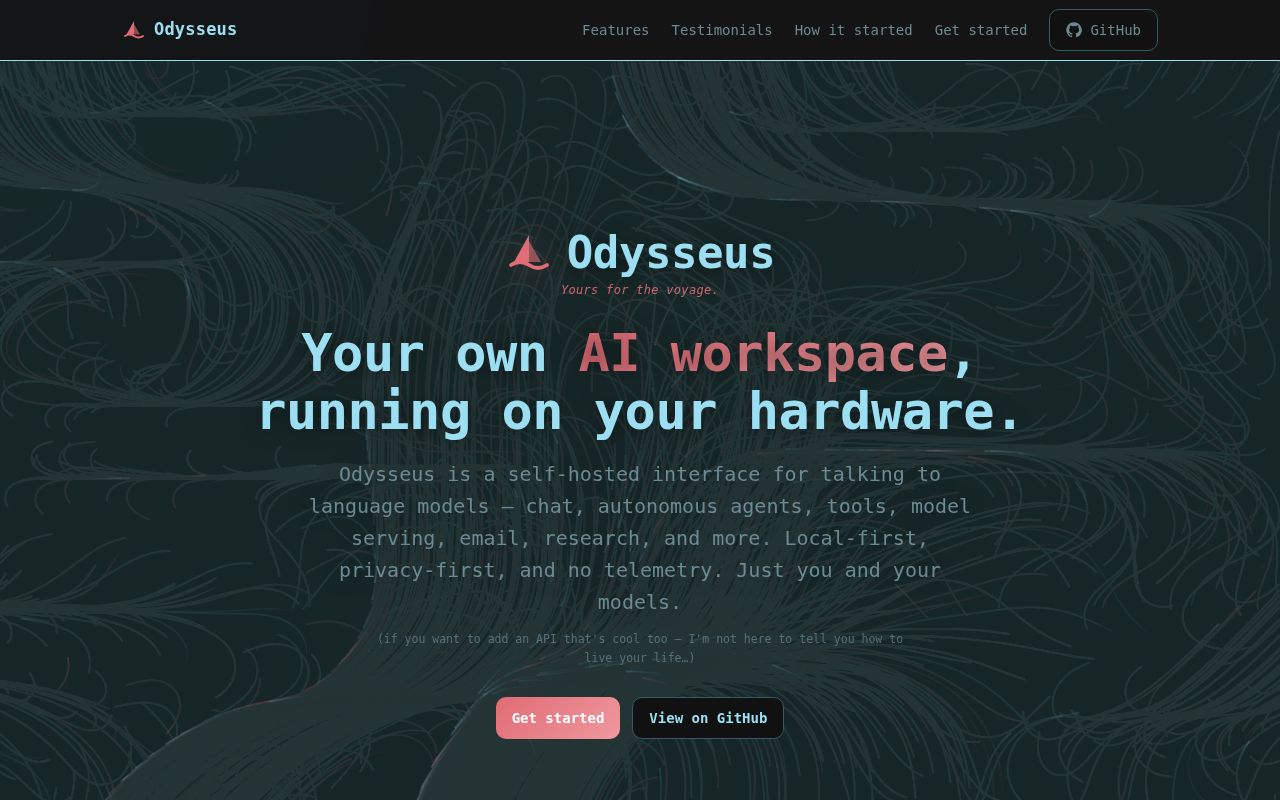
Odysseus tries to replace a row of separate tabs. Its browser interface covers chat and agents, model downloads, deep research, model comparison, documents, email, personal planning, and media extras. Agents can use files, shell access, skills, memory, and MCP tools. That mix is attractive when your AI assistant should work with the same notes and calendar you use, rather than live in a chat box with no surrounding context.
The scope is physical in the repository. Our commit 2992bf6 checkout had 1,573 files, about 416,095 lines of source, and occupied 35.4 MB before installation. The code is primarily Python even though a small npm manifest is present. Odysseus includes a web app, a companion client, platform launchers, Compose variants, 11 CI workflow files, a Dockerfile, and a tests directory. This is a young product with the surface area of several products.
Four Compose services make the quick start a real deployment
The recommended command starts Odysseus alongside ChromaDB, SearXNG, and ntfy. ChromaDB handles vector storage, SearXNG supplies web search, and ntfy supports notifications. Persistent mounts hold the app database, logs, model cache, locally installed serving tools, and an SSH identity for remote model hosts. The default web bind is loopback on port 7000, which is a good boundary for a machine holding email, documents, and agent tools.
Local models add another layer. Docker on Apple Silicon cannot use Metal, so the setup guide directs GPU users there to a native launch path. NVIDIA and AMD hosts use different Compose overlays and still need working host runtimes. The Cookbook can also reach remote machines over SSH. None of that was covered by our 8-second npm install, and model size, GPU memory, or inference speed were not measured in our sandbox.
What happened when we ran it
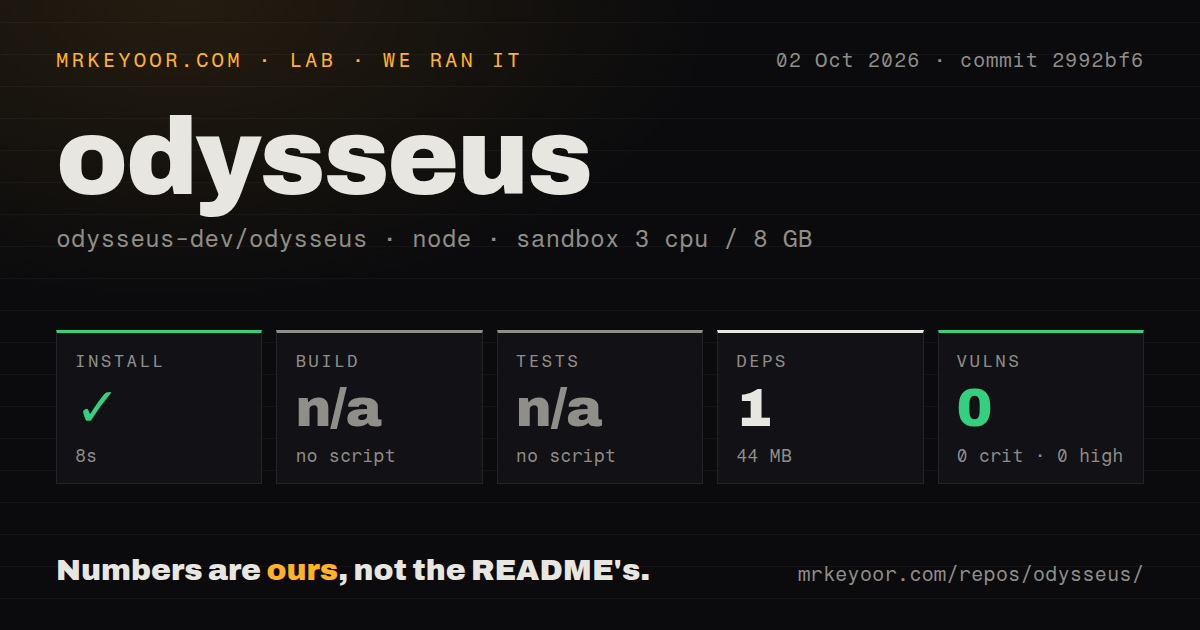
Our sandbox installed commit 2992bf6 in 8 seconds. Npm added 1 package and used 44 MB on disk. The fresh Debian container had 3 CPUs, 8 GB of RAM, no secrets, and no elevated privileges. Npm audit found 0 known vulnerabilities. The checkout included a Dockerfile, a Compose file, 11 CI workflow files, and a tests directory.
There was no npm build script or target, so the build step was skipped. There was also no npm test script or target, so the test step was skipped. Those are not passing build and test results. The measured npm path did not install the Python requirements, build the container, start any of the 4 services, download a model, or exercise the supplied test directory. A clean npm audit covers only the 1 package that npm installed.
This result exposes a mismatch in automated setup checks: npm is present, but it is not the application stack. A useful Odysseus acceptance run would need Docker or Python, a healthy login, and checks for the exact model and integrations you plan to use. We did not perform that run, so there is no honest claim to make about startup time, test coverage, research quality, email sync, or local inference.
The roadmap says fresh installs and integrations still need proof
The project's own roadmap is candid. High-priority work includes fresh-install smoke tests across Linux, macOS, Windows, Docker, native Python, and WSL. It also asks contributors to check whether integrations work and to improve Cookbook reliability across machines, GPUs, drivers, shells, and Python environments. That wording matters more than the long feature list if you are choosing software for daily use.
Small local models face a named limitation too. The roadmap says tool schemas, skills, memory, documents, and instructions can consume the context before a user's request on 4k, 8k, and 16k windows. The proposed work is to shrink prompts and choose fewer tools. Until that is proven, the widest agent configuration may give a small model less room to solve the task that triggered it.
Authentication protects tools that can reach beyond chat
Odysseus creates an admin account on first setup and prints a temporary password. The docs tell operators to keep authentication enabled for any network-accessible deployment, leave the localhost bypass disabled, and avoid exposing raw service ports. Those instructions fit the risk: an agent may access files and a shell, while email and calendar connections bring private credentials and data into the same workspace.
Host Docker control stays off by default. Enabling the optional socket overlay gives the container broad power over the host Docker daemon, which the setup guide calls high trust. Production users also need an immutable image tag because latest and plain version tags move. GitHub showed no published latest release on October 2, 2026, so the branch and image pin become the release decision.
An October 2 push shows activity, while 1,311 open items show churn
GitHub showed 88,405 stars and 1,311 combined issues and pull requests on October 2, 2026. The repository was pushed that day, and recently updated issues covered provider setup, GPU detection, deep research, email, and packaging. That is active development and active triage. The size of the queue also makes it important to search your chosen provider, operating system, and hardware before committing data to the workspace.
Odysseus is easiest to recommend as an ambitious private lab. Its AGPL-3.0-or-later code gives a self-hoster an unusual amount to try under one roof, and the documentation calls out several sharp edges plainly. For a dependable daily system, pin the code, back up the data directory, and prove each required integration. The deciding evidence will come from that deployment, because our npm-only run never reached the application.