This is Obsidian's distribution hub, not its source code
The decisive fact about obsidianmd/obsidian-releases is stated in its README: Obsidian is not open-source software, and this repository does not contain the application's source. It hosts public releases and the directories for community plugins and themes. That makes it important infrastructure, but a poor destination for anyone seeking a notes app to compile, fork, or audit end to end. Its 21,212 stars measure attention, not access to core implementation or permission to reuse it.
Created in 2020 according to the supplied community item, the repository connects Obsidian's proprietary application to contributor-built extensions. Plugin and theme authors submit metadata here so their work can appear inside Obsidian. The README links separate submission guides and developer policies. It also draws a clear support boundary: plugin problems belong in each plugin's repository, while questions about core Obsidian go to the community forum.
The delivery contract is specific enough to be useful
The README maps the plugin retrieval path in concrete terms. Obsidian reads community-plugins.json, searches the name, author, and description, then fetches a plugin's manifest.json and README for its detail page. During installation it downloads manifest.json, main.js, and styles.css when present. Those 3 possible files tell authors what users actually receive and help explain why a valid catalog entry alone is not a complete release.
Compatibility rules are equally direct. A repository's manifest identifies the latest version, while versions.json lets Obsidian select an older compatible release when required. GitHub release tags must exactly match the version in manifest.json. A plugin can therefore contain working code but remain uninstallable when its tag, manifest, or assets disagree. This 2-file metadata relationship makes the README best treated as a release checklist, not a guide to writing a plugin from scratch.
What happened when we ran it
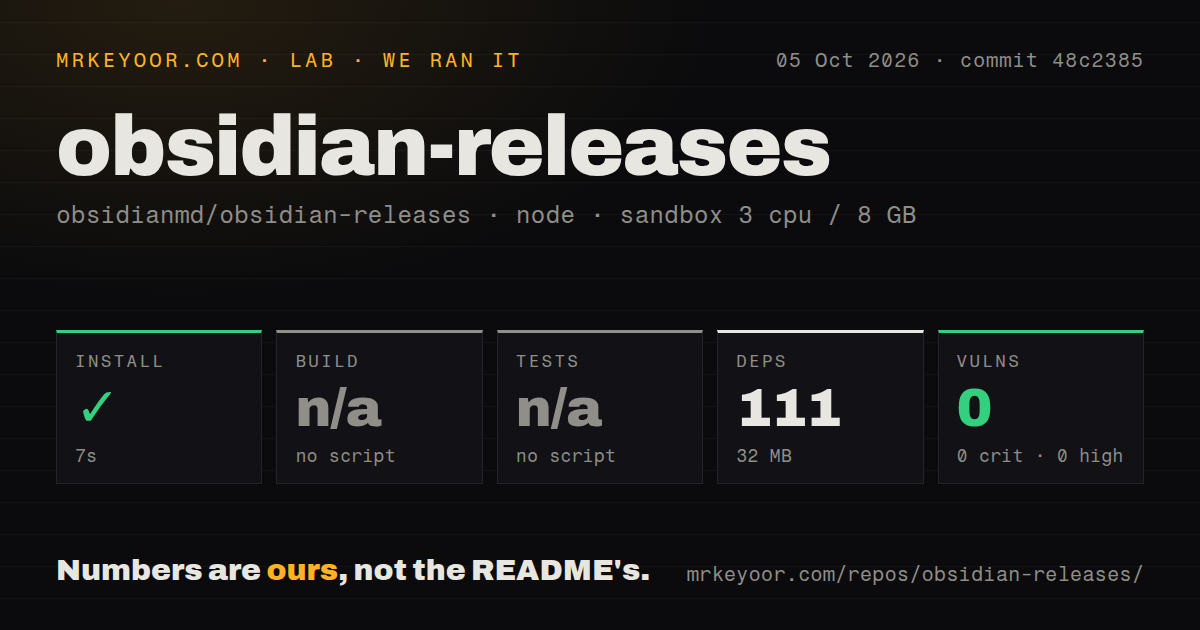
We cloned commit 32eff65 into an unprivileged Debian container with 3 CPUs and 8 GB of RAM. The checkout contained 19 files, occupied 5.6 MB, and had roughly 0 lines of source. The npm install step succeeded in 11 seconds, installing 111 packages and using 32 MB on disk. npm audit found 0 known vulnerabilities at critical, high, moderate, or low severity. These figures describe this catalog checkout only, not Obsidian or third-party plugins.
There was no build script or target, so we skipped the build rather than calling it successful. There was also no test script or target, so 0 tests ran. We found 2 CI workflow files, no Dockerfile, and no tests directory. On our box, dependency setup was straightforward, but there was no runnable application or conventional verification suite. Clone it to inspect catalogs and contribution plumbing, not to start a local Obsidian instance.
Clear scope is its biggest strength
The repository says what it owns and where other work belongs. Plugin and theme submissions have distinct documentation, policy requirements are linked, and installation behavior is described. Authors can announce a public beta through BRAT before official directory admission. After acceptance, they can use the forum showcase and Discord updates channel, although the README says Discord posting requires a developer role. Those 2 submission paths provide concrete operational guidance rather than a vague invitation to contribute.
The weak spots are expectation and verification gaps
The repository name and 21,212-star count may attract developers expecting Obsidian's implementation, but these files cannot answer questions about core architecture, privacy, or application security. The license is unknown in the supplied data, so reuse rights should not be assumed. The missing build target fits the catalog role, yet it prevents normal source-review checks from saying anything useful about the installed product. This is an index with release plumbing, not evidence about the quality of the editor.
External verification is thin too. With 0 tests run and no tests directory, our run cannot prove that every catalog entry resolves, every release contains its assets, or every compatibility fallback works. The clean npm audit covers only the 111 packages installed in this checkout. It says nothing about community plugin code fetched from separate repositories, and nothing about proprietary Obsidian code. Users assessing plugin risk must review those plugin projects individually.
Maintenance is active, but the issue count needs context
The repository was pushed on September 1, 2026, the day of this review, and the latest listed release was v1.13.8 from August 21, 2026. Those signals together indicate active maintenance. Only 4 issues are open, but the README says the repository does not accept issues and redirects support elsewhere, so the low count is policy, not proof of unusually fast responses. One recent tag also cannot establish a dependable long-term release cadence.
It belongs downstream of plugin development
In a real workflow, authors build and test plugins in their own repositories, publish GitHub releases tagged to match manifest.json, maintain versions.json for compatibility, and then submit directory metadata here. Obsidian reads that catalog and retrieves up to 3 installation files. This repository is therefore closer to a registry index and release-control point than a library, server, or framework. You consult its rules and contribute catalog changes; you do not deploy it as a notes backend.
Choose Joplin, Logseq, or SilverBullet if you need an open-source application you can modify. Choose this repository when you are committed to Obsidian's ecosystem and need the official path for shipping an extension. Its documented 3-file contract and version rules can decide whether users install your work. Use it as a directory, evaluate plugins in their own repositories, and judge Obsidian through product documentation and hands-on testing rather than mistaking this catalog for source evidence.