Version 1.0.27 supports three different sync models
Self-hosted LiveSync 1.0.27 can move an Obsidian vault through CouchDB, S3-compatible object storage, or WebRTC peer-to-peer connections. CouchDB keeps a central database and supports continuous replication. Object storage uses buckets such as Cloudflare R2 or another S3-compatible service. P2P avoids a central copy of the vault, although a signalling relay still introduces a discovery service. The choice changes where data rests, which credentials exist, and when another device must be awake.
All 3 paths demand more care than signing into a hosted sync account. The README tells users to back up every vault, disable Obsidian Sync and iCloud for the same files, and verify ordinary notes before enabling hidden-file or customisation sync. That sequence matters. A setup screen can initialise a new remote, overwrite an existing one, fetch remote data over local files, or keep extra local files. Read those choices as data operations, not onboarding decoration.
The 769-package checkout builds cleanly but exposes no test target
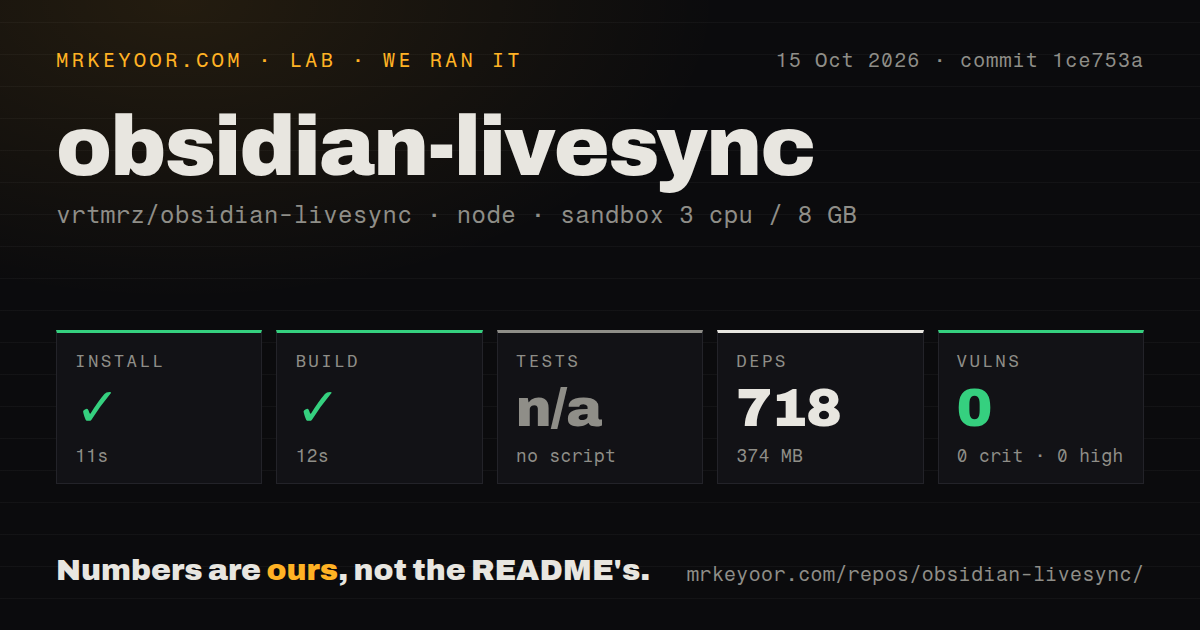
Our fresh Debian sandbox installed 769 npm packages in 13 seconds, occupying 388 MB. The build completed in another 18 seconds on 3 CPUs with 8 GB of RAM. Those numbers make contributor setup reasonable for a TypeScript project of this size. The checkout itself had 930 files, about 118,492 lines of source, and 13 MB before dependencies, so a small Obsidian plug-in download sits on top of a substantial development codebase.
The repository has 9 CI workflow files and a tests directory, yet its package scripts did not provide a tests target that our runner could invoke. We therefore skipped tests rather than treating the directory as proof of a passing suite. Npm audit found 0 known vulnerabilities in the installed tree. That is useful evidence for commit 35a8a4b, but it does not test conflict resolution, remote upgrades, or recovery with a real multi-device vault.
What happened when we ran it
Our run installed 769 packages in 13 seconds and built the checked-out commit in 18 seconds without an error. The dependency tree used 388 MB on disk. No test command was available, so the test step was skipped. The clean build says the source could be bundled in our stated Node 22 container; it says nothing about whether two devices will reconcile a difficult rename or survive a remote outage.
The sandbox used no secrets and did not connect to CouchDB, an object store, or the public P2P relay. It also did not exercise Obsidian itself. The 0-vulnerability audit result covers known advisories in the installed npm tree on September 7, 2026. Anyone adopting the plug-in should still trial the exact back end, device mix, vault size, and recovery steps they expect to use, because those parts sit outside a repository build.
CouchDB setup needs four connection values and two passphrases
The manual CouchDB guide asks for a complete URL, username, password, and database name. Mobile clients require HTTPS. A Setup URI packages encrypted connection settings, including credentials, and its passphrase is separate from the vault encryption passphrase. Sending the URI and its passphrase over different channels is sensible, but the better lesson is operational: whoever administers LiveSync is now responsible for database access, certificate renewal, credential rotation, and backup restoration.
Object storage substitutes an endpoint, bucket, region, access key, secret key, and optional prefix. The guide recommends a distinct prefix per sync set and says object storage is not a vault backup. On the first device, the safe procedure is to create 1 ordinary test note, let it upload, then check a second device in both directions before turning on optional file handling. That is slower than a login, and much safer than guessing which copy is authoritative.
P2P removes the central copy but still needs two online devices
In version 1.0.27, P2P transfers vault data through an encrypted WebRTC connection while using a Nostr-compatible relay for peer discovery. The project's public relay saves you from provisioning that part, or you can supply another relay. A remote peer must explicitly approve the connection. If direct WebRTC cannot cross the networks involved, the troubleshooting guide discusses TURN, which adds another service and another place to secure credentials.
P2P has a practical availability limit that cloud-backed sync does not: at least 1 device containing the needed data must be online while another receives it. That can work well between a laptop and phone used at the same time. It is a poor match for devices that rarely overlap or for an unattended machine expected to fetch changes overnight. LiveSync does not make peer availability disappear merely because no central vault copy exists.
September 7 brought 12,262 stars, a release, and active reports
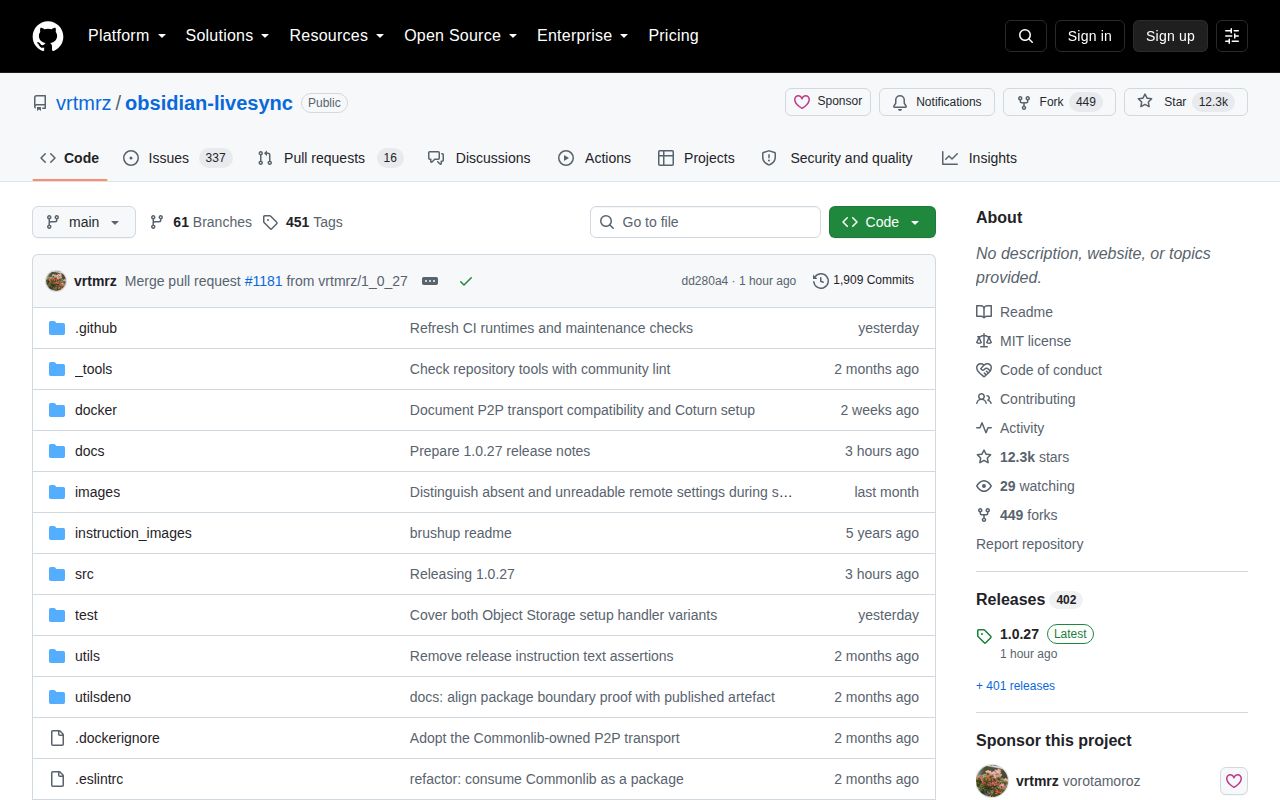
GitHub showed 12,262 stars, 449 forks, and 353 open issues and pull requests on September 7, 2026. A search limited to open issues returned 337 reports, so the queue is busy even after separating pull requests. The last push and release 1.0.27 both landed that day. Its release note fixes first-time object-storage setup when a custom HTTP handler is used against an empty remote, including a new Cloudflare R2 bucket.
Recent issue handling gives that large queue useful context. The maintainer said version 1.0.26 fixed an E2EE rebuild problem and object-storage startup sync; reporters were asked to retest, and the startup-sync reporter confirmed the correction. Another reporter confirmed that 1.0.26 stopped a case-only external folder rename from producing a deletion tombstone. Fast fixes are a good sign, but users should still read current release notes and test upgrades against a copied vault.