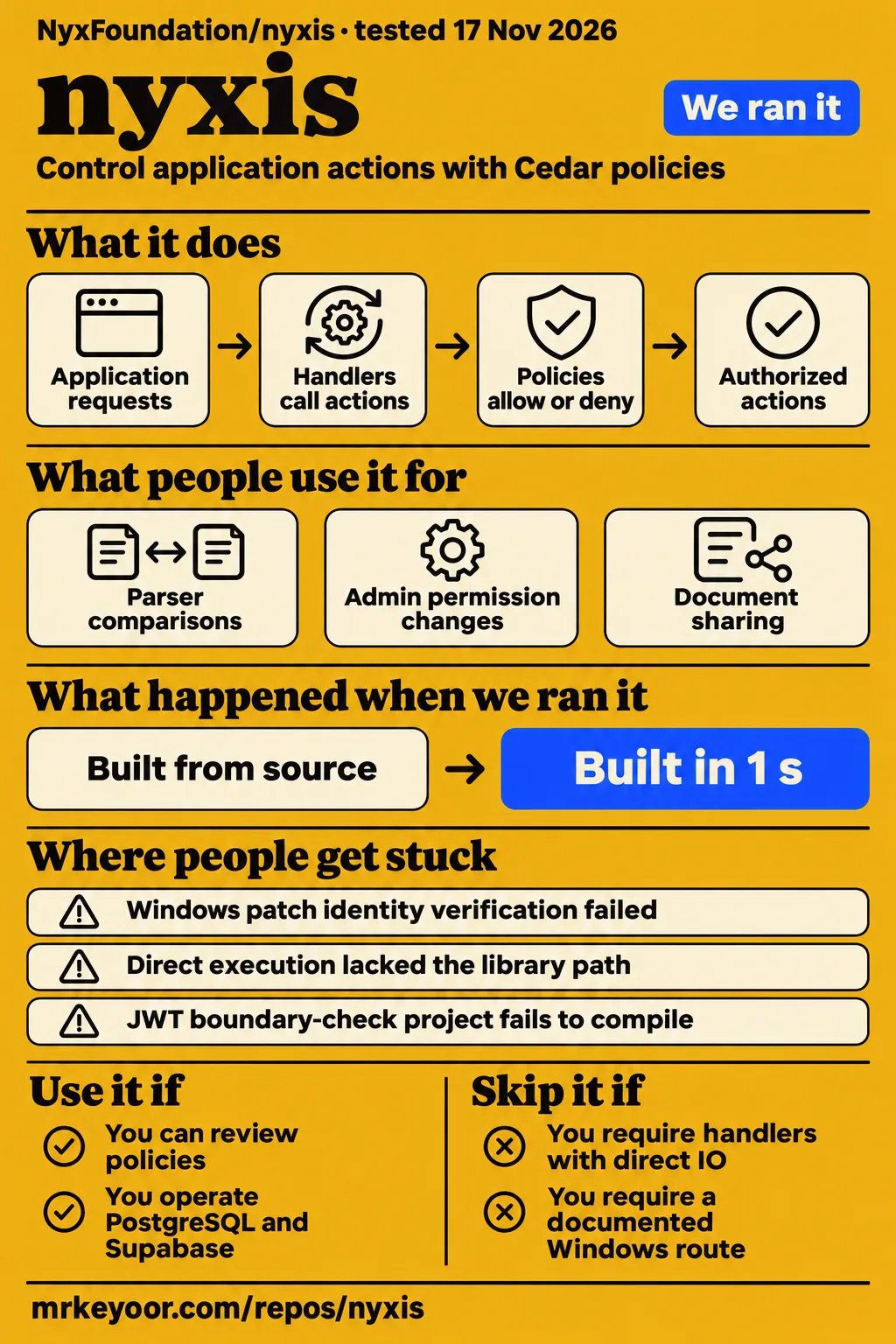
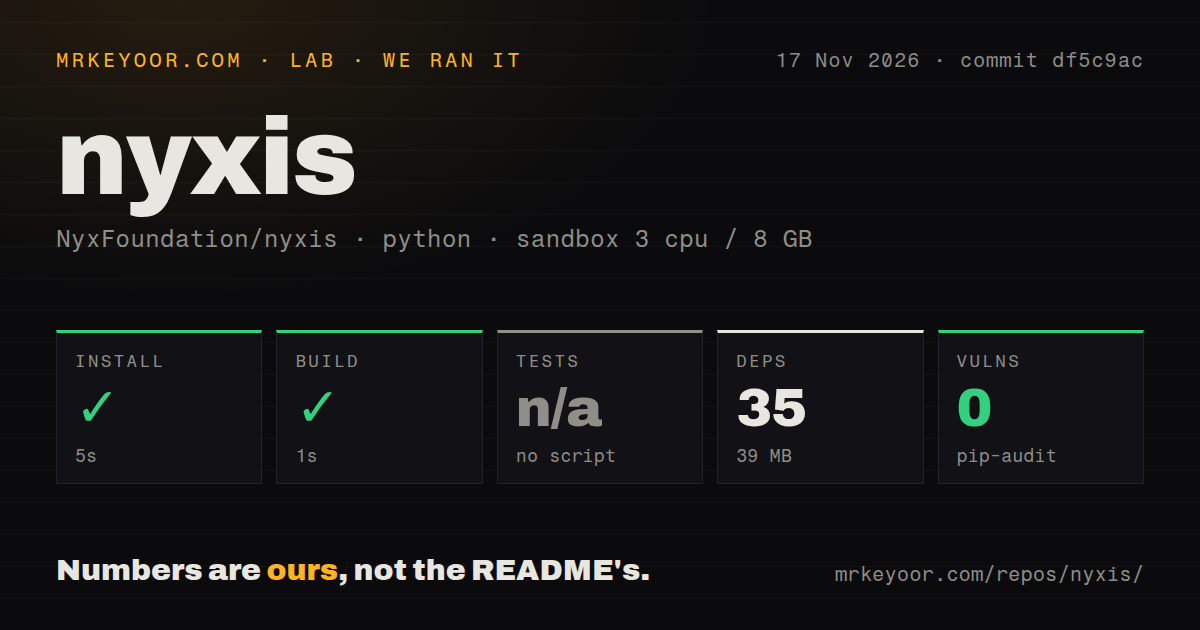
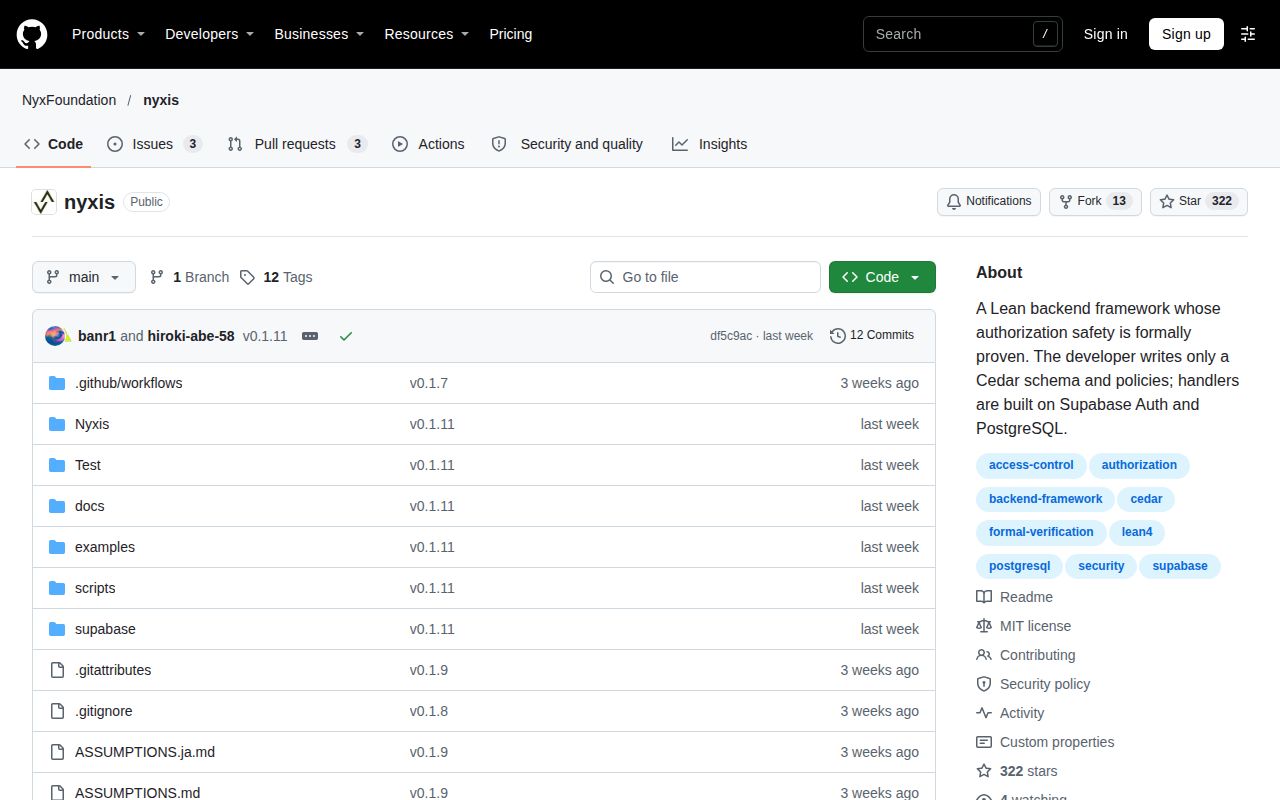
NyxFoundation/nyxis is a Lean backend framework whose handlers call Cedar-controlled authorization actions. Its README identifies v0.1.11 as under active development. Our sandbox recorded installation in 5 seconds and a build in 1 second at df5c9ac, with tests skipped. The adoption decision turns on whether your team wants this restricted handler model and can operate the documented Lean, PostgreSQL and Supabase stack. Nyxis README
What people use nyxis for
Nyxis's supplied use cases include parser comparisons, Linux integration checks and two official application samples. These records answer different questions: whether parsers agree, whether connected components execute, and how an application expresses permissions. The table keeps the actor attached to each result so a maintainer's sample and an issue reporter's checks retain their own evidential weight. Project samples
| Who used it | What they did | What the evidence shows |
|---|---|---|
| Issue #6 reporter | Compared Nyxis parsers with cedar-policy-cli 4.13.0 | Reported matching expressions and policy documents across roughly 20,000 random and handwritten cases, then identified a schema-comment discrepancy. The maintainer reports a v0.1.6 fix. Parser comparison |
| Issue #18 reporter | Exercised HTTP, JWT, PostgreSQL and sample startup paths on Ubuntu 24.04 aarch64 in Docker | Reported seven checks passing after setting the shared-library search path. The maintainer reports an embedded rpath fix in v0.1.4. Linux execution report |
| Project authors | Supplied a bulletin board with draft and published posts, Google OAuth and admin permission changes | The README describes a Next.js frontend for observing policy allow and deny behavior. Bulletin-board sample |
| Project authors | Supplied organization document sharing with roles, attachments, notifications and external API calls | The README describes a backend-only sample. Document-sharing sample |
| Issue #20 reporter | Attempted Windows dependency preparation and core-module compilation | Reported decoding and patch-identity failures, then module progress with a stub pkg-config. Native shim requirements remained a separate obstacle. Windows preparation report |
The bulletin board gives a developer concrete permission decisions to inspect: an author editing a post, an administrator changing access, and draft versus published content. The organization sample adds memberships, roles and external effects. Start with the workflow closest to your application, then read its schema and policies alongside the README's explanation of the authorization layer. These are project-authored examples rather than customer case studies. Official sample descriptions
What happened when we ran it
Our November 17, 2026 sandbox recorded installation in 5 seconds and a build in 1 second at commit df5c9ac; tests were skipped. The harness classified the repository as Python. Its scan recorded 236 files, approximately 7,247 source lines and 2.9 MB checked out. The README instead describes Lean core tests under Test/ and integration scripts under scripts/, making the scanner's classification consequential when interpreting the results.
| Recorded check | Result | How to read it |
|---|---|---|
| Install | Succeeded in 5 seconds | The harness recorded 35 dependencies and 39 MB on disk. |
| Build | Succeeded in 1 second | This is the recorded harness step outcome. |
| Tests | No test script or target found; skipped | The run recorded a skipped test step. |
| pip-audit | 0 known vulnerabilities | The audit scanned 35 packages under the Python classification. |
| Repository scan | 236 files, approximately 7,247 source lines, 2.9 MB checked out | These are repository scanner measurements. |
| Delivery signals | One CI workflow file, no Dockerfile, no tests directory detected | The README separately documents Test/ and integration scripts. |
The recorded sandbox configuration was 3 CPUs, 8 GB RAM and image label ghcr.io/astral-sh/uv:python3.12-bookworm. The separate deployment attempt failed its safety step because none of compose.yaml, compose.yml, docker-compose.yaml or docker-compose.yml existed. The runner required a Compose file for that route and labelled the repository unsafe on that basis. This was a runner prerequisite failure.
The run summary says the project was deployed with its own Docker Compose on November 17, 2026, with every port bound to 127.0.0.1. That statement conflicts with the failed prerequisite record. Teardown is recorded as successful. We classify the attempt as blocked because the supplied step record stops at the missing Compose file.
Where people get stuck: native linking and stale check fixtures
Issue reports distinguish Linux linking, direct executable startup and Windows dependency preparation. Their reported fixes span v0.1.2 through v0.1.6. Matching the failing step matters: a linker error occurs before an executable starts, a missing shared library stops direct startup, and an outdated fixture can fail a check even when its underlying dependency behaves correctly. Linux linking issue #17, startup issue #18, Windows issue #20
| Reported symptom | Reported cause | Recorded resolution |
|---|---|---|
| Linux linker errors mentioning glibc symbols | System library paths preceded Lean's sysroot | Maintainer reports linking libpq by its full path in v0.1.3. Issue #17 |
| Direct executable cannot load libcrypto_shim.so | Direct execution lacked the library path supplied by Lake | Maintainer reports embedded rpath support in v0.1.4. Issue #18 |
| Windows UnicodeDecodeError, then patch identity mismatch | Locale-dependent reads, followed by CRLF conversion of a pinned patch | UTF-8 mode addressed decoding; the supplied issue remains open. Issue #20 |
| PostgreSQL dependency check rejects decoded bytes | Fixture expected nyxis from hex that decoded to ricato | Maintainer reports a v0.1.2 fix. Issue #8 |
| Handler-effects check rejects the sample | Its word search matched the explanatory module comment | Maintainer reports removing the forbidden words from that comment in v0.1.2. Issue #12 |
| JWT boundary-check project fails to compile | Disposable project's HTTP API usage lagged behind the core | Maintainer reports updating it in v0.1.6. Issue #10 |
| Approved-declaration check fails | Startup fixtures lagged behind deployment fields, jobs and outbox changes | Maintainer reports updating fixtures in v0.1.6. Issue #14 |
Issue #18 is especially useful for deployment planning because the reporter distinguished lake exe from launching the binary directly. Lake supplied a library path; direct execution failed to locate libcrypto_shim.so. After setting LD_LIBRARY_PATH, the reporter exercised the connected paths successfully. The maintainer's embedded rpath change addresses that launcher difference. An application package also has to carry the link definitions described in the current README. Runtime-library report, application linking instructions
Issue #8 explains why compilation and execution deserve separate rows in a review. Its fixture passed bytes for ricato while expecting nyxis, so the assertion failed when the executable ran. Issue #10 describes a different coverage gap: a disposable project was outside the default build and used an obsolete HTTP API. Both reports identify executable checks that a successful default build could miss. PostgreSQL fixture, JWT boundary project
The authorization design makes policy approval your main job
Nyxis handlers call authorization-layer actions instead of performing IO or accessing the database directly. The README says developers approve a Cedar schema and policies, and the schema also defines tables and columns. Nyxis derives the principal from the JWT and the resource from the current database row. Those choices make the approved declarations central to reviewing an application's permission model. Handler design
The README's post-management policy permits an author or administrator to manage a post. That is a concrete review task: decide whether those are the intended actors, then inspect the declared actions and effects. An update effect can name its writable columns explicitly. The useful question for an evaluator is whether this declaration-oriented workflow makes the application's intended permissions easier for their team to inspect and maintain. Schema and policy examples
The assumptions document distinguishes the pure runtime model, proven connection code and trusted execution machinery. It explicitly trusts the pinned Lean toolchain, native libraries and unproven parts of the connection code. Reading those categories alongside the policy model gives an evaluator a more precise account of the architecture than the proof badge alone. The document also identifies developers and operators as trusted participants in correct use. Authorization assumptions
Security depends on services and configuration outside the theorem
The assumptions document places HTTP decoding, cryptographic internals, database semantics and parts of external-effect delivery outside the proven connection code. It describes a pure runtime model and names the components relied on to connect that model to actual requests and services. These are explicit parts of the project's security explanation, rather than a reason to read the README's authorization claim as an unconditional application guarantee. Trust categories
The documented environment includes a dedicated PostgreSQL role, Supabase Auth and a frontend that terminates TLS. The database assumption says rows change only through Nyxis-issued operations and are unreachable through the Data API, other roles or other applications. For an operator, that makes access paths and credentials part of the application design: independently writable tables would introduce a route outside the described runtime model. Cloud and runtime assumptions
English docs exist, but Japanese assumptions take precedence
The English assumptions document says the Japanese version is authoritative and that the project's checks run against it. The README supplies English and Japanese entry points, so English readers can begin with the requirements, architecture and official examples. For decisions about the security contract, the language-precedence notice is a specific instruction about which document controls when the two versions differ. Language-precedence notice
The supplied English assumptions describe identity verification via OAuth. The v0.1.11 release says the bulletin-board sample adds passwordless email sign-in alongside Google. The release describes both an emailed link and a one-time code, and says a first-time address becomes a new Auth user. These passages describe authentication in different terms; the final section records the unresolved reconciliation. Authentication assumption, v0.1.11 release
Nyxis vs Cedar and conventional web frameworks
Cedar is an authorization language and engine that applications call; Nyxis organizes backend handlers around authorized actions. Cedar's README also describes validating policies against a declared schema. That makes Cedar an alternative for a team retaining its own application architecture, while Nyxis asks the team to adopt its handler boundary and supporting stack. Cedar architecture, Nyxis architecture
| Approach | What it supplies | Pick it when |
|---|---|---|
| Nyxis | Handlers restricted to authorization-layer actions, with approved Cedar schema and policies | You want to evaluate a backend organized around that restriction. Nyxis README |
| Cedar in your application | An authorization engine called by application code and a schema-based validator | You want Cedar policy decisions within an architecture you already own. Cedar README |
| Conventional handlers with direct IO or database access | The contrasting handler model identified by Nyxis's restriction | Your application requires handlers to perform those operations directly. Nyxis handler restrictions |
| Django | A high-level Python web framework with installation, tutorial and deployment documentation | A conventional Python framework fits the application you intend to build. Django README |
Django's supplied README gives a conventional learning route: installation instructions, tutorials, deployment guidance and topical documentation. Cedar's README explains policy integration into an application. Nyxis's README explains a restricted action interface and application-specific linking and approval declarations. Choose according to the responsibilities your team wants to own; the supplied sources describe different architectural starting points. Django documentation route, Cedar integration, Nyxis integration
What the other reviews get wrong
The supplied evidence establishes a historical README badge error, rather than an error in an identified backend review. Issue #4 reports badges still showing v0.1.0 while other declarations said v0.1.1; the maintainer reports a correction in v0.1.2. The current supplied README identifies v0.1.11. Treat the mismatch as a historical documentation defect when reading an older screenshot or copied description. Historical badge report, current supplied README
Historical fixes and similarly named projects
NyxFoundation/nyxis and nyxis-io/nyxis are separate software projects. The first is the MIT-licensed Lean backend reviewed here; the latter's repository is the open core for the NXS format. Search results also contain a night-routine supplement and medical dictionary usage. Keep the GitHub owner in technical searches so licensing, product claims and benchmarks remain attached to the project that supplied them. Backend identity, NXS repository, supplement result
FAQ
NyxFoundation/nyxis is the Lean backend framework discussed here, rather than the similarly named serialization project. The supplied search suggestions include nyxis meaning, nyxis switch 2 and nyxis 3 ultra, which makes the repository owner useful context. The technical questions below come from the supplied synthesis and issue reports, with historical fixes kept attached to their reported versions. Search suggestions, backend README
What is Nyxis, and which project does the name refer to?
Nyxis here means NyxFoundation's Lean backend framework using Cedar policies and Supabase Auth. The separate nyxis-io repository describes a serialization format. Use the full owner and repository name when finding setup instructions, licensing or examples. The backend README's official samples are a bulletin board and organization document sharing, which also help identify the intended project. Backend README, serialization project
Why does the schema parser interpret a comment followed by CR differently from Cedar?
Issue #6 reports that the schema tokenizer ended line comments at LF, while Cedar also ended them at CR. The maintainer reports a v0.1.6 correction. The consequence was an interpretation difference: both parsers could accept the same document while reading different schemas. This is why the issue belongs to the correspondence between an approved source file and the schema actually used. Schema parser report
Why does lake build fail on Linux with glibc linker errors?
Issue #17 attributes its Linux linker failure to a system library directory preceding Lean's sysroot. The maintainer reports a v0.1.3 change linking libpq by its full path. For application packages, the supplied README also says link arguments do not propagate from Nyxis and instructs developers to copy the relevant definitions into their own lakefile. Linker report, application link instructions
Why can Linux executables not find libcrypto_shim.so when run directly?
Issue #18 reports that Lake supplied a library path that direct executable launch lacked. The maintainer reports embedding the runtime search path in v0.1.4. This question concerns startup after linking, so match it to a missing shared-library diagnostic rather than the glibc linker failure in issue #17. The current README describes the corresponding application link definitions. Executable startup report, link definitions
Why does prepare-dependencies.py fail on Windows with encoding or patch identity errors?
Issue #20 reports locale decoding first, followed by a patch-identity mismatch after CRLF conversion. UTF-8 mode addressed the first failure only. The supplied report separately describes progress building modules with a stub pkg-config and outstanding native requirements. Follow that sequence when interpreting the report: dependency text decoding, patch identity and native linking are distinct preparation tasks. Windows dependency report
What we have not tested yet
The Python-classified harness supplies recorded install, build and audit outcomes, rather than evidence of an exercised Lean application. Raw toolchain logs are needed to identify actual runtime versions and what the successful build step executed; the image label supplies configuration only. The skipped tests supply no passing test count, and the Python audit does not assess native dependencies or the authorization proof boundary.
The Compose attempt stopped before an application session, despite its conflicting run-summary wording. We have not independently reproduced the parser comparison, Linux fixes or Windows module compilation. The supplied records also provide no measured throughput, concurrency, database-growth behavior, external-effect reliability or operating cost. A useful next run would use the documented native setup, launch the sample executable directly and record allowed and denied requests against the same policy.
The supplied English assumptions require identity verification via OAuth, while the v0.1.11 sample release adds passwordless email authentication. Their reconciliation remains unresolved in this evidence. The supplied extract does not support an instruction to disable email or phone authentication. Reading the English document is also not an independent proof audit or a reconciliation with the authoritative Japanese version. Assumptions, release authentication description
The adoption records supply official samples, reported checks and an organizational evaluation inquiry, with no named production deployment or independent performance comparison. The social and video records provide no attributable framework demonstration, and the pack contains no Reddit experience reports. Issue #33 asks about funding and development, intellectual-property and release authority; its supplied record provides no answer. Those questions establish an evaluator's information needs, rather than funder control or misconduct. Governance inquiry