The clean-only command deletes application folders
Antigravity Fixer's --clean-only mode can remove ~/.antigravity and platform-specific Antigravity application-data directories. The current cleaner calls shutil.rmtree without a backup or confirmation prompt. Before trying it because a login screen says your account is ineligible, understand what sits in those directories. A command described as clearing cache may erase state you intended to keep, even if it never asks for your Google password.
The repository is small enough to inspect: our checkout contained 12 files and roughly 1,000 lines of source, occupying 3.1 MB. Its purpose is narrow, combining credential removal with a guided route through Google verification and another login attempt. That can make a repetitive support procedure easier to follow. It does not establish that local state caused the eligibility failure in the first place.
What happened when we ran it
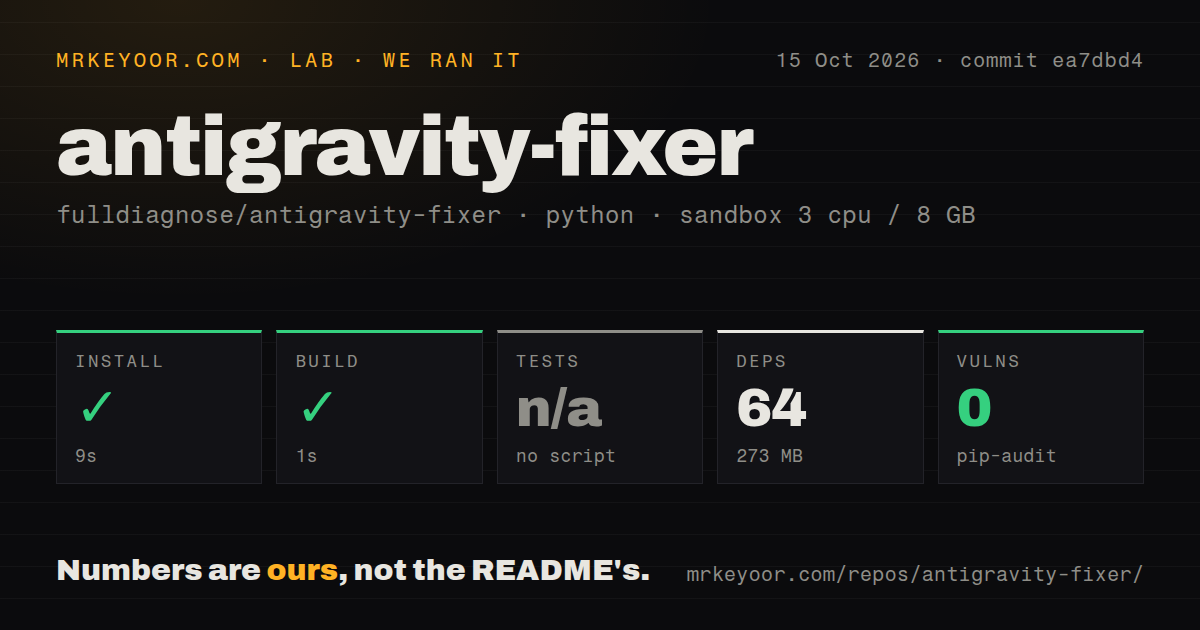
Our Antigravity Fixer run installed 64 packages in 9 seconds and completed its build in 1 second. We measured commit ea7dbd4 on October 15, 2026, in the uv Python 3.12 Bookworm image. The fresh Debian container had 3 CPUs, 8 GB of RAM, no secrets, and no elevated privileges. The installed environment occupied 273 MB on disk.
Tests were skipped because the harness found no script or target. Pip-audit reported 0 known vulnerabilities, and the lab scan found no CI workflow files, Dockerfile, or tests directory. These results establish a successful dependency and build path in that sandbox. They provide no evidence that a Google account became eligible, that browser authentication completed, or that a workstation retained its settings after cleanup.
The no-secrets condition is a hard boundary on what our run can show. Account diagnosis and permission revocation involve a real Google session, while the final login requires user action. Our 273 MB environment is the measured footprint of installation, not proof that the browser assets and desktop integrations required by every documented path work on a fresh machine.
English is available, but the default interaction is Indonesian
The interface defaults to Bahasa Indonesia and offers an English selection. The README is in English and explains prerequisites, cleanup, verification, and the final agy login. That is enough for an English-speaking developer to follow the intended sequence. The important dependency is an existing Antigravity installation: this helper repairs surrounding state rather than providing the editor or command-line client itself.
A 9-second install should not be confused with the time or effort to recover access. The interactive path requests a Google email and password, automates account pages, and asks the user to complete age verification. The README says passwords remain in memory and sessions are temporary. Those are project assurances, without an independent credential-handling assessment from our lab. You still choose whether to trust this code with your account.
The backup safeguard is still a proposal
Pull request 2's backup proposal addresses the same cleaner used by the published workflow. It describes IDE settings, extensions, workspace state, and chat history as data that may live in the deleted directories. The proposed fix would move folders to a backup location and ask before acting. The request remained open when checked, so those protections cannot be assumed to exist in the default branch.
Our build passed in 1 second, but build success cannot resolve that behavior. The source also uses process-name matching to stop Antigravity-related programs and operating-system tools to remove stored credentials. Some deletion errors are ignored while paths are still added to the reported removal list. Read a cleanup success message as the script's report, without assuming it proves that every requested deletion actually succeeded.
Verification cannot promise account eligibility
Issue 1's failed-recovery report says the user completed the steps, including selfie verification and the CLI authorization code, yet still received the eligibility error. That is a user report rather than a failure reproduced in our sandbox. It is enough to reject the README's broad promise that this procedure fixes the error for everyone. Account policy and stale local credentials are different possible constraints.
The measured checkout has no CI workflows or discovered test target to establish regression coverage for these paths. Browser automation also depends on Google's page structure, while credential cleanup uses different commands on Windows, macOS, and Linux. If your account's eligibility is uncertain, check the official account flow before repeatedly deleting state. Repeating the same cleanup does not provide new evidence about why access was denied.
Recent reports leave meaningful work unresolved
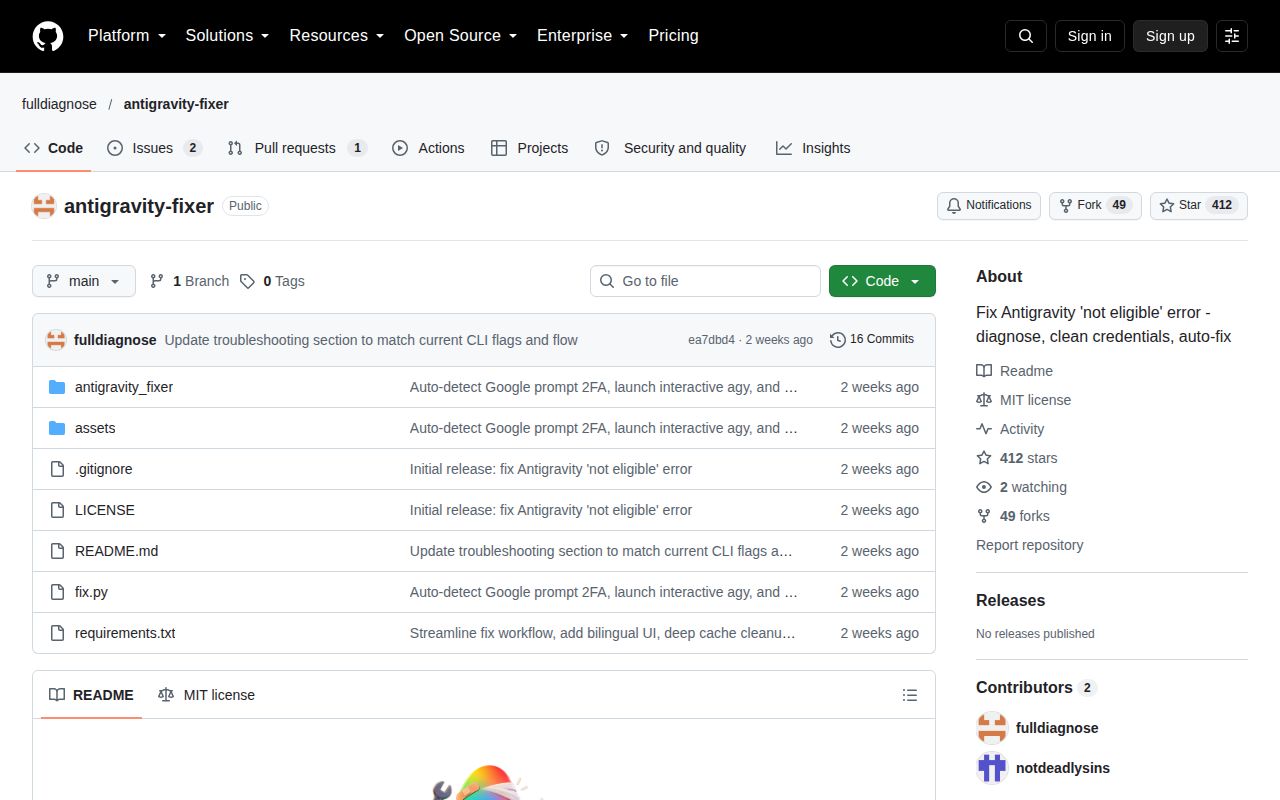
The last push was September 29, 2026. GitHub listed 412 stars and 3 open issues and PRs, with October activity that includes the backup proposal and a separate task-destruction report. There was no latest published release. Recent reports show people trying the tool, but an open safeguard proposal is a reason to inspect current behavior, not a reason to assume a fix is imminent.
If your immediate goal is to resume coding, OpenCode or Aider may offer another provider route. Neither repairs Antigravity eligibility. For the fixer itself, my requirement is simple: preserve the directories before using a command that removes them. An unresolved login problem is easier to investigate while your original editor state still exists.