Bazel pays off when one build graph crosses team boundaries
Bazel models source files, generated outputs, tests, tools, and external dependencies as a graph. It rebuilds the parts affected by an input change and can reuse results from local or remote caches. The same command structure can cover Java, C++, Android, iOS, Go, and other languages supplied by rule sets. This is most useful when those parts share a repository or CI system.
The scale is apparent in our checkout: 13,686 files, about 1,590,268 source lines, and 220.3 MB on disk. Bazel is itself a substantial platform, not a thin wrapper around compilers. Adopting it means choosing its target model, label syntax, dependency rules, configuration transitions, platforms, and toolchains as part of the repository's permanent design.
Incremental and remote builds require accurate declarations
Caching works because actions declare their inputs and outputs. When those declarations are complete, Bazel can avoid work and move execution to another machine without changing the requested target. When a custom rule reads an undeclared file or depends on ambient machine state, cached results can be wrong or remote execution can fail. The build language forces useful discipline, but teams still have to write correct rules.
Remote operation also becomes a service boundary. Bazel 9.2.0 includes changes to gRPC keepalive, parallel chunk transfer, non-gRPC cache handling, and recovery when remote outputs disappear. An open August 2026 report concerns missing path validation while parsing a cached action result. These details show why a remote cache is infrastructure with security, capacity, and compatibility work, rather than a URL added once to CI.
Starlark makes Bazel extensible without letting every rule execute arbitrary build-language code. Community rule sets cover many ecosystems, and organizations can write their own. The cost is another API surface to own. Language package managers still exist underneath, toolchains must be pinned, and incompatible flags can require migrations across many BUILD files.
What happened when we ran it
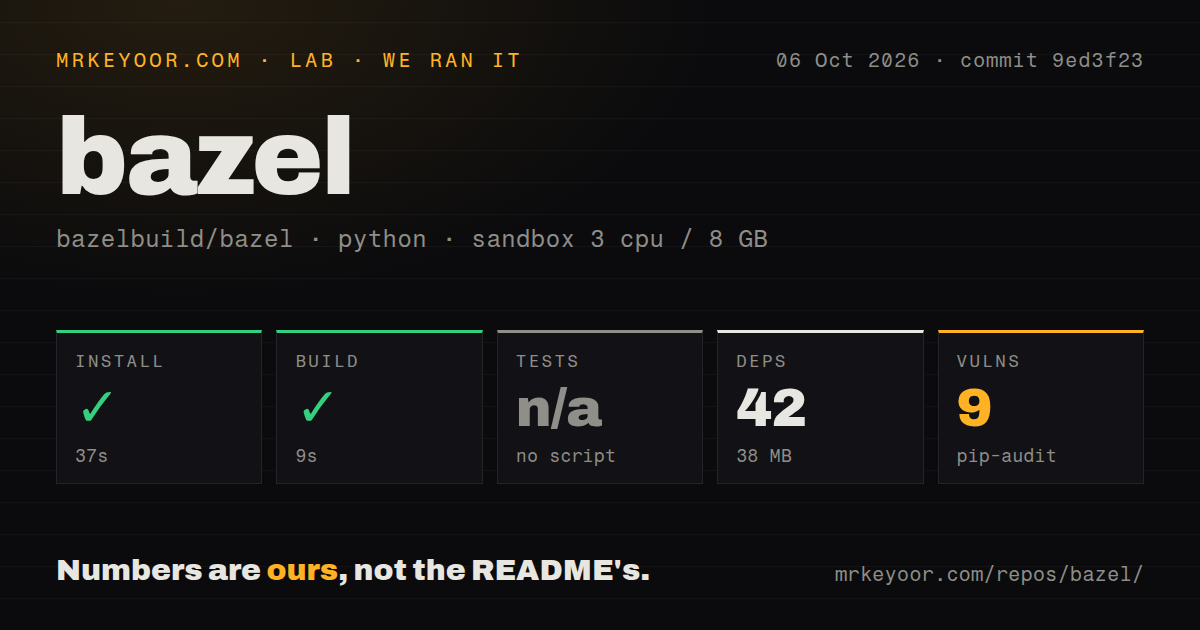
Our sandbox classified the checkout as Python, installed 40 packages in 30 seconds, and used 38 MB for those dependencies. Its chosen build step succeeded in 6 seconds. pip-audit reported 2 known vulnerabilities in the installed Python set. These are facts about the path selected by our generic harness, not a benchmark of compiling Bazel itself.
The harness found no test script or target and skipped testing. It also found no tests directory. Since GitHub identifies Java as the repository's primary language, the absence of a Python test target says little about Bazel's own test suite. We will not turn a skipped generic step into a claim that the main project is tested or untested.
We ran commit 609cb51 in a fresh Debian container with Python 3.12, 3 CPUs, 8 GB of RAM, no secrets, and no elevated privileges. The repository had 9 CI workflow files and no Dockerfile. A meaningful contributor assessment would need Bazel's documented bootstrap path and project-specific targets, which were outside this measured run.
The README explains the promise, while bazel.build holds the manual
The root README is only 2,380 bytes. It explains incremental builds, multiple languages, scaling, and extension rules, then links out to installation, tutorials, the command manual, query documentation, rule concepts, and the test encyclopedia. That is enough to identify the product but not enough to operate it or build it from source. Reviewers and contributors must use the external documentation.
For application teams, the first useful experiment should be narrow. Pick one representative target, model its dependencies, run it locally, and inspect whether changes invalidate the expected actions. Only then test shared caching. A monorepo migration that begins by rewriting every build file postpones the evidence needed to judge whether the graph and rule ecosystem fit.
Version management also deserves a policy. Release 9.2.0, published July 13, 2026, is a minor LTS release and says it is backward compatible with Bazel 9 starting at 9.0.1. Its notes also announce a future package-boundary restriction behind an incompatible flag. Pinning through Bazelisk and rehearsing flagged changes is safer than letting developer machines drift.
Active maintenance does not remove migration cost
GitHub recorded a push on August 25, 2026, and recent work spans local execution, Windows integration tests, remote caching, Java rules, and configuration behavior. The 1,924 open issues and pull requests are a combined count, not 1,924 confirmed bugs. They do show the size of the supported surface and the amount of coordination behind releases.
Bazel 9.2.0 fixes a CPU regression, Windows path and elevation problems, external repository cache errors, and several remote execution failures. That release history is evidence of active maintenance. It is also a warning against treating upgrades as routine package bumps, because changes touch build semantics and platform behavior. Large adopters need owners for release notes, incompatible flags, custom rules, and CI capacity.
Use Bazel for organizational scale, not fashion
Bazel makes sense when incremental correctness, cross-language targets, and shared remote work can save many engineers time. It can also give a large repository one queryable view of dependencies that separate native tools cannot provide. Apache 2.0 licensing and current upstream activity make long-term adoption plausible.
A smaller codebase may pay all of the setup cost without reaching that payoff. Native tools usually have simpler onboarding and deeper language conventions. Our run could build only a small Python-classified path in 6 seconds and found no test target, which is a useful reminder: evaluate Bazel on your actual dependency graph before making it the company standard.