Nuwa keeps the research behind a simulated perspective
Ask Nuwa to build a Feynman perspective and it saves the research alongside the instructions your agent will use. Its workflow separates authored work from interviews, outside criticism, and observed decisions. You can inspect how a claim became a rule for answering your question. That paper trail is the reason to consider Nuwa: a recognizable voice alone gives you little basis for deciding whether the answer deserves your trust.
The project is primarily Chinese, including its main skill instructions, although a substantial English README exists. The lab checkout contained 159 files and about 1,812 source lines, occupying 35.3 MB. Example research sits beside Python helpers and media. English readers can understand the premise without translation, but inspecting the actual extraction rules and many source notes means working through Chinese text. Decide whether you're willing to do that before adopting the workflow.
What happened when we ran it
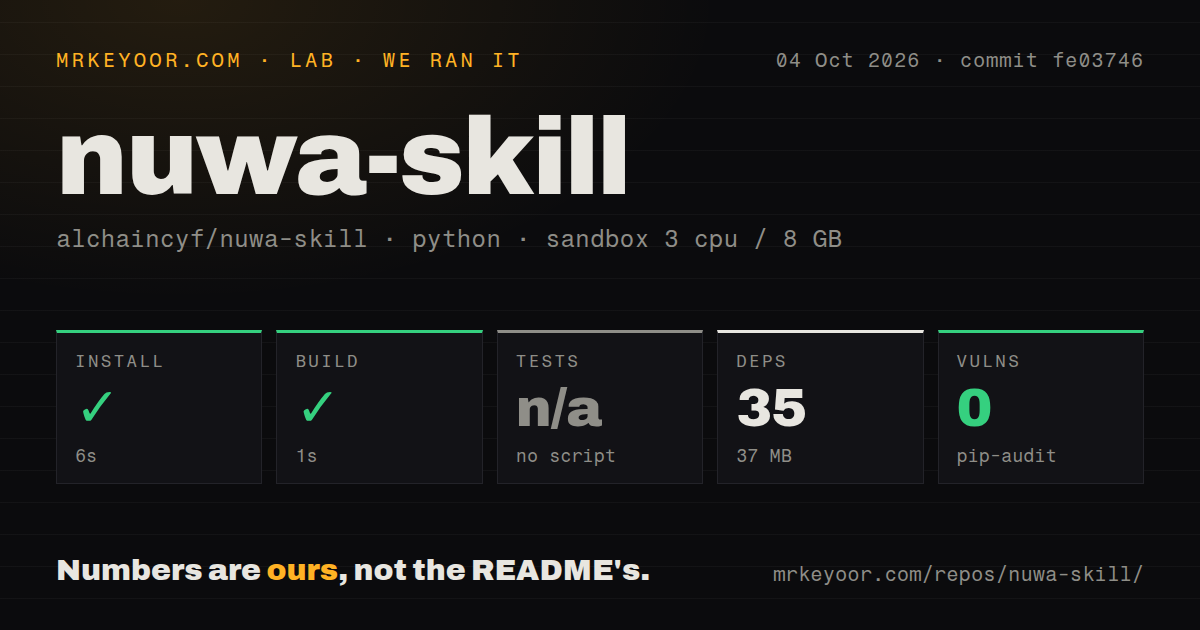
Our sandbox installed Nuwa at commit fe03746 in 6 seconds, adding 35 packages and occupying 37 MB on disk. The build succeeded in 1 second. We ran it on October 4, 2026, in an unprivileged Debian Bookworm container using the uv Python 3.12 image, with 3 CPUs, 8 GB of RAM, and no secrets. Both recorded steps succeeded, so basic repository setup was straightforward in that environment.
Pip-audit reported 0 known vulnerabilities. The lab found no tests script or target and skipped tests. Its scan also found 1 CI workflow file, no Dockerfile, and no tests directory. Those results establish a working setup and build, with a clear limit: the run provides no automated regression result. The measurements contain no generated-perspective accuracy, research duration, or model-spending result. None of those can be inferred from a successful build.
The research job depends on your agent and its tools
The main skill supports supplied documents, web research, or a mixture of both. It assigns separate research lanes and saves their findings under references/research/. You need an agent with model access, file-writing permissions, and working search or browsing tools for the web route. Nuwa names no mandatory hosted account of its own. Model credentials or a subscription belong to your chosen agent, and optional video-source work invokes yt-dlp.
The 6-second install tells you little about that research workload. Nuwa documents sequential fallback when parallel agents aren't supported and saving progress between sessions when context runs short. Portability also needs attention: the instructions create and scan .claude/skills/ despite advertising other runtimes. The English installation table points Hermes users to tools/install_hermes_skill.py, which is absent from the current repository tree. Confirm the output directory and discovery path in your own agent before starting source collection.
The quality checker can mistake formatting for missing evidence
Issue 77 concerns the actual check_primary_sources() helper. It reports that the heading expression crosses lines and reads the wrong source section. The current checker code uses re.DOTALL with a greedy heading match. Its source ratio counts words labeling primary and secondary material. That method can inspect document structure, but it cannot verify that a linked source actually supports the extracted claim.
Our 1-second build offers no regression evidence for those checks because the lab found no test target. Pull request 83, still open on October 13, reports that the limitations check misses numbered lists and can select the wrong section. The current code counts only dash and asterisk list markers there. If a generated skill fails that check, inspect the section yourself before accepting the script's verdict or rewriting valid content to satisfy it.
Fidelity reports still need a reader who checks the sources
The fidelity rubric separates the answering agent from the scoring agent. It compares documented positions, recognizable expression, and uncertainty outside the available evidence, then saves the assessment in FIDELITY.md. That's a useful attempt to make a perspective reviewable. The scoring agent still interprets the same public record through a model, so its approval cannot establish what the person privately believes or would say about an unfamiliar situation.
Installing 35 packages successfully does not make a simulated answer attributable to Feynman or Munger. Nuwa's own instructions require source labels and limitations, and distinguish a direct statement from an inference. Keep that distinction visible when using the output. For a product decision, you could ask the perspective to challenge an assumption, then check the supporting material yourself. Publishing its generated wording as the person's actual advice would discard the evidence boundary the workflow tries to preserve.
October maintenance includes unresolved script reports
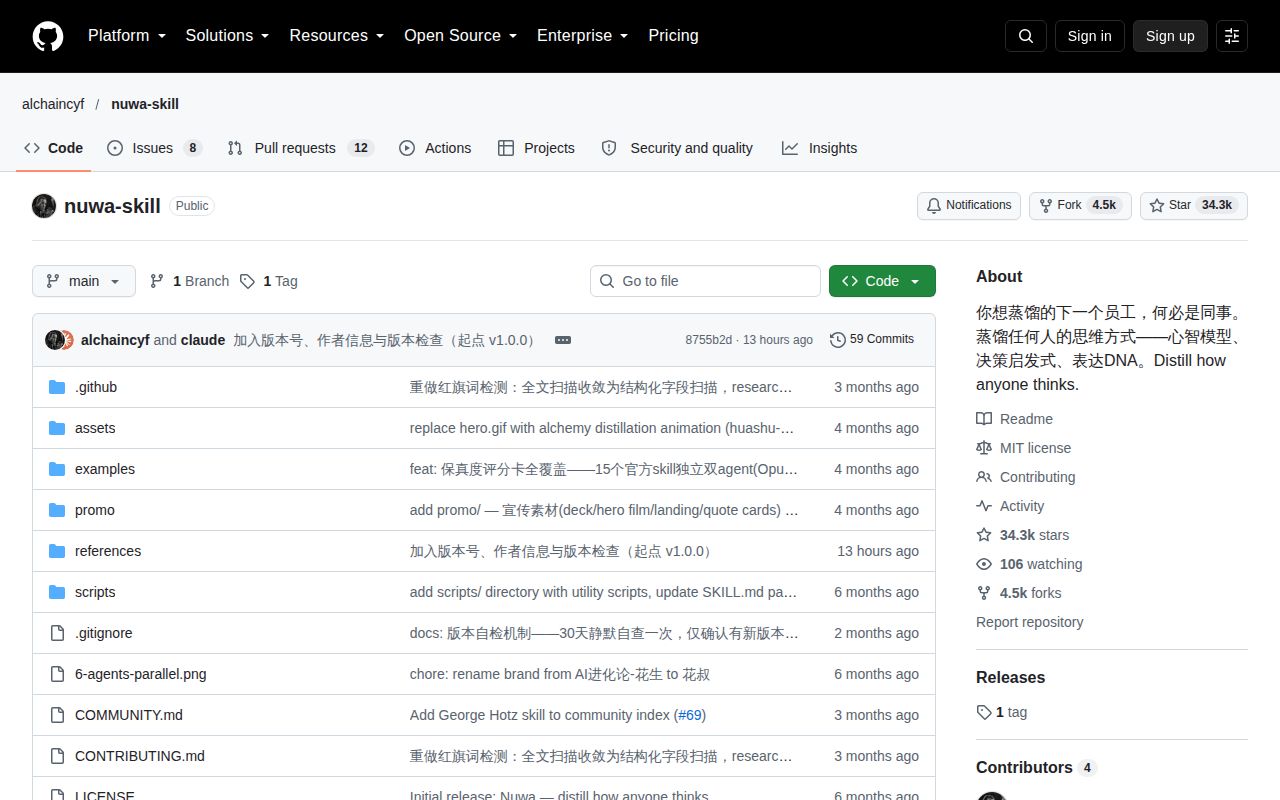
Nuwa's last push was October 13, 2026. GitHub listed 34,283 stars and 20 open issues and PRs, including recent checker and subtitle-script reports. The latest-release endpoint returned no published latest release. The push and discussion show current activity, while the unresolved helper reports give a concrete reason to keep manual review in the process. A busy repository can still have unreliable checks.
The lab's 1 CI workflow has a narrower job: the community PR check runs when the community index changes. It checks out the repository's own code rather than contributor code. For supplied-person materials, consider Distilly, the renamed colleague-skill. For reusable analysis prompts without person modeling, consider Fabric. Nuwa's measured 37 MB environment makes setup a modest commitment. Choose it when you're willing to read the research files. If you only want a famous name attached to an answer, those files won't protect you from believing it too readily.