Fabric turns prompts into shell commands
Fabric's most useful idea is simple: give a prompt a stable name, keep its instructions in readable Markdown, and invoke it against stdin or a supplied source. summarize, analyze_claims, and other Patterns behave like small text-processing commands, except a selected language model produces the output. Patterns can contain variables, use a model assigned through configuration, and remain separate from private custom Patterns.
The repository is much larger than a folder of prompts. Our checkout contained 843 files, roughly 49,072 source lines, and 28 MB. The Go CLI manages providers, models, sessions, contexts, attachments, output files, updates, strategies, extensions, media transcription, web search, image generation, and speech. It can also start a REST service or present Fabric Patterns as models through Ollama-compatible endpoints.
This breadth makes Fabric attractive to people who live in a terminal. Clipboard contents, a file, a web page, or a YouTube transcript can flow into the same Pattern, while --dry-run prints what would be sent before spending API credit. A custom Pattern with the same name takes precedence over the supplied one and survives catalog updates, which is the right behavior for a team that edits instructions under version control.
The Pattern catalog saves time without proving quality
Fabric includes prompts for extracting ideas, writing, threat analysis, summarization, and many other jobs. Each Pattern is inspectable, copyable, and usable outside Fabric. That openness is a practical advantage over prompt products whose behavior lives behind an interface. It also makes review possible: a team can read the system instructions and decide whether the requested format, assumptions, and tone fit its work.
Nothing in our 295-package dependency install tests the truth of a model response. A long, carefully structured Pattern may improve consistency, but output still varies by provider, model, sampling controls, and input. Some Patterns encode the author's preferred way to frame a task. Treat them as maintained starting points. For consequential analysis, add source checks, evaluation cases, and a human decision after the command completes.
Provider choice is broad. Native integrations cover major hosted services plus Ollama and LM Studio, while many OpenAI-compatible vendors are listed. Per-Pattern environment variables can pin a vendor and model. That flexibility is useful when a local model should clean sensitive text before a hosted model receives it, or when a costly model is reserved for one demanding Pattern. It also means reproducibility requires recording the Pattern revision, Fabric version, provider, and model.
What happened when we ran it
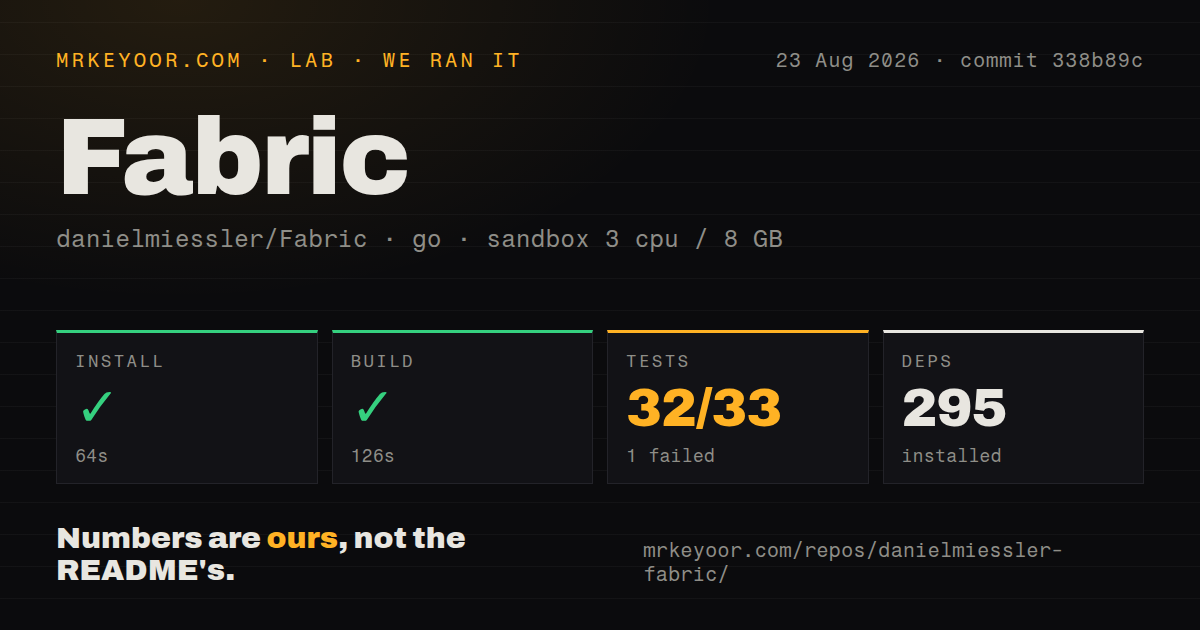
Our dependency step completed in 64 seconds and installed 295 Go packages. The build succeeded in 126 seconds at commit 338b89c. Those figures make source installation heavier than the one-line installer or release binary suggests, though an end user can avoid compiling by choosing a packaged build. The repository had 4 CI workflow files and no Dockerfile or tests directory in our signal scan.
The Go test command failed after 26 seconds. It reported 32 passing packages and 1 failing package out of 33. The supplied tail shows successful packages for the server, converters, custom Patterns, notifications, Spotify, and YouTube, along with several packages containing no test files. It then ends with FAIL. Because that excerpt does not name the failed package or assertion, this review does not assign a cause.
A 32-to-1 result is close to green and still a failure. Maintainers evaluating a source change need the complete log or a rerun that isolates the package before relying on the suite. Users installing v1.4.470 can reasonably try the binary, but should smoke-test the exact provider and Patterns they need. Our run measured compilation and package tests, not response quality, provider availability, or YouTube extraction success.
External sources add convenience and failure points
Fabric can retrieve YouTube transcripts and comments, extract visual frames with OCR and FFmpeg, send Spotify metadata to a model, or scrape a page through Jina AI. These shortcuts make transcript analysis pleasant, especially when piped into an extraction Pattern. They also introduce changing third-party behavior, optional binaries, network access, and sometimes more credentials. A private local-model workflow is only local if its inputs stay local too.
The 26-second test run included passing YouTube and Spotify packages, but that does not guarantee their upstream services will answer tomorrow. Keep raw inputs when the output matters. For videos, capture the transcript separately if it must be reproducible. The --dry-run option is worth using when a Pattern includes confidential text, because it exposes the constructed request before Fabric sends it to a model provider.
Two open reports identify friction for automated use of v1.4.470. Issue 2196 says canceling an Ollama streaming client does not cancel the underlying request, so generation continues until completion or timeout. Issue 2190 says normal invocations create unused fabric-patterns-* directories; the reporter reproduced about 55,000 directories before a 10-day cleanup window in a high-frequency daemon. Both reports have associated fix pull requests, a useful sign, but released behavior still deserves checking.
The server mode needs an explicit trust boundary
fabric --serve exposes chat, Pattern management, contexts, sessions, provider listings, YouTube extraction, and configuration over HTTP. An API-key flag is available, as is a configurable address. Ollama mode makes Patterns appear as model names to existing clients. This can turn a personal CLI workflow into a shared internal service, but it also exposes provider spending and stored configuration to network callers if deployed carelessly.
GitHub showed 43,530 stars, 65 open issues and pull requests combined, a push on 2026-08-09, and v1.4.470 released on 2026-08-04. Recent activity includes provider additions and fixes for cancellation, temporary directories, input handling, and Pattern normalization. Fabric is actively maintained. The one-package test failure prevents an unqualified endorsement, while the readable Pattern format and provider range still make it one of the better prompt-workflow tools for shell users.