The browser app works, while the desktop data layer is unfinished
Northstar is more specific than a decorated to-do list. Its contract connects a long-term direction to a quarterly focus, weekly capacity, today's actions, and a review loop. Ideas cool before promotion, memories require confirmation, and changes to strategy appear as proposals. The interface wraps this in a dark or light workspace with a procedural Three.js core. You can use the planning demo offline and without a model key.
Our checkout was small: 95 files, about 1,987 lines of source, and 11.8 MB before installation. The code still spans React, TypeScript, Vite, Three.js, Tauri 2, and Rust. The browser path stores its snapshot in localStorage. The intended desktop architecture calls for Rust commands, SQLite, and the Windows credential store, but the repository's own limitations file says those pieces are not complete or fully verified.
The domain layer blocks AI from rewriting protected facts
The strongest idea in Northstar is the boundary around model output. The model proposes typed commands; ordinary code decides whether they are allowed. The TypeScript domain module checks request identity, base versions, capacity, dependencies, locked tasks, hard due dates, and protected fields. It records audit entries and uses compensating actions for undo rather than letting a model edit arbitrary JSON or SQL.
That boundary carries a version number and a fixed command shape, which makes failures easier to reason about. Replaying the same request ID returns a prior result, while reusing it with different content is rejected. A stale base version cannot overwrite newer work. Growth events are deduplicated and capped by period. These rules are more useful than a prompt asking the model to behave because they still apply when the model returns a malformed or overreaching suggestion.
What happened when we ran it
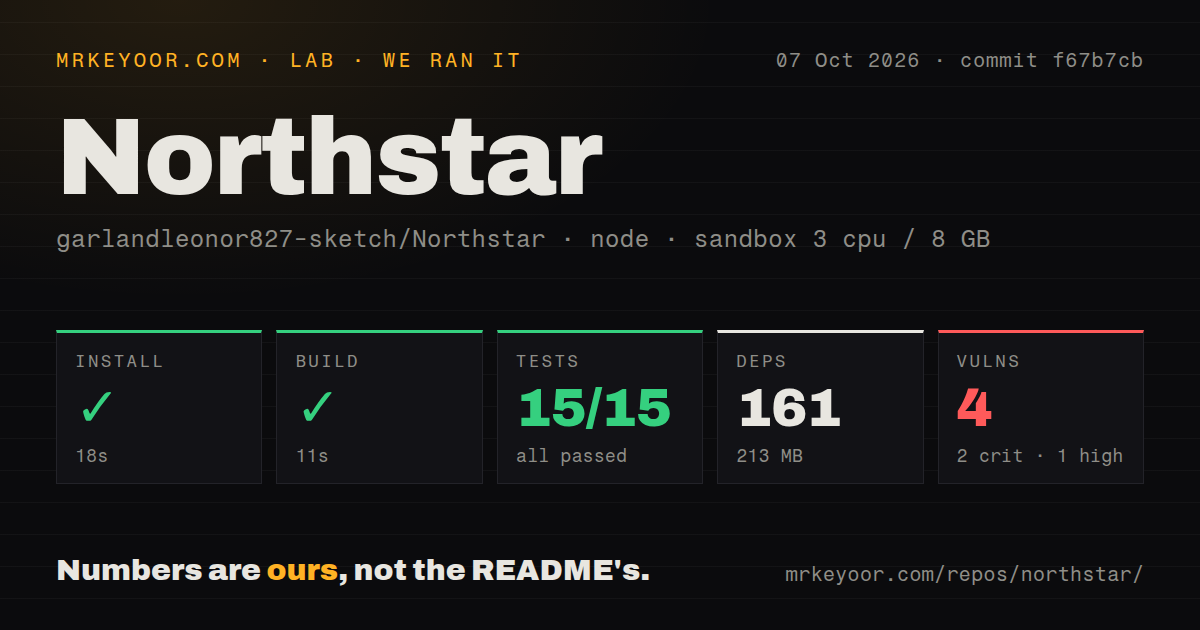
Our sandbox installed commit f67b7cb in 18 seconds. Npm added 161 packages, and dependencies occupied 213 MB. The production build completed successfully in 11 seconds. Vitest then completed in 4 seconds with 15 passed and 0 failed out of 15. We ran the checks in a fresh unprivileged Debian container with 3 CPUs, 8 GB of RAM, Node 22, and no secrets.
Npm audit reported 4 known vulnerabilities: 2 critical, 1 high, 1 moderate, and 0 low. The supplied measurement does not name the affected packages, reachable paths, or fixes, so we will not guess at them. Our scan found a tests directory, no Dockerfile, and 0 CI workflow files. A green local build and 15 passing tests therefore sit beside a dependency warning and no visible automated GitHub workflow.
SQLite and Windows credential storage are still missing
Northstar's browser storage is suitable for a demo, not the stated production design. The limitations file says localStorage is not a SQLite consistency snapshot and does not claim full-database encryption. Migration, transaction crash testing, backup replacement, and Windows Credential Manager integration remain unverified. A strategy record is the sort of data people expect to survive upgrades and machine restarts, so persistence is not a detail to postpone.
Version 0.1.0 also has no installer, updater, account system, cloud sync, or external platform integration. The Windows development window has been started by the project author, but the repository stops short of a packaged application. Native testing still needs Rust MSVC, Visual Studio C++ tools, and WebView2. Screen-reader behavior, several window sizes, DPI scaling, and frame rate remain open acceptance items.
Provider safeguards exist only against mocked endpoints
The adapter design gets several important details right on paper. It accepts OpenAI-compatible Chat Completions roots, requires HTTPS except for explicit loopback use, limits retries, avoids retrying authentication failures, supports cancellation, and checks structured candidates before any write. Users are meant to preview which context categories leave the device. Sensitive family or financial detail is excluded by default unless separately authorized.
The project did not use a real provider key in its own acceptance work, and our lab used no secrets on October 7, 2026. Actual TLS redirects, streaming differences, rate limits, model JSON behavior, and credential persistence therefore remain unknown. This matters because compatibility labels are cheap until one provider returns a partial stream or redirects a request. Northstar should keep its manual planning path useful even when the adapter fails, as its contract requires.
Four audit findings block a production recommendation
The successful build and test run show that the checked-in browser code is coherent at commit f67b7cb. They do not cancel the audit result. Two critical, one high, and one moderate advisory require package-level review before the app holds personal plans or calls a paid model endpoint. With no CI workflow in the repository, contributors also need to add repeatable build, test, and audit gates rather than relying on handoff logs.
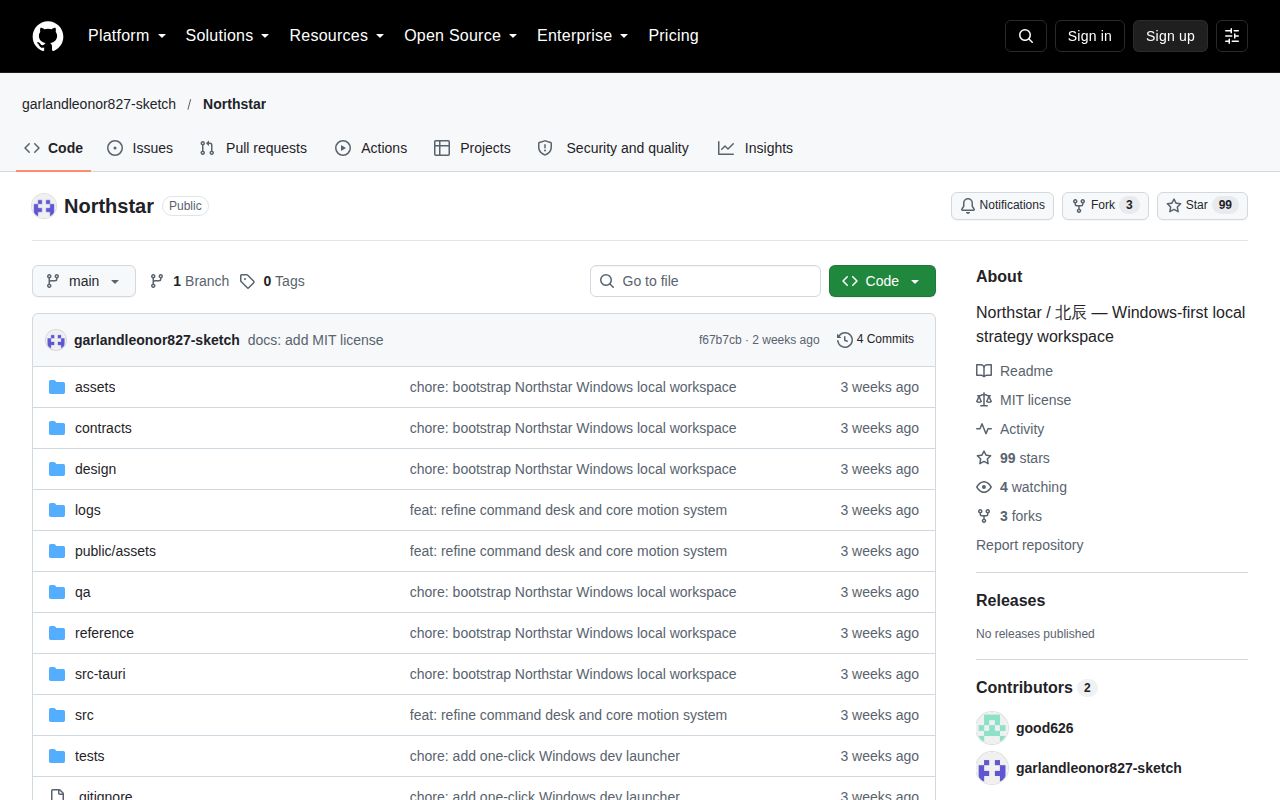
GitHub showed 99 stars, 0 open issues and pull requests, and no published release on October 8, 2026. The last push was September 27, when the MIT license was added. That is recent enough to call the project current, but there is almost no public issue history to show how defects are handled. Northstar is an interesting codebase and a usable browser prototype. It is not yet the Windows strategy system its contract describes.