This is a Sanguosha game first, not a starter kit
Noname is a Chinese-language implementation of the Sanguosha card game with browser play, desktop packaging, an Android client, multiplayer support, and an extension system. The latest v1.11.6 notes name dozens of new characters and changes to card resolution, equipment slots, interface scaling, Android display behavior, and online play. That breadth is the reason to choose it. You are adopting an existing game world rather than receiving a blank engine for your own rules.
The language boundary matters immediately. The main README, local setup guide, v1.11.6 notes, and most issue titles are in Chinese. We found no English guide linked from the README. A player can download the separate PC or Android clients linked there, but a contributor needs enough Chinese to follow rule terminology, build instructions, bug reports, and extension compatibility notes without depending on machine translation for every decision.
The 1,305.2 MB checkout carries the game with it
commit 7fcf23e contained 15,431 files and roughly 790,787 lines of source before installation. The checkout occupied 1,305.2 MB, then pnpm added 197 packages using another 792 MB. This is a large working tree for a JavaScript project because it includes a mature game's code and materials, not merely a reusable networking package. Cloning, caching, and CI storage deserve planning even though dependency installation itself was uneventful.
The root workspace spans apps, packages, and extension packages. The documented path is Node.js ^20.19.0 or at least 22.12.0 with pnpm 9 or newer. pnpm dev starts Vite and uses ports 8080 and 8089. A separate workspace command starts the WebSocket service on port 8082 for a local multiplayer lobby. Electron builds have platform-specific commands, and the Android client is distributed from a separate repository.
What happened when we ran it
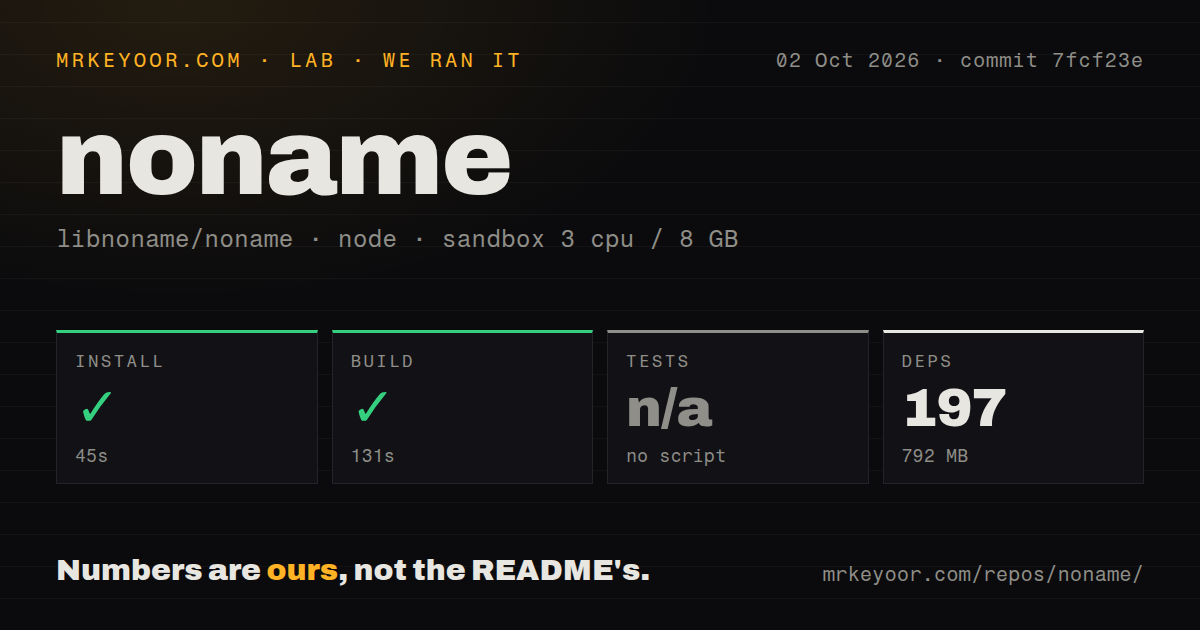
Our fresh Debian sandbox installed commit 7fcf23e in 45 seconds. Pnpm installed 197 packages and used 792 MB on disk. The build completed successfully in 131 seconds on 3 CPUs with 8 GB of RAM, inside an unprivileged container with no secrets. Those numbers cover repository setup and compilation. They do not measure browser frame rate, multiplayer behavior, AI turns, or a complete match.
There was no test script or test target, so the test step was skipped. Our scan also found no tests directory. Five CI workflow files are present, which shows that the project does automate repository work, but that is not the same as a runnable gameplay suite. A change to a character skill, card-resolution event, or multiplayer interaction therefore needs hands-on checking unless the relevant package has a narrower check outside the root command.
The build result is useful because this is no toy repository: 790,787 source lines compiled in 131 seconds without an error. The missing test command is just as useful. Release v1.11.6 changed event timing and warned extension authors to update code that overrides card-resolution flows. When extension compatibility depends on details like useCardEffectEnd and effectCount, a green build cannot tell you whether a match still resolves correctly.
Firefox is excluded, and local play occupies three ports
The README requires Chromium 91 or Safari 16.4 or newer and explicitly says Firefox is unsupported. That rules out a browser some self-hosters deliberately standardize on. WebView age matters on mobile too. The README asks players to keep the Chromium-based browser or phone WebView at version 91 or newer, while the current release changes Android orientation and system-bar handling.
Running the browser client is simple by the standards of the repository, but multiplayer adds another process. Vite takes ports 8080 and 8089, and the documented WebSocket server listens on 8082. Desktop distribution then brings Electron packaging and operating-system targets into the picture. There is no Dockerfile in the measured commit, so container deployment is yours to define if you do not want those processes installed directly on a host.
v1.11.6 shipped while 141 issues remained open
GitHub showed 5,082 stars and 164 combined open issues and pull requests on October 2, 2026. The split was 141 issues and 23 pull requests. The repository was pushed that same day, one day after v1.11.6 was published, so the open queue sits alongside active development rather than a dormant project. Recent reports cover a card-distance error, audio that keeps playing, Android system-bar behavior, and match states that can freeze.
That activity is encouraging for players who want the latest character and rule changes, but it also describes the maintenance burden. The October release credits 23 contributors and warns extension authors about changed resolution hooks. GitHub identifies the repository as GPL-3.0, while the README separately asks users to preserve attribution and avoid commercial use. Anyone distributing a commercial build should resolve that policy mismatch with the maintainers instead of guessing.
Noname makes sense for one narrow reason: you want this Sanguosha implementation and its accumulated content. Our run showed that its huge workspace can install and build cleanly. It did not provide an automated test target, and the live issue queue includes gameplay failures that compilation would miss. For contributors, the practical price is Chinese-first documentation plus manual match testing whenever a rule or extension path changes.