The repository is a blockchain node, not a normal Rust crate
The main implementation lives under ex/ and mixes Elixir with a native Rust component. Its directories cover peer networking, consensus coordination, transaction pools, RPC APIs, chain storage, snapshots, rate limiting, validator work, and built-in contracts. The project describes AMA as a privacy-focused layer 1 with 500 ms blocks, BLS12-381 signatures, WASM contracts, sorted Merkle proofs, and matrix multiplication as useful proof of work.
Contract samples sit beside the node in AssemblyScript and Rust. Examples cover a counter, deposits, a token, and an NFT. The local testnet exposes Elixir helpers for deployment and calls, while a separate amadeus-cli path creates keys, transfers test tokens, deploys WASM, and queries RPC endpoints. This is protocol-specific infrastructure, so its value depends entirely on choosing the AMA network.
What happened when we ran it
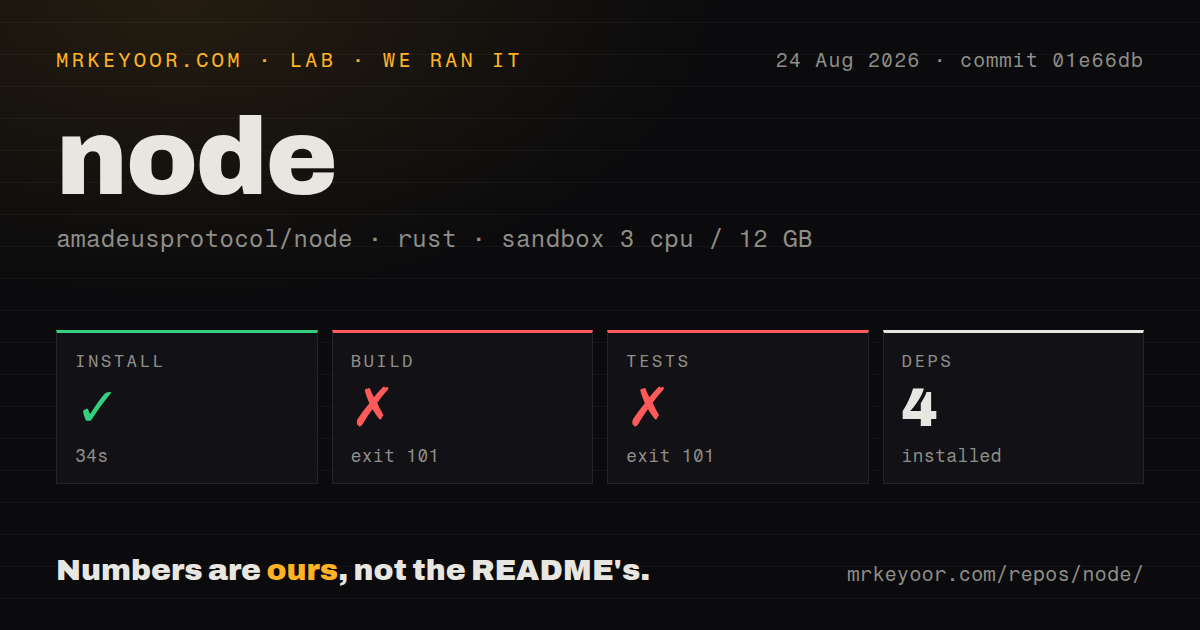
Our sandbox cloned commit 01e66db into a fresh, unprivileged Debian container with 3 CPUs, 12 GB of RAM, and no secrets. The whole checkout occupied 1.3 MB, contained 172 files, and held about 18,075 lines of source. The harness detected the runnable Rust project under contract_samples/rust/, rather than the Elixir node under ex/.
Inside that Rust sample, installation succeeded in 34 seconds and installed 4 packages. The build failed after 34 seconds with exit code 101. Cargo reported 20 errors in amadeus-sdk; the visible example showed a macro path expected to return u128 but receiving () from the abort path.
The test command failed after 32 seconds with exit code 101. Its log again reported 20 errors for the library test and 21 for the library build, plus a warning. It also said unwinding panics are unsupported without the standard library and suggested a nightly build-std panic-abort route. Those lines describe compilation failure, so no tests actually ran.
This result is limited to the Rust smart-contract SDK sample. It does not establish whether ex/build.sh can produce the node binary. The supplied measurement block identifies the Rust subdirectory as the project the harness found, and the repository has no root manifest that would redirect a generic Rust run into the Elixir build. The node remains unverified by our sandbox.
Building the node requires a dedicated Linux environment
The README says its tested environment is Ubuntu 24.04 with Linux kernel 6.8. The preferred build creates an Erlang builder image from ex/build.Dockerfile and then runs ex/build.sh. The local route tells contributors to follow that Dockerfile as root, then run mix deps.get and mix compile for language-server support. This is a specialized toolchain rather than a release binary quick start.
Running a local testnet adds host and browser changes. The README maps nodes.amadeus.bot to localhost, permits unprivileged binding on ports 80 and 443, and launches Chrome with certificate verification plus web security disabled. That browser command should only be used in an isolated testing profile. It weakens protections that normal browsing depends on.
The contract getting-started guide is candid about documentation. It points readers directly to consensus, WASM import, RPC, and proof-generation source files because those are more current than any prose documentation. Its remote testnet section says it will be finished later and recommends local deployment for now. Engineers should expect source archaeology, not a stable application developer guide.
The operator recipe changes the whole host
The systemd section writes global network buffer values and raises file, process, task, and memory-lock limits. Several limits become unlimited, while the file-descriptor target is 1,048,576. The sample service runs as root from /root, starts the node inside GNU Screen, restarts after 3 seconds, and can enable automatic updates through an environment variable. A brief note shows how to change the user.
These settings may be intentional for a high-throughput validator, but copying them onto a shared server is poor operational hygiene. Create a dedicated host, justify each sysctl and limit, use a non-root service account, pin the binary, and understand how AUTOUPDATE=true obtains and verifies a release. Release v1.5.8 says signed updates fail closed and reject rollback, but operators should verify that path before enabling it.
Contract and RPC edges are still under repair
The Rust SDK failure blocks the most approachable contract language in this repository. AssemblyScript may still work, but that is a separate path with its own compiler and samples. The Rust guide also depends on amadeus-cli, a testnet faucet, external RPC endpoints, and generated signing keys. Until the SDK compiles at the reviewed commit, new Rust contract work starts with repairing the toolchain.
Open pull request 24 covers invalid limit and offset query parameters that could trigger a bad argument exception and return 502, while negative values reached the database or native layer. The proposed fix validates integers and returns 400, but its test-plan boxes were still unchecked. Open issue 8 asks for backoff because traffic to unconfirmed peers could make data centers flag nodes as scanners.
Current releases do not replace missing project hygiene
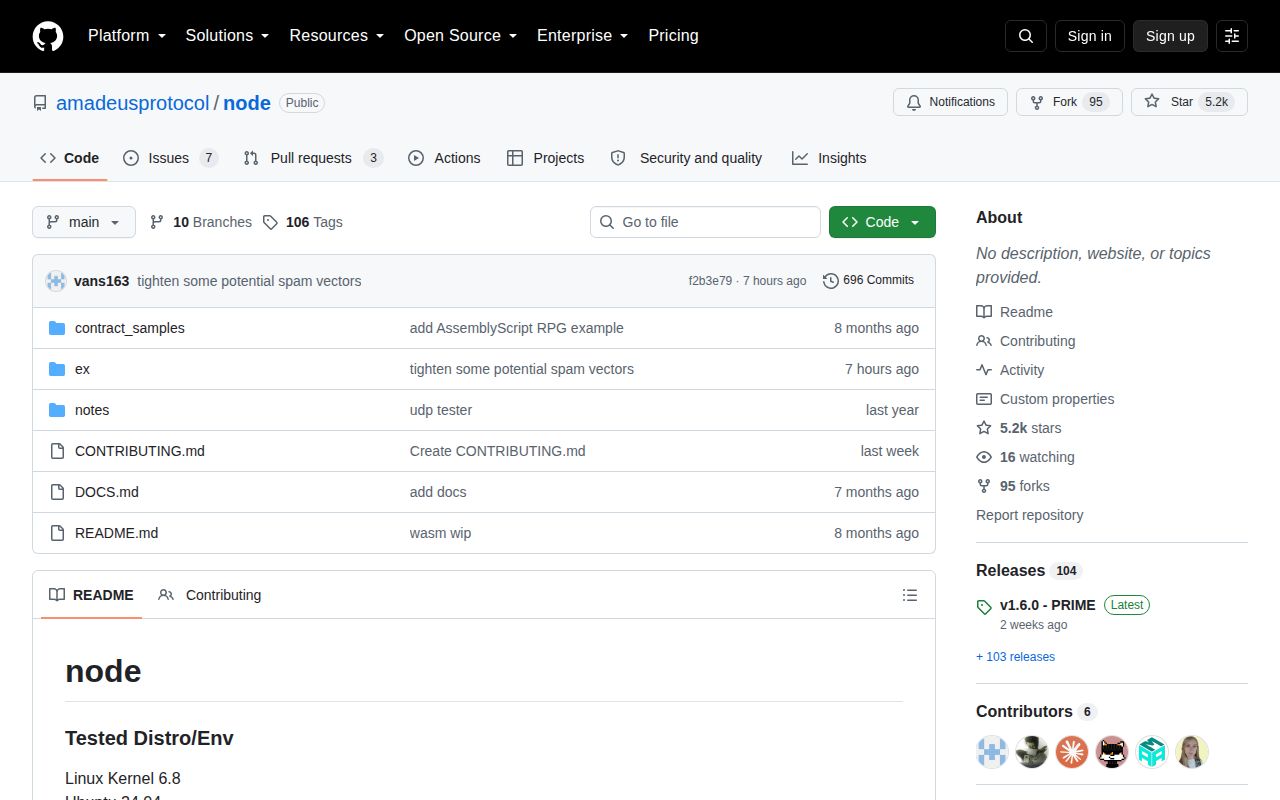
GitHub recorded a push on August 25, 2026, and listed 10 open issues and pull requests together. Release v1.6.0 arrived August 10 with a one-line note about PRIME points at mainnet epoch 792. Earlier releases contain much deeper consensus, validator, proof, snapshot, and security notes, showing that substantial implementation work exists behind the sparse top-level README.
Repository hygiene is much weaker than that release history. The measured snapshot had 0 CI workflows, no root Dockerfile, and no top-level tests directory. Several open issues have one-word titles without actionable detail. GitHub detects no license, and the root listing has no license file. An experimental disclaimer is not permission to use, modify, or redistribute code. AMA specialists may still learn from the implementation, but general users have safer, better documented options.