This is a chain-building workspace, not a single library
Polkadot SDK contains the parts needed to build a Substrate node, compose a FRAME runtime, connect a parachain through Cumulus, and move messages through XCM. The repository merges three formerly separate codebases: Substrate, Polkadot, and Cumulus. That consolidation makes dependency selection easier, but it also creates a workspace whose internal surface is far larger than most Rust applications.
The boundary is easy to miss. The repository supplies SDK components used by Polkadot and parachains, while the actual Polkadot runtime lives under fellowship/runtimes. A team changing a pallet API may work here; a team tracking the exact production runtime must follow the Fellowship repository too. Our checkout measured 9,530 files and about 1,810,702 source lines, which puts that organizational distinction into perspective.
FRAME and Cumulus justify the size for chain teams
FRAME is the main reason to accept this codebase. Runtime engineers can assemble pallets, define dispatchable calls and storage, and compile the resulting runtime to WebAssembly. Cumulus supplies the parachain side, while client crates cover networking, database access, consensus, keystores, RPCs, and other node responsibilities. The SDK is a platform for creating a chain rather than an application SDK that hides the chain.
That makes Polkadot SDK a poor starting point for a team that only needs a smart contract. The 223.4 MB checkout and 2,011 installed packages carry systems that a contract does not own. ink! is the closer alternative for Rust contracts on compatible chains. Cosmos SDK is a more relevant comparison for teams choosing a chain framework, although its Go module model and ecosystem assumptions differ substantially.
Stable releases trade speed for a defined support window
The project publishes a stable release every three months and supports each stable line for one year with patches. It also provides psvm to move the related Cargo dependencies to a consistent release. That policy matters because a workspace with many interdependent crates is easy to break by selecting versions independently. Consumers should choose a stable line deliberately instead of tracking arbitrary master commits.
The latest GitHub release on August 10, 2026 was polkadot-stable2606-1, corresponding to node v1.24.1. Its notes split changes by client and runtime audiences, then identify the affected crates. The patch fixed a database reference-count problem, adjusted collator behavior, changed persistent database channel capacity, and updated runtime calls. This is infrastructure where patch notes require review, not a dependency to update blindly.
What happened when we ran it
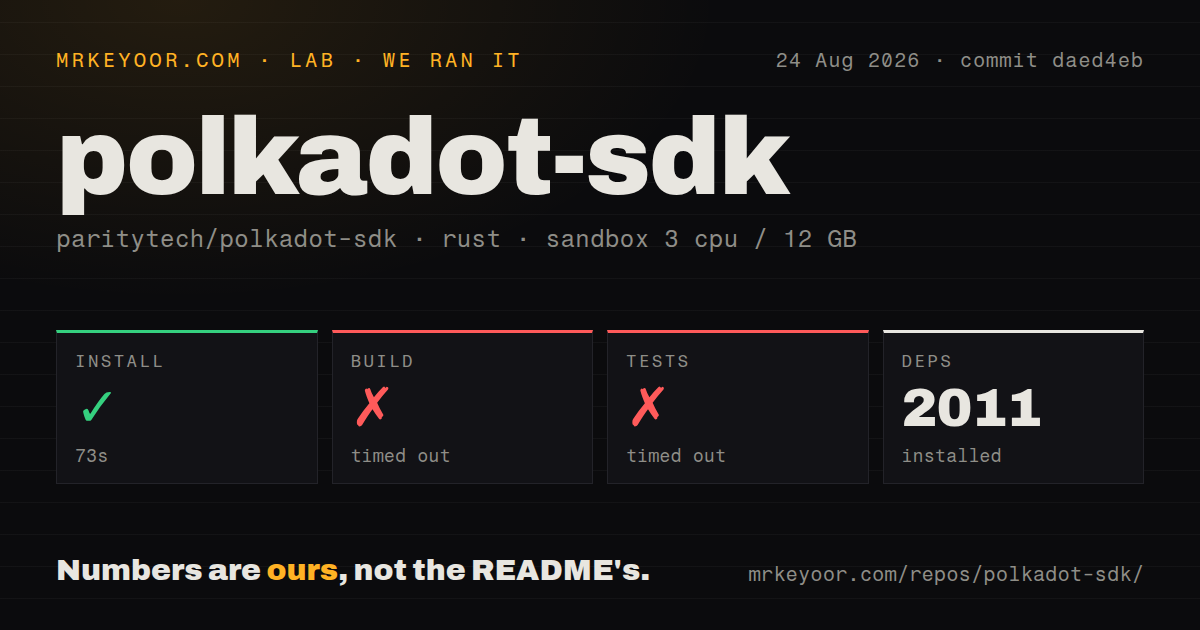
Our sandbox installed 2,011 packages in 73 seconds at commit daed4eb. The checkout contained about 1,810,702 lines across 9,530 files and occupied 223.4 MB. Installation succeeded cleanly in an unprivileged Rust container with 3 CPUs and 12 GB of RAM, but that fast dependency step did not predict how long compilation would take.
The build timed out after 900 seconds. Tests also timed out after 900 seconds, and the final test log was still in compilation: jsonrpsee-ws-client, scale-decode, pallet-balances, pallet-timestamp, and wasm-opt-sys were among the crates shown. There was no failing assertion or compiler error in the supplied tail. We only know that neither command completed within the 15-minute cap.
This is a capacity finding, not proof of broken code. On our box, the complete validation path needs more time or more compute than the sandbox allowed. A contributor should use the project's targeted crate workflows instead of making every small change wait for the whole workspace, then leave full validation to adequately sized CI. The repository's 76 workflow files show that its maintainers already divide a large testing problem into many jobs.
Target and toolchain details can stop an otherwise valid build
Full runtime builds use a WebAssembly builder that manages required configuration. Individual crates targeting no_std may need RUSTFLAGS="--cfg substrate_runtime", according to the README. PolkaVM builds need a riscv32 or riscv64 target. These are product requirements, not optional polish, because runtimes and native node code compile for different environments.
The one-line getting-started script is useful for an example node, but production work extends beyond that command. Developers need the documented system dependencies and Rust setup. Operators then own node keys, chain specifications, data storage, networking, observability, and upgrades. Our 900-second build timeout arrived before any of those runtime concerns, which is why setup ease scores lower than documentation or maturity.
The activity level matches critical infrastructure
The repository was pushed on August 25, 2026. GitHub reported 2,445 open issues and pull requests, and the most recently updated items included state-sync validation, statement-store memory bounds, runtime benchmarking, governance scheduling, and protocol work. That count should not be described as 2,445 bugs; it combines proposals, fixes, and active pull requests across a very large workspace.
Documentation is spread across the main README, the Polkadot documentation portal, generated Rust API pages, contributor guides, the release registry, and community support channels. The spread makes first contact harder, yet each audience has a path. Teams building a chain should assign ownership for release notes and dependency updates. Teams that cannot justify that role should choose a managed chain, deploy a contract, or use a smaller framework.