It fixes one specific agent writing habit
No Negative Echo addresses a small failure that becomes annoying after a long coding session. An agent proposes one approach, the user rejects it, and the implementation changes. The final commit title or handoff still talks about avoiding that rejected approach, even though a new reader only needs to know what shipped. This skill tells the agent to regenerate each delivery surface from the accepted, verified state.
The primary README is Chinese, and the repository includes a full English version. Both use the same simple example: a dish title should name the selected dish rather than mention a meal that was discussed and removed. Applied to engineering, that means commit subjects, pull request descriptions, comments, filenames, and release notes should describe the resulting code unless a rejected path is still needed for safety, compatibility, or audit history.
The decision rule preserves facts that still matter
The instruction is more careful than a blanket word filter. It asks whether a reader who missed the conversation needs the information, whether removing it would create an inaccurate or unsafe account, and whether it records a real change from the accepted baseline. Released API removals and migrations stay. So do external operations, diagnostics, tests, snapshots, and user work that existed before the task.
That distinction keeps the tool from erasing necessary negative information. A failed test remains a failed test. A compatibility break still belongs in a migration note. The skill targets session residue, such as rejected draft wording that became the center of a title. Its scanner can inspect text, filenames, and suspicious Unicode, while a high-assurance path is available for sensitive or public delivery work.
What happened when we ran it
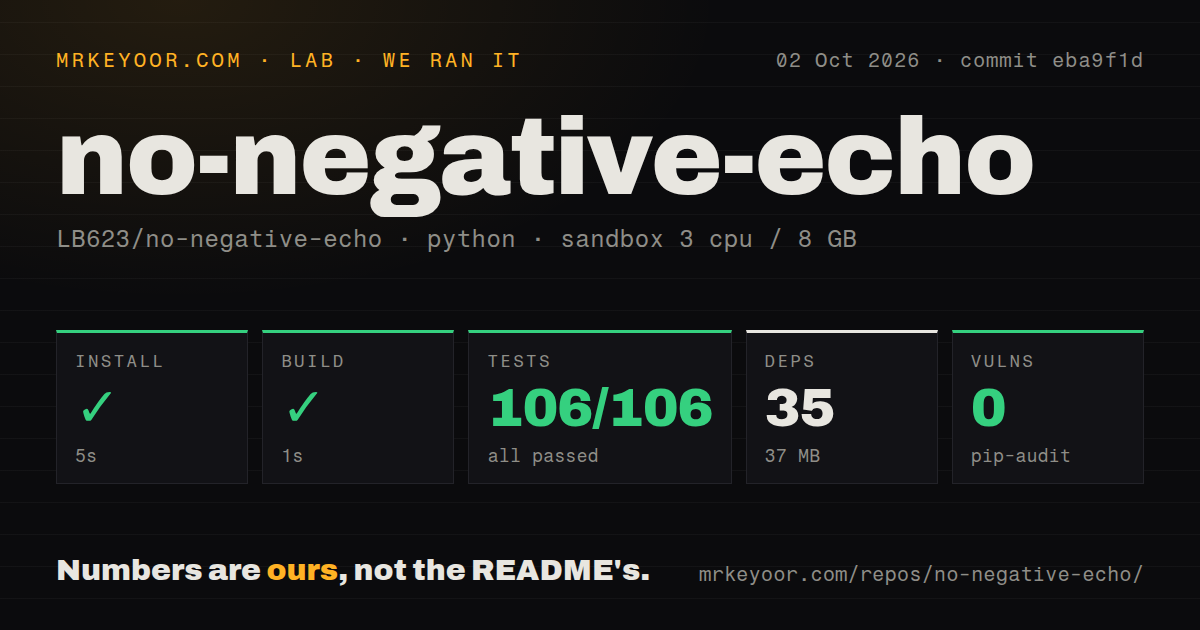
Our sandbox installed no-negative-echo in 16 seconds, adding 35 Python packages and using 37 MB on disk. Its build completed in 3 seconds. Pytest then ran for 15 seconds and reported 105 passed, 0 failed, and 8 skipped out of 105 collected tests. Pip-audit found 0 known vulnerabilities in the installed dependency set.
The repository itself was small: 26 files, about 5,676 lines of source, and a 3 MB checkout at commit c771b7e. It contained one CI workflow and a tests directory, with no Dockerfile. Those numbers make the implementation easy to inspect compared with a large agent framework. They do not prove that a language model will follow the instruction correctly in every conversation, a limitation the README states directly.
Our run verifies the Python package mechanics and deterministic tests. It does not measure how often the skill improves final text across models or hosts. The project says its CI tests scripts and scorers without presenting those results as proof of model behavior. That is the right claim boundary for prompt-driven software.
Installation offers a full skill and a smaller rule
The full installation path clones the repository, runs Python's isolated unittest discovery, and invokes an installer with a provenance hash, discovery root, and agent selection. The README requires Python 3.10 or newer and points other hosts and project-level installs to a separate contract. Important deliveries should explicitly name the skill because discovery alone does not show that the agent activated it.
A smaller option puts the core instruction in a project's AGENTS.md. That can give a supported agent a persistent rule without installing Python scripts. The tradeoff is clear: this route cannot call the bundled surface checker or high-assurance procedure. Codex loads project instructions at the beginning of a run, so a newly edited AGENTS.md may require a fresh session before its contents apply.
The scanner cannot decide what a sentence means
The README's strongest warning is easy to miss if you focus on the passing suite. A scanner PASS does not establish that the handoff describes the correct final state. Text and filename checks can find known residue or suspicious characters; they cannot determine whether a removed sentence was required for security, law, compatibility, or an honest test report. The agent and reviewer still make that judgment.
The skill also cannot erase context already given to a model. It does not control terminal logs or the host application's interface. Those boundaries rule it out as a credential scrubber, privacy control, or compliance system. A dedicated secret scanner and a human release review remain separate jobs. No Negative Echo improves a narrow authoring step rather than securing the surrounding agent platform.
Recent activity is stronger than the missing release tag
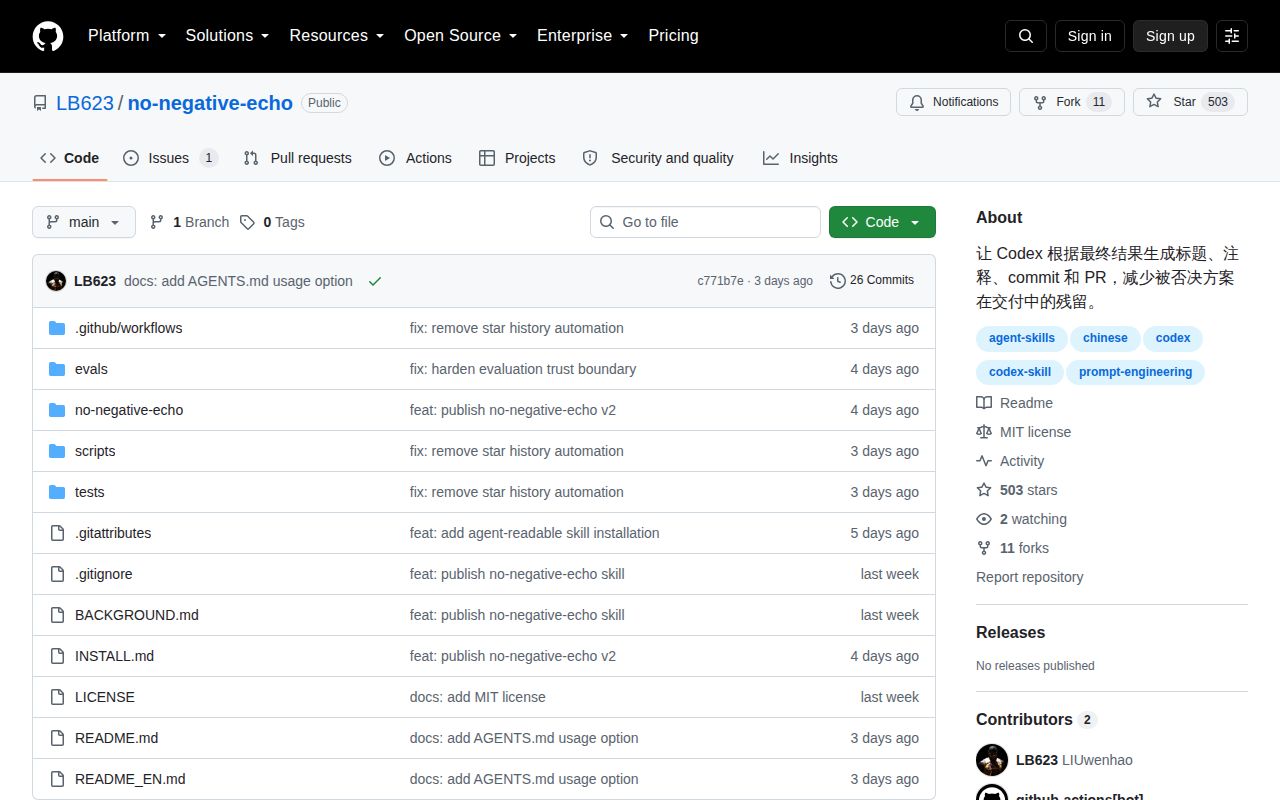
GitHub showed 503 stars and one combined issue or pull request when fetched. The last push was August 26, 2026, one day before this review. The repository has no published GitHub release, so users install from source and should pin the commit or provenance hash that they reviewed. The MIT license leaves room to adapt the rule inside another workflow.
A missing release is worth noting, but it is not evidence of abandonment beside an August 2026 push and a clean 105-test sandbox result. The project is young and tightly scoped. Its maturity question is behavioral: whether repeated evaluations across real agent sessions show fewer misleading handoffs without deleting necessary history.
Use it as an editorial check, not an authority
No Negative Echo earns a place in agent-heavy repositories where reviewers keep seeing rejected approaches repeated in public-facing text. The 16-second install, 37 MB environment, and passing test run make evaluation inexpensive. Its compact AGENTS.md form is enough when the team only wants the rule; the full skill suits important releases where separate surface checks help.
Do not let the tool's name become another ritual phrase in every handoff. The desired output is ordinary, accurate delivery text based on the final diff. Invoke it before the commit, pull request, or publication step, then read the result once for facts the scanner cannot understand.