The product is a 35-pattern editing prompt
Humanizer is one SKILL.md instruction set rather than a text-processing model or application. A compatible agent reads 35 patterns, rewrites the input, checks the draft, and produces another pass. The rules cover inflated claims, sales language, vague sourcing, repetitive structure, stock chatbot phrases, typography, filler, and several habits that make prose sound mechanically even. Because the file is readable, an editor can audit every instruction before giving it access to a document.
There are 3 output modes. Pasted text returns a draft, a short critique, and a final rewrite. File mode changes prose while preserving code blocks, metadata, data, and link targets. Embedded mode returns only the final text for another workflow. A supplied writing sample overrides the default style guidance, so the same input can produce different wording depending on the example and agent context.
It improves prose through a model, not through fixed rules
The skill does not implement a parser that replaces banned phrases one by one. It asks the host model to identify patterns, keep supported claims, vary rhythm, and rewrite paragraphs around their main point. That approach can repair awkward structure instead of merely swapping words. It also means two agents, or 2 runs with different context, may make different editorial choices.
A 35-item checklist is broad enough to catch familiar habits, yet it cannot prove who wrote a passage. Open issue #229 describes a user's blind study in which the rewrite was preferred for quality while AI-detection results barely changed. The repository's promise is narrower: make AI-sounding text read more naturally without changing its meaning. Buyers should hold it to readability and claim preservation, not detector scores.
What happened when we ran it
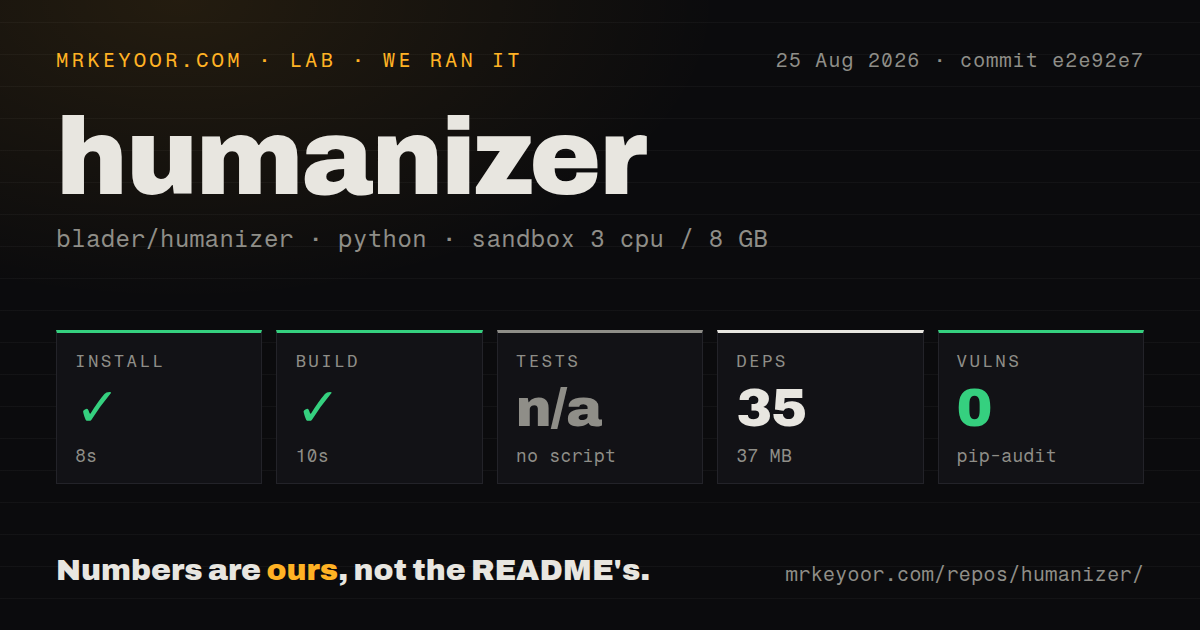
Our sandbox installed commit e2e92e7 in 8 seconds. The harness added 35 packages and used 37 MB on disk, then completed the package build in 10 seconds. Pip-audit found 0 known vulnerabilities. The checkout contained 9 files, about 89 lines of source, and 0.1 MB before installation.
There was no tests script or target, so our run skipped tests. That is the largest evidence gap in this review. A package validator can confirm that metadata, paths, and version fields line up; it cannot show that all 35 rules preserve dates, rankings, citations, commands, or the writer's tone across different models. The repository had 1 CI workflow, but no tests directory or Dockerfile.
The measurement came from an unprivileged Debian container with 3 CPUs, 8 GB of RAM, Python 3.12, and no secrets. We did not ask a model to rewrite a document because the lab block measures repository setup rather than subjective prose quality. The 8-second install therefore supports an easy setup score, while the absent behavioral suite limits the maturity score.
Claim preservation is the hardest part of the promise
The instructions explicitly forbid adding a name, number, date, quote, citation, or factual detail that the source does not contain. They also ask the model to check whether the rewrite lost a claim. This matters because shortening padded language can accidentally remove a ranking or qualification that carries the author's actual conclusion.
Issue #212 gives that problem a concrete shape: an editing pass removed the force of a ranking and dropped a simultaneity claim while cleaning style. An open pull request proposes making the final self-check agree with patterns that intentionally remove unsupported or formulaic material. Until such behavior is tested across supported agents, compare the output against the original rather than approving it because it sounds better.
File mode needs a trust boundary around source text
Pointing the skill at a file authorizes the host agent to edit that file. Issue #238 notes 2 related gaps: the instructions do not explicitly treat commands inside the document as untrusted content, and they do not require a preservation check before writing. A malicious or accidental instruction embedded in prose could be mistaken for a command to the agent if the host does not provide its own boundary.
Use a diff, version control, and narrow file permissions. Review code spans, commands, frontmatter, numbers, citations, and link destinations after every rewrite. For untrusted uploads, paste the text into a context with no write or shell tools. Humanizer can guide wording, but the surrounding agent controls what it may read and change.
Claude installation is easy, while validation stays manual
The README documents the Skills CLI, manual copying, Claude Desktop ZIP upload, and a Claude Code plugin command. Claude Code 2.1.142 or newer can install the plugin. GitHub's latest release endpoint returns v2.11.1 from August 18, 2026, while the README history already lists 2.11.2, so source users should inspect the checked-out metadata instead of assuming the latest release asset is the newest text.
GitHub recorded 38,035 stars, 18 combined issues and pull requests, and a last push on August 19, 2026. That is current interest around a very small repository. The sensible use is modest: run it as a second pass, inspect the diff, and reject edits that change meaning. Teams that need enforceable house style should pair or replace it with a deterministic linter such as Vale.