The repository is archived after an August 2026 takedown demand
Nitter gave people a way to read X through a server that fetched the site on their behalf. Pages used no client-side JavaScript or ads, the browser did not contact X directly, and RSS feeds made accounts readable outside X's own interface. The idea was concrete: reduce browser tracking and avoid requiring every reader to hold an X account. GitHub still recorded 13,637 stars when we fetched the archived project. It also gave self-hosters themes, responsive pages, and media handling under the AGPLv3 license.
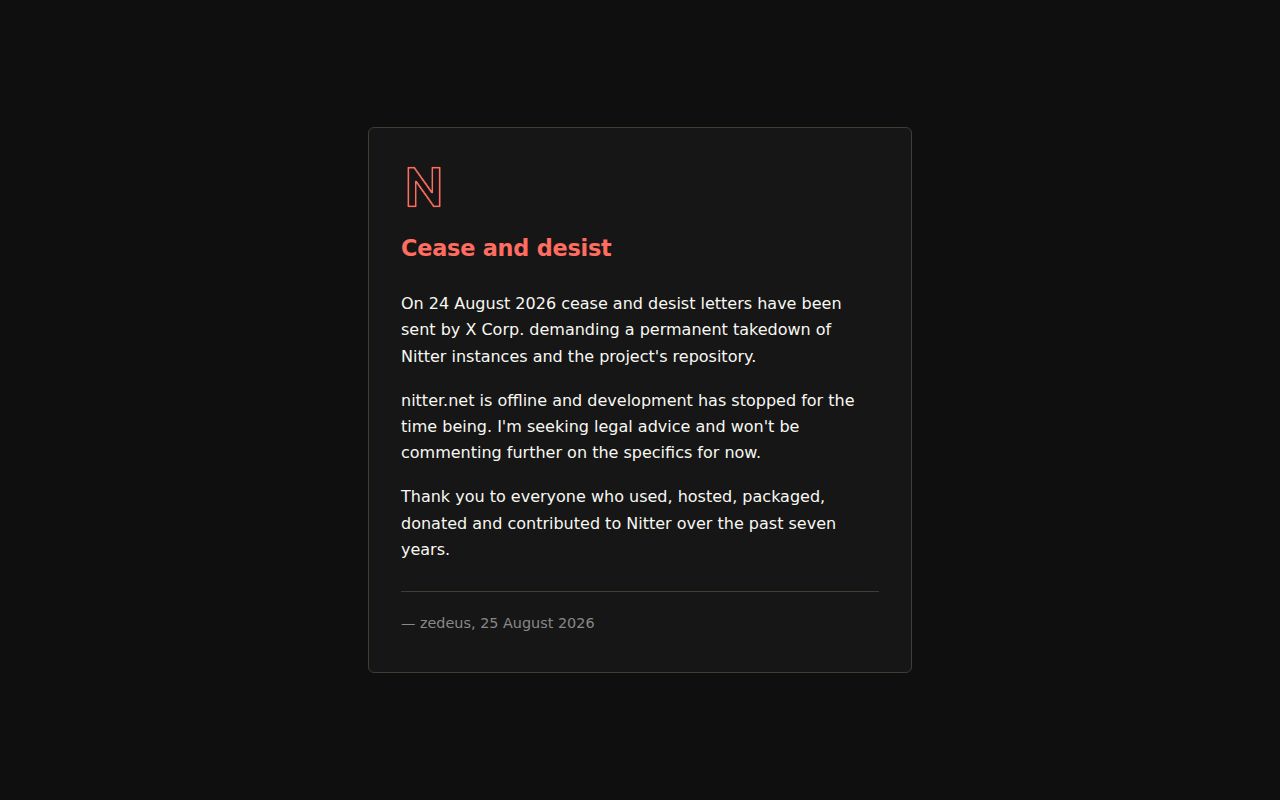
That product case is now subordinate to the repository status. The README says X Corp sent cease-and-desist letters on August 24, 2026, demanding permanent removal of Nitter instances and the repository. GitHub marks the repository archived, and the releases API returns no latest release. A push on August 26 shows that the notice and donation text were still being edited, but archive status means readers should not interpret recent repository activity as continued product support.
Public instances were reported rate limited on August 25
Issue 1442 says all listed public instances were returning Instance has been rate limited. after the legal notice. GitHub counted 156 open issues and pull requests, including that report. It does not prove every private installation fails in every network, yet it cuts directly against the normal reason to choose Nitter: dependable account-free access to X. A front end can be elegant and still be unusable when the upstream platform refuses the traffic it depends on.
The architecture always carried that dependency. Nitter used X's unofficial API and did not require a developer account, according to the README. Its backend shielded the reader's browser, but the server still had to obtain sessions and make requests that X could identify or restrict. The project documented account creation and archiving as roadmap hopes, not shipped capabilities. There is no independent social network or stored copy underneath the interface.
What happened when we ran it
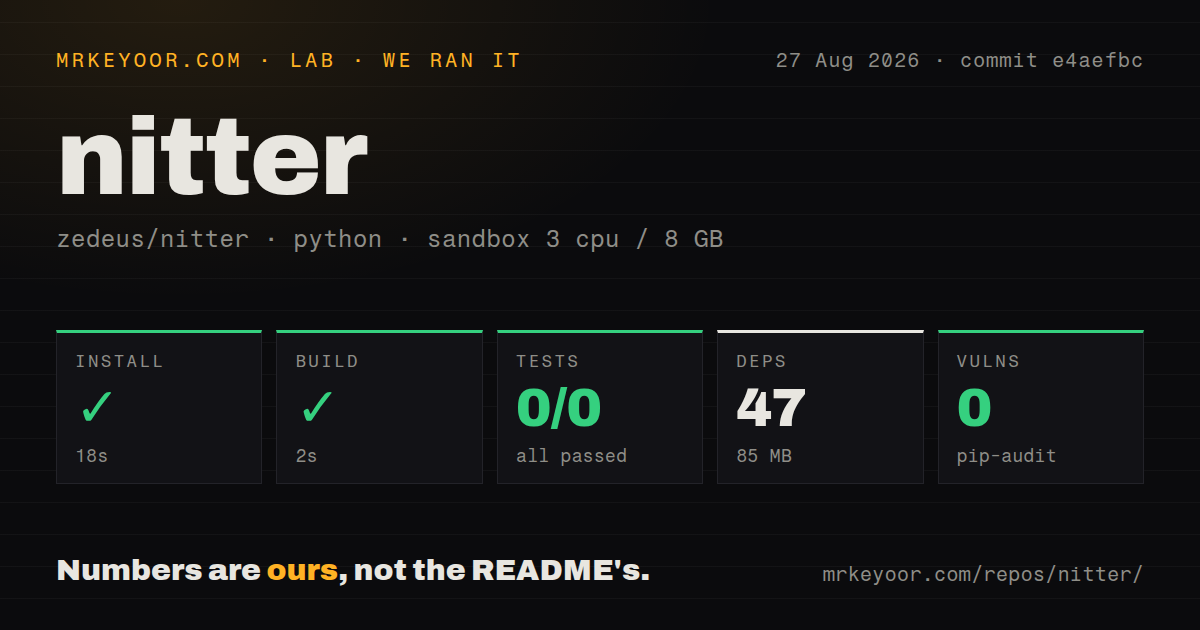
Our sandbox exercised the Python project under tools/ at commit e4aefbc. Installation succeeded in 18 seconds, added 47 packages, and occupied 85 MB. The measured build passed in 2 seconds. Pip-audit reported 0 known vulnerabilities in that installed Python environment. Those are modest mechanics for the tooling slice, but they do not establish that the Nim web service can still retrieve X content.
Pytest exited with code 5 after 6 seconds. It reported 0 passed and 0 failed out of 0, with the final line no tests ran in 0.00s. The log gives no cause beyond collection producing no tests, so we will not assign one. The repository contains a tests directory and 2 CI workflow files, while the measured tools project exposed no Dockerfile. A green install and build cannot compensate for a test command that checks nothing.
The full service asks for more than the 85 MB tools install
The README's source route describes a Nim application with libpcre, libsass, and Redis or Valkey. Operators compile the application, SCSS, and Markdown, copy nitter.example.conf, and set the hostname, port, HMAC key, HTTPS behavior, and cache connection. It recommends putting the process behind Nginx or Apache. That is normal work for a small self-hosted web service, but none of it was covered by our Python tools measurement.
Docker does not remove the service dependencies. The documented container still needs nitter.conf, and the compose route adds Redis as a second container. The README warns that a missing bind-mounted file becomes a directory and makes the container fail. Logging is also basic: errors go to standard output, with journalctl or Docker logs as the inspection route. There is no hosted control plane to diagnose a broken upstream session for you.
A 1970 timestamp bug remains relevant to ARMHF hosts
Issue 1420 reports that an X post dated July 4, 2026 appeared as January 7, 1970 on ARMHF. The report attributes the result to 32-bit integer overflow and includes a proposed change to use wider integer handling. We did not reproduce it, but the issue is specific enough to make timestamp verification mandatory for a 32-bit deployment. Archived code also means users cannot assume a reported fix will land upstream.
Nitter's privacy model was easy to understand and its plain HTML approach remains worth studying. That does not make it a responsible new service choice in August 2026. The archived repository, explicit takedown notice, 0 collected tests in our measured tools run, and rate-limit report all point in the same direction: preserve the code for study or retirement work, and choose a supported path for any live user need.