yt-dlp turns unstable media pages into scriptable downloads
yt-dlp accepts a page URL, identifies the site, extracts available media, chooses formats, and writes files using a configurable naming template. It can also save subtitles, thumbnails, comments, chapters, and structured metadata. For automation, that is much more useful than copying a media URL from browser tools because the command can express playlist filtering, archive history, retries, output layout, and post-processing in one reproducible invocation.
Its scope is huge. Our commit 81ecd58 checkout contained 1,234 files, about 249,102 lines of source, and occupied 12.3 MB. Much of the maintenance burden comes from site-specific extractors whose inputs are controlled by other companies. A website can change a JSON shape, require a different client identity, block a request, or move a playlist endpoint without coordinating with yt-dlp. Extractor health is therefore a moving target.
Full YouTube support now needs JavaScript beside Python
Python 3.10 or newer is supported on CPython, while PyPy starts at 3.11. The core package has many optional dependencies, yet the README strongly recommends 4 pieces: ffmpeg, ffprobe, yt-dlp-ejs, and a supported JavaScript runtime. Deno is the recommended runtime, with Node.js, Bun, and QuickJS also listed. The EJS component handles JavaScript challenges required for full YouTube support.
FFmpeg has a separate job. Many sites publish the best video and audio as distinct streams, so yt-dlp downloads both and asks FFmpeg to merge them. Audio extraction, recoding, subtitle embedding, metadata work, and other post-processors also depend on it. Installing the Python package named ffmpeg is not sufficient; the README specifically requires the executable. Container images should pin and verify that binary alongside yt-dlp.
What happened when we ran it
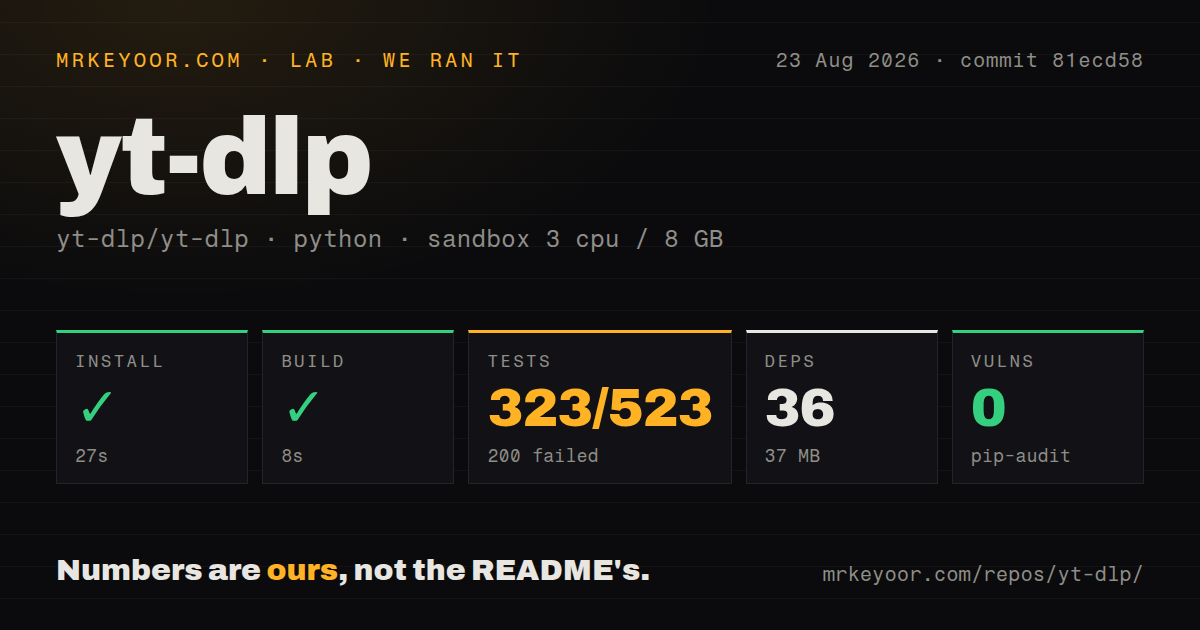
Our sandbox installed 36 Python packages in 27 seconds and used 37 MB on disk. The build completed successfully in 8 seconds. Pip-audit reported 0 known vulnerabilities in the installed packages. We tested commit 81ecd58 in a fresh Python 3.12 Debian container with 3 CPUs, 8 GB of RAM, no secrets, and network access available to the test command.
Pytest exited with code 1 after 735 seconds. It reported 323 passed, 200 failed, and 50 skipped out of 523, plus 39 passing subtests. The suite stopped after reaching its 200-failure threshold, with 726.40 seconds recorded in the final summary. This was not a marginal failure or a timeout after an otherwise clean suite.
The tail shows several kinds of failure. Bibel TV extractors could not find expected page data. Bild responses failed JSON parsing. BiliBili requests received HTTP 412, and one BiliBili playlist returned 1 entry where the test expected 26. A Bigo case said its own test definition lacked the required output-extension field. These results mix remote-site behavior with a test-definition problem; the log does not provide one cause for all 200 failures.
Nightly is the practical channel because stable can go stale
The project offers stable, nightly, and master binary channels. Stable is published roughly monthly, but the README says external site changes can make it stale and recommends nightly for regular users. Nightly publishes on days with source changes, while master publishes after every push and may contain more regressions. Users reporting a stable-channel bug are asked to reproduce it on nightly or master first.
That policy fits the August 19, 2026 release. Its changelog includes extractor fixes or reworks for Apple, Bandcamp, BFMTV, Instagram, Showroom, TikTok, Twitter, Vimeo, Whyp, and YouTube. GitHub recorded the last push on August 26, followed by more site fixes that day. For personal use, staying on nightly is reasonable. For a production job, test nightly, then pin the exact artifact until the next controlled update.
Authentication can expose formats without guaranteeing them
The CLI can read cookies from major browsers and supports username, password, two-factor codes, .netrc, client certificates, proxies, and browser impersonation through curl_cffi. These options help when a site expects a logged-in or browser-like request. They also move sensitive session data into the downloader process. Run it under an account with the minimum access needed, restrict configuration permissions, and keep verbose logs away from shared storage.
Even complete credentials may not unlock every format. Open issue 17542 shows stable 2026.08.19 using 3,309 Chrome cookies, FFmpeg 8.1, Deno 2.6.10, and yt-dlp-ejs 0.8.0, yet an age-restricted YouTube item exposed only format 18 at 360p. The debug log says higher formats needed a PO token that was not supplied. Authentication, JavaScript challenge solving, and format authorization are separate gates.
Format selection is powerful enough to surprise old scripts
Output templates can use metadata fields for directories and filenames, while format expressions filter and sort video, audio, codecs, size, language, and quality. SponsorBlock integration can mark or remove selected segments. Plugins can add extractors and post-processors, and Python applications can embed YoutubeDL rather than launching a subprocess. This breadth rewards explicit configuration because defaults can evolve.
The README already warns that a future default format may change when multiple formats are streamed to standard output through FFmpeg. Licensing also varies by distribution: the repository and PyPI packages use the Unlicense, while PyInstaller executables contain GPLv3+ code and other bundled licenses. GitHub showed 187,196 stars and 2,598 combined issues and pull requests on August 27, 2026. That large, active queue matches a tool maintained against thousands of moving targets.