It builds one kind of SeaDrop mint from chain data
NFT Public Mint Sniper focuses on public SeaDrop stages. It reads the active stage, price, fee recipient, and wallet limit from the contract, constructs the call, signs it locally, and broadcasts it through configured RPC endpoints. An OpenSea login is unnecessary when the user supplies a contract address or item link. That narrow design is easier to inspect than a general trading bot and avoids depending on a marketplace API during the last seconds before a mint opens.
The project is tiny: our checkout had 19 files, about 1,837 source lines, and measured 0.1 MB. The README points readers to roughly 150 lines in src/local-mint.ts for the signing path. Small is helpful when private keys and irreversible calls are involved, though it does not mean safe. A reviewer still needs to trace the destination contract, encoded arguments, value, chain ID, nonce, gas fields, and every RPC destination before putting funds behind the program.
Public stages work; allowlists do not
The tool explicitly rejects allowlist and signed first-come stages. Those SeaDrop paths call mintSigned() and need a signature generated for a particular wallet through an authenticated OpenSea session. NFT Public Mint Sniper's premise is that every required value comes from public chain state, so adding an account-dependent stage would break that boundary. This is a good limitation because it prevents the CLI from pretending that an unavailable off-chain authorization can be inferred.
Three networks are built in: Ethereum with chain ID 1, Base with 8453, and Robinhood Chain with 4663. The CLI probes RPC endpoints for the selected chain and drops endpoints on the wrong network. It accepts a collection link, item link, slug, or contract address, but the README says slugs need a lookup that may be unauthenticated while raw addresses avoid that dependency. For a timed run, resolve and verify the contract before the launch window rather than discovering a lookup problem at the deadline.
What happened when we ran it
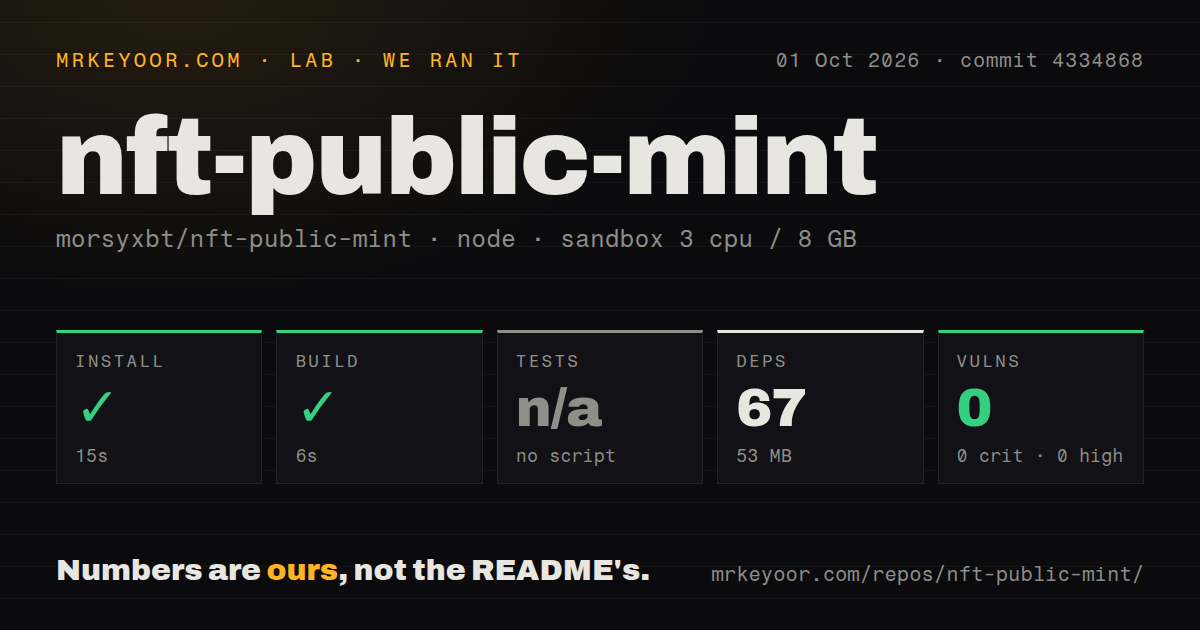
Our fresh Debian sandbox installed commit 4334868 in 9 seconds. Npm added 67 packages and used 53 MB on disk. The TypeScript build completed in 7 seconds, and npm audit reported 0 known vulnerabilities. No manual packages, chain credentials, or secrets were required to reach the compiled result. That is a clean source setup and makes code inspection cheap. It does not say that any transaction was sent or accepted.
There was no test script or target, so our harness skipped tests. The repository also had 0 CI workflow files and no tests directory. For software that handles private keys, balances, fee arithmetic, multi-wallet nonces, and timed broadcasts, that absence is the deciding weakness. The 7-second compiler pass catches type and syntax problems; it does not prove correct calldata, sufficient balance checks, rejection behavior, or receipts under network congestion. We did not invent a transaction trial to fill that gap.
Private keys stay in memory but still enter the process
The CLI asks users to paste one or more private keys, hides terminal input, derives addresses for confirmation, and says it keeps keys only in memory for the run. Its ignore rules cover .env, wallet directories, and key files, while the README tells users to fund dedicated hot wallets with only the intended spend. Those are sensible boundaries. A compromised machine, terminal logger, malicious dependency, or altered source can still read process memory and sign something else.
Using several wallets multiplies the exposure. Our install pulled 67 packages, any of which becomes part of the trusted execution environment even with 0 known audit findings. Install from a pinned commit, examine the lockfile, build locally, and do not reuse a wallet that controls other assets. The repository's README says private keys do not belong in .env; following that advice also avoids leaving them in shell history, backup tools, or a checked-in configuration file.
Gas checks reduce mistakes without guaranteeing inclusion
The wizard displays the current base fee and asks for a priority fee and maximum fee. It rejects a ceiling below the base fee, a tip above the ceiling, and balances that cannot cover the node's upfront reservation. The README explains that nodes consider gas limit multiplied by maximum fee plus mint price, even when the eventual charge is lower. This can prevent a thin wallet from broadcasting despite an apparently affordable likely fee, so the preflight computes a ceiling the balance can support.
Those checks cannot make a congested mint deterministic. The default flow pre-signs and sends when the public stage starts, but an open pull request proposes private Flashbots routing on Ethereum, fee bumps after a pending interval, and dynamic gas estimation. Because pull request 1 remains open, buyers should not describe those features as released. The current README's approximate gas figure is guidance from the project, not a measurement from our sandbox. Test fee settings with money you can lose and verify the deployed commit before launch.
The first release has not happened
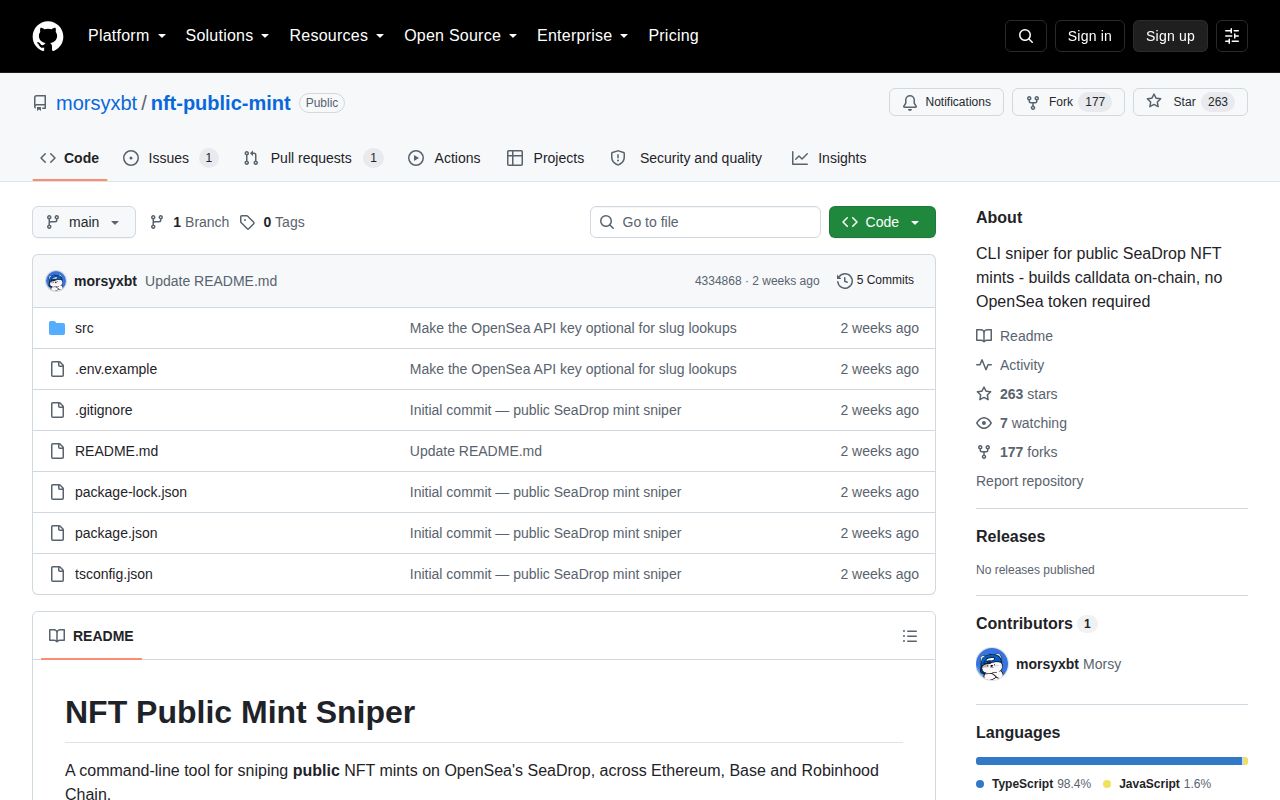
GitHub says the repository was created August 15, 2026, and last pushed the same day. It had 263 stars and 2 combined open issues and pull requests when fetched on August 26. The latest-release endpoint returned no release, and the root contains no LICENSE file even though the README labels the project MIT. Until an actual license file appears, organizations should not assume that a one-word README statement supplies every term they need.
The tool is understandable and quick to build, which makes it suitable for study and a low-stakes rehearsal. The missing test target, absent CI, unpublished release, and live-key workflow prevent a stronger recommendation. Our run proves that 67 dependencies install and TypeScript compiles; it does not prove a safe mint. A careful user can audit the small signing path and isolate funds. Anyone seeking unattended execution with valuable wallets should wait for tests, tagged releases, and verified replacement behavior.