Nineteen skills cover the work around a paper
Nature Skills turns recurring research jobs into instruction packages an agent can load. The 19 listed skills cover paper reading, academic search, reference verification, manuscript polishing, reviewer responses, figures, presentations, statistics, data statements, experiment logs, and Chinese patent drafts. That breadth is the attraction. A researcher can keep one set of task rules close to the files and ask Claude Code, Codex, Chatbox, or another compatible agent to follow them.
The project is Chinese-first, and that shapes its examples and community links. It also has a 37,843-byte English README plus mirrored English pages for individual skills. The English documentation is detailed enough to judge inputs, outputs, boundaries, and installation. Some surrounding material, including Douyin tutorials and the Knowledge Planet community, remains aimed at Chinese speakers. English-only teams can use the code, though they will miss part of the support environment.
Four Stable labels make selective installation the sensible default
The repository calls 4 of its 19 listed skills Stable: figures, polishing, reference verification, and the literature pipeline. The remaining entries are Beta or Draft. Those labels are useful because the jobs carry different risks. A rough presentation deck can be corrected. A fabricated reference, shifted numeric claim, or careless patent draft can waste weeks or create a formal problem.
Install the smallest set that answers a real task. The README shows npx skills commands for one skill, a project-local install, a global install, or all skills. Shared support files must accompany several modules. Copying only SKILL.md can break references to templates, scripts, static assets, or nature-shared. The project says this directly, and it is the sort of packaging detail an agent may overlook when asked to copy a single prompt file.
What happened when we ran it
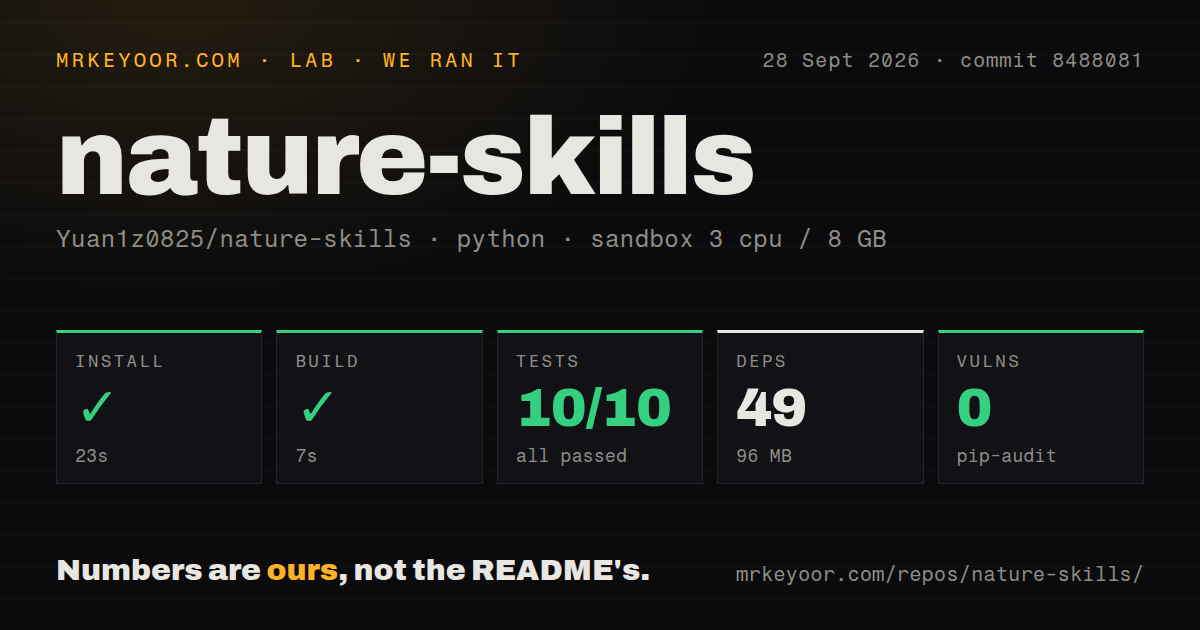
Our sandbox installed the Python project in skills/nature-downloader/ in 23 seconds. The run added 49 packages and used 96 MB on disk. Its build completed in 7 seconds, then pytest finished in 9 seconds with 10 passed and 0 failed. Pip-audit reported 0 known vulnerabilities in the installed environment.
Those results cover the tested downloader component at commit 8488081, not all 19 research workflows. The checkout contained 807 files, about 50,945 lines of source, and occupied 43.5 MB before the installed packages. We found 8 CI workflow files and a tests directory, but no Dockerfile. The passing suite is a good signal for that component, while figure rendering, manuscript judgment, browser flows, and external database access need their own task-level checks.
The installer does not install the research stack
The skill manager copies instructions and supporting files. It does not add every runtime those instructions may call. The README separately lists Python requirements for patent and academic-search tools, plus an optional Playwright Chromium install for Chinese patent search. Academic search needs PUBMED_EMAIL; Scopus and ScienceDirect providers use local credentials. Figure, PDF, PowerPoint, browser, and R work can bring more tools depending on the selected skill.
That separation is reasonable for a 19-skill collection because few labs need every dependency. It also means the quick installation command is not a complete readiness check. A useful acceptance test starts with one real paper and one expected artifact. Confirm that the agent loaded the intended skill, preserved values and citations, wrote files only where allowed, and stopped for missing credentials instead of filling gaps.
Auto-update scripts trade convenience for change control
Both Claude Code and Codex instructions describe keeping a dedicated clone and synchronizing skill folders. The optional session-start updater throttles network checks to once per hour, refuses to advance a dirty clone, and verifies copied files. That is thoughtful behavior for an individual workstation. It still changes instructions between sessions, which can change how the same research request is handled.
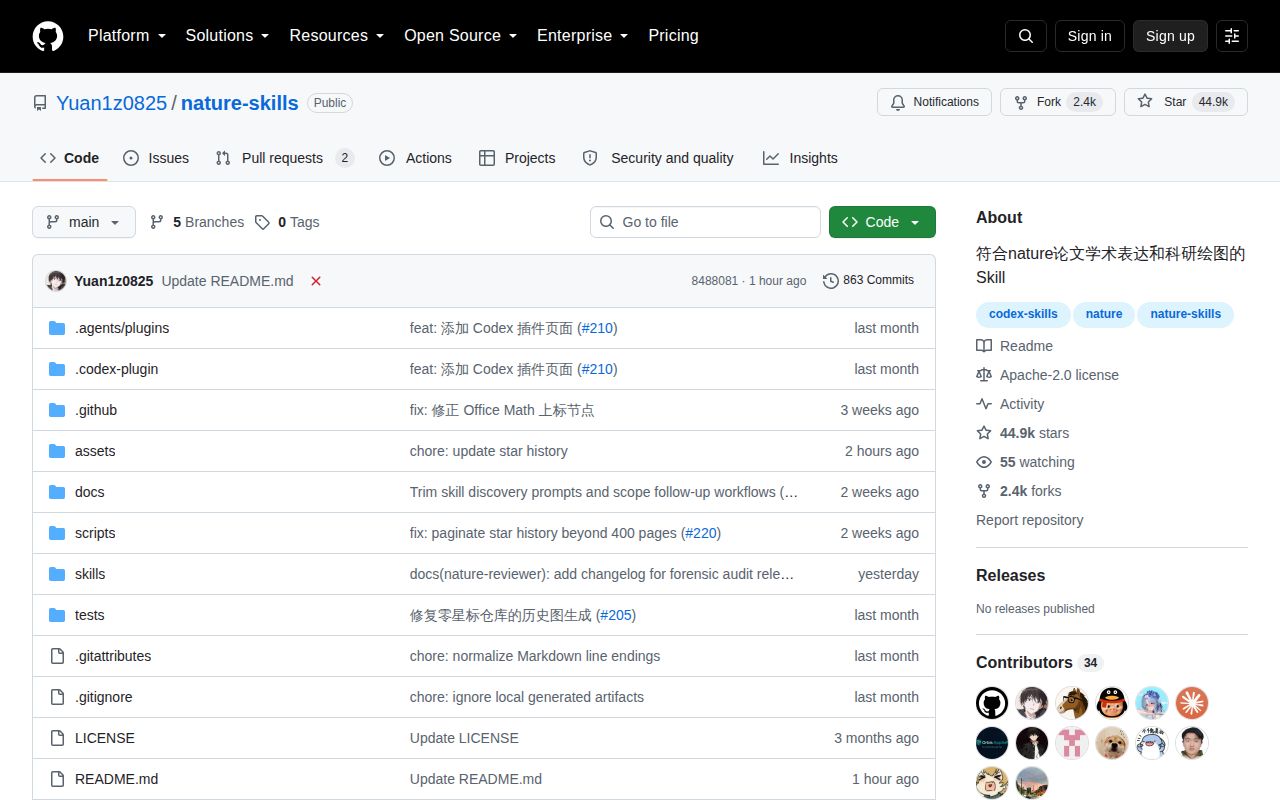
A regulated lab should pin commit 8488081 or another reviewed revision and promote updates after checking the changed skill files. The repository had no latest GitHub release when we fetched it, so there is no versioned release channel to substitute for that process. Main was pushed on September 28, 2026, and GitHub showed 44,872 stars plus 2 open items, both pull requests. The project is active, but activity does not provide reproducibility by itself.
The collection is best treated as a lab manual under review
Nature Skills is more useful than a loose prompt collection because it keeps workflows, supporting references, scripts, and output expectations together. The strongest fit is a lab that already lets agents work with local files and wants one reviewable place for recurring procedures. Selective installation keeps the tool surface and context smaller. The Apache-2.0 license also permits internal adaptation.
The boundary matters more than the catalog size. All 10 tests passing tells us the measured downloader package was healthy in our container. It does not prove a reviewer report is fair or a scientific figure tells the truth. Keep source documents attached to the output, review high-stakes claims, and freeze the exact skill revision used for work that must be reproduced later.