The catalog gives agents scientific operating instructions
Scientific Agent Skills does not provide a new model or one scientific program. Each skill is a SKILL.md package that tells a compatible agent how to approach a tool or workflow, often with reference files and executable scripts. The catalog spans Python libraries, public databases, lab platforms, literature work, visualization, regulatory evidence preparation, and document production. Claude Code, Codex, Cursor, Gemini CLI, and other hosts can discover the same basic format.
That approach is useful because agents often know a library's vocabulary while missing the safe order of operations, current parameter names, or domain checks. A good skill can put those details near the moment of execution. It cannot make a language model scientifically reliable by itself. The README repeatedly confines clinical material to research, aggregate analysis, or drafts for qualified review, and it rejects patient-specific diagnosis and treatment decisions.
Installing 1 skill is safer than loading the full catalog
The shortest install uses npx skills add K-Dense-AI/scientific-agent-skills. GitHub CLI 2.90.0 or newer can install one named skill and pin a release or commit. The repository also follows the Agent Plugins layout, so plugin-capable clients can discover every immediate child under skills/. Manual copies work when a host scans the chosen user or project directory.
The README itself advises against installing everything. It says community contributions may not have received the same depth of internal review as K-Dense-authored material. A skill can tell an agent to run code, modify files, install packages, or contact external services. That makes each installed folder part documentation, part executable supply chain. Read the instructions and scripts, inspect their history, run a scanner, and pin a version before letting the host use them.
A topical subset also reduces standing context. The README notes that 161 skills add up to a large amount of material, even though the current badge and introduction say 163. Those inconsistent counts are minor as product facts, though they show why the directory itself should be treated as authoritative. Install the 2 or 3 skills for the current project rather than treating the catalog as one indivisible plugin.
What happened when we ran it
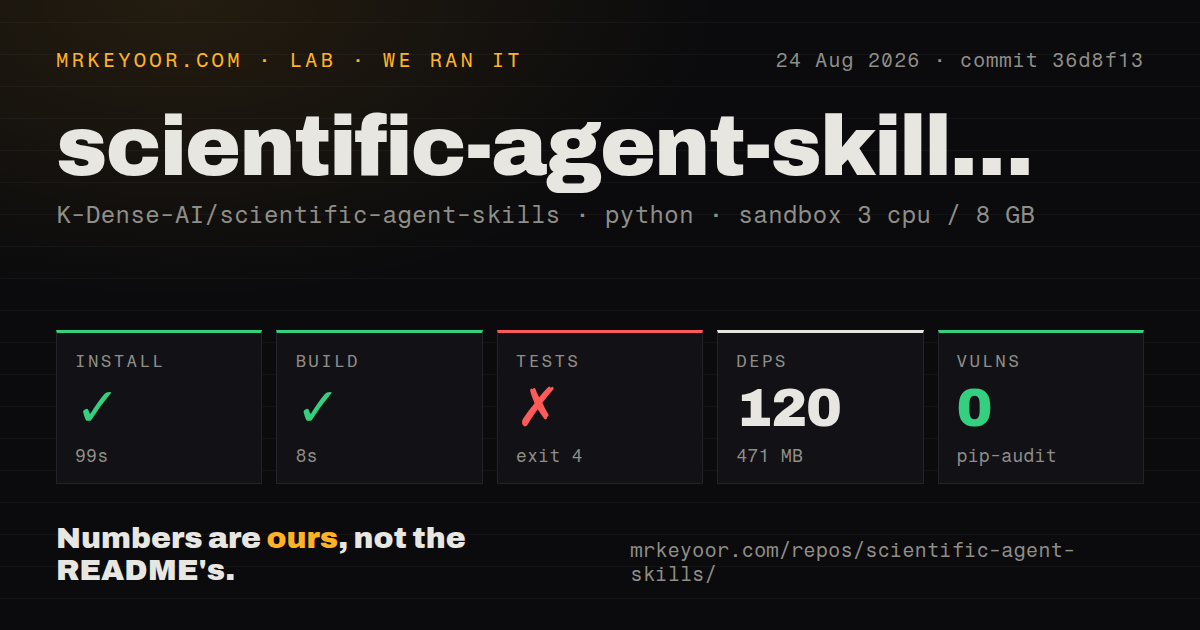
Our sandbox installed 120 Python packages in 99 seconds and used 471 MB on disk. The package build succeeded in 8 seconds. pip-audit reported 0 known vulnerabilities. The measured checkout contained 2,446 files and about 221,698 lines of source, with 5 CI workflow files and a tests directory. It had no Dockerfile.
The test command failed during collection with exit code 4 after 14 seconds. Its message was specific: 105 skills could not be collected in one process because their scripts/ directories reuse module names such as _common.py. Python could resolve one skill's helper while testing another. The runner instructed users to run one skill at a time. No test assertions ran in that invocation, so this was a test-layout failure rather than evidence that 105 skill behaviors are broken.
The README's contribution section matches that constraint. It gives a repo-level metadata test, then a separate pytest tests/<skill-name> command for each skill. Contributors can work that way, but a buyer auditing a broad subset must create an isolated loop or rely on CI jobs that preserve module separation. A single green build in 8 seconds says the package assembles; it does not validate scientific results or live API compatibility.
Live APIs can make correct-looking guidance wrong
Two open pull requests show the maintenance problem clearly. Pull request #201 says the U.S. Fiscal Data skill documented Treasury auction fields that do not exist, causing an error or an empty column. The correction replaces the field names and explains that one value described as a percentage is a currency amount. A researcher following the old example could get no result or misread the returned quantity.
Pull request #228 is more serious. It updates the Genomic Intelligence skill after checking the live /v1 contract. The old guidance suggested a wrong-strand splice call could be detected from empty or zero output. Live checks showed the reverse complement could still return high-looking scores, so that heuristic could let an incorrect result pass. The proposed text now requires getting sequence orientation right before the call.
These are healthy corrections, and the repository was pushed on August 24, 2026, with issue and pull-request activity continuing the next day. They also prove that prose can drift even when its format validates and its scripts parse. Any skill that wraps a remote schema needs a fixture against the live service, a dated compatibility note, and an independent check of scientific semantics.
Credentials and scientific responsibility stay with the operator
Repository tooling needs Python 3.13 or newer and uv. Individual skills may broaden Python support, but they can bring large packages, model weights, external databases, and API credentials. A default-deny agent sandbox such as NemoClaw also needs explicit domain approval before package installation or API calls work. The skill file should identify these needs; the operator still has to scope secrets and network access.
For research code, inspect intermediate data rather than accepting the final narrative. Confirm identifiers, units, reference genomes, statistical assumptions, and database dates. For lab automation, simulate before touching equipment. For clinical or regulatory material, keep the generated artifact visibly draft and route it to the qualified person named in the workflow.
Scientific Agent Skills is worth using when it saves the first hour of reading scattered package and API documentation. Its 471 MB base install, per-skill test isolation, and current API corrections rule out blind trust. Choose a small pinned subset, test it against known fixtures, and treat the agent's output as work to verify rather than a scientific result.