Dexter leaves a research trail you can inspect
Dexter's documented scratchpad records tool arguments, raw results and the model's summary for each query. That is the strongest reason I'd evaluate this financial research agent: you have material to check when an answer looks plausible. The README describes an agent that plans research and chooses tools to retrieve financial data. Our sandbox results establish a much narrower outcome, so I'd approach it as a research experiment requiring human verification.
A tool result and a polished paragraph can disagree about a reporting period or what a figure means. Keeping both gives you somewhere to start checking. It doesn't make the final answer correct. Dexter's README expressly limits the project to educational, entertainment and informational use and says it isn't intended for real trading or investment. That boundary belongs in the decision before you connect it to a consequential workflow.
What happened when we ran it
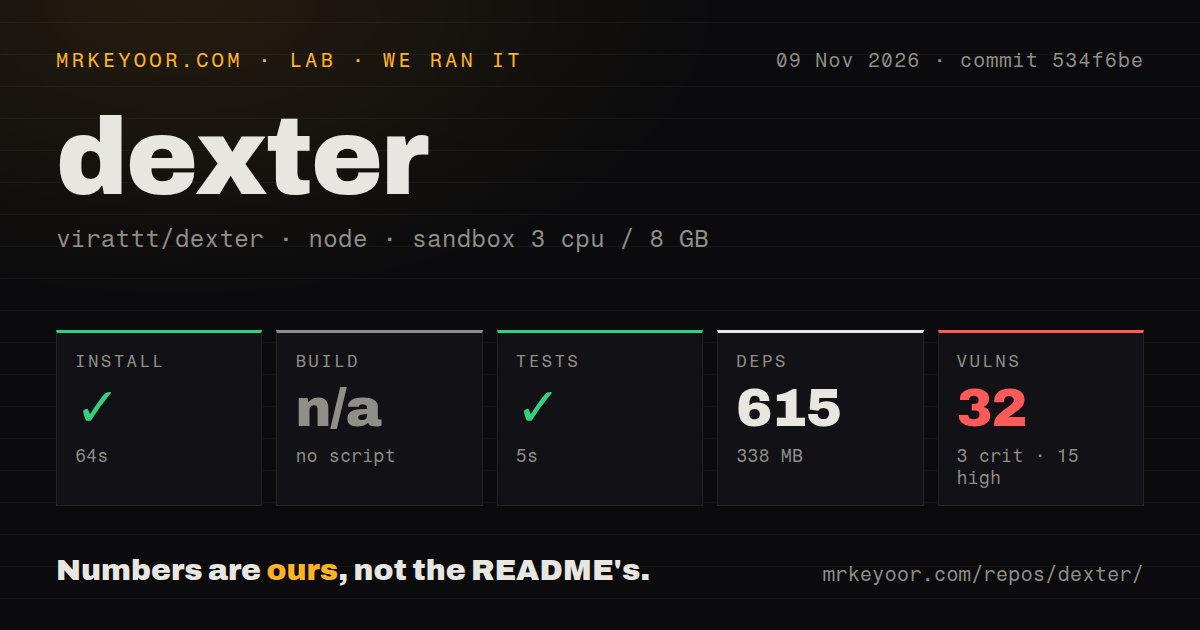
Our Dexter installation succeeded in 64 seconds, and its test step succeeded in 5 seconds. We cloned commit 534f6be on November 9, 2026. The record gives no test count or case names, so the successful exit cannot support a claim about how much behavior was exercised. No build script or target was found, and that step was skipped. A skipped build is neither a passing compilation result nor a build failure.
The recorded 615 dependencies occupied 338 MB, compared with a 1.7 MB checkout containing 239 files and roughly 27,158 source lines. The sandbox configuration specified 3 CPUs, 8 GB RAM and image label lab-node:22. Dexter uses Bun, but the image label establishes neither the Bun version nor the actual operating-system version. The scan found 2 CI workflow files, no Dockerfile and no tests directory. That directory observation doesn't establish an absence of tests elsewhere.
Our npm audit recorded 32 known vulnerabilities: 3 critical, 15 high, 5 moderate and 9 low. This deserves investigation before you give the checkout credentials. The supplied block doesn't identify the affected dependency paths, their reachability or available fixes. It also contains no completed financial research question, answer-quality assessment or API-cost measurement. The passing test step settles none of those questions.
Bun setup still leaves provider configuration
The README lists Bun v1.0 or higher and a Financial Datasets API key among the prerequisites. Its basic instructions use bun install, environment configuration and bun start. Model-provider examples include OpenAI and several alternatives, plus an optional local Ollama endpoint. Search configuration names Exa with Tavily as a fallback. Choose the provider path you intend to use before treating the local process as a usable research setup.
A local model option doesn't establish an offline financial-data workflow. Nor does a successful dependency installation establish that a provider account has the data access your question requires. Those remain checks for your trial. The README's short path is enough to explain the moving parts, but our record contains no authenticated provider session, verified data coverage or demonstrated operating cost. Budget for those unknowns separately from the measured dependency footprint.
The scratchpad helps verification and retains query data
The documented log location is .dexter/scratchpad/, with a new JSONL file for each query. That makes it possible to compare a retrieved financial statement with the model's interpretation rather than relying on the answer alone. Treat those files as retained research data: the documented entries include the original question and raw tool results. If your work cannot leave that material on disk, assess this logging behavior before using sensitive questions.
For a first trial, ask a narrow question about a named company's annual operating cash flow across specified fiscal years. This is a suggested evaluation, not a workload we ran. Check the reporting dates and currency in the raw result, then recompute the change yourself. Reject an answer that silently changes periods or substitutes another cash-flow measure, even if its prose is confident. The log is useful only when someone reads it against the underlying source.
Evaluation sends questions and answers to LangSmith
The evaluation runner sends question inputs and generated answers to LangSmith. Its source calls the LangSmith client's createRun with both, alongside evaluation information. The README describes an LLM judge for correctness. That's a separate data flow to consider before evaluating private research, and a judge's score needs its own scrutiny. Our 5-second test result is not a recorded run of this financial-question evaluation.
The September push doesn't tell the whole maintenance story
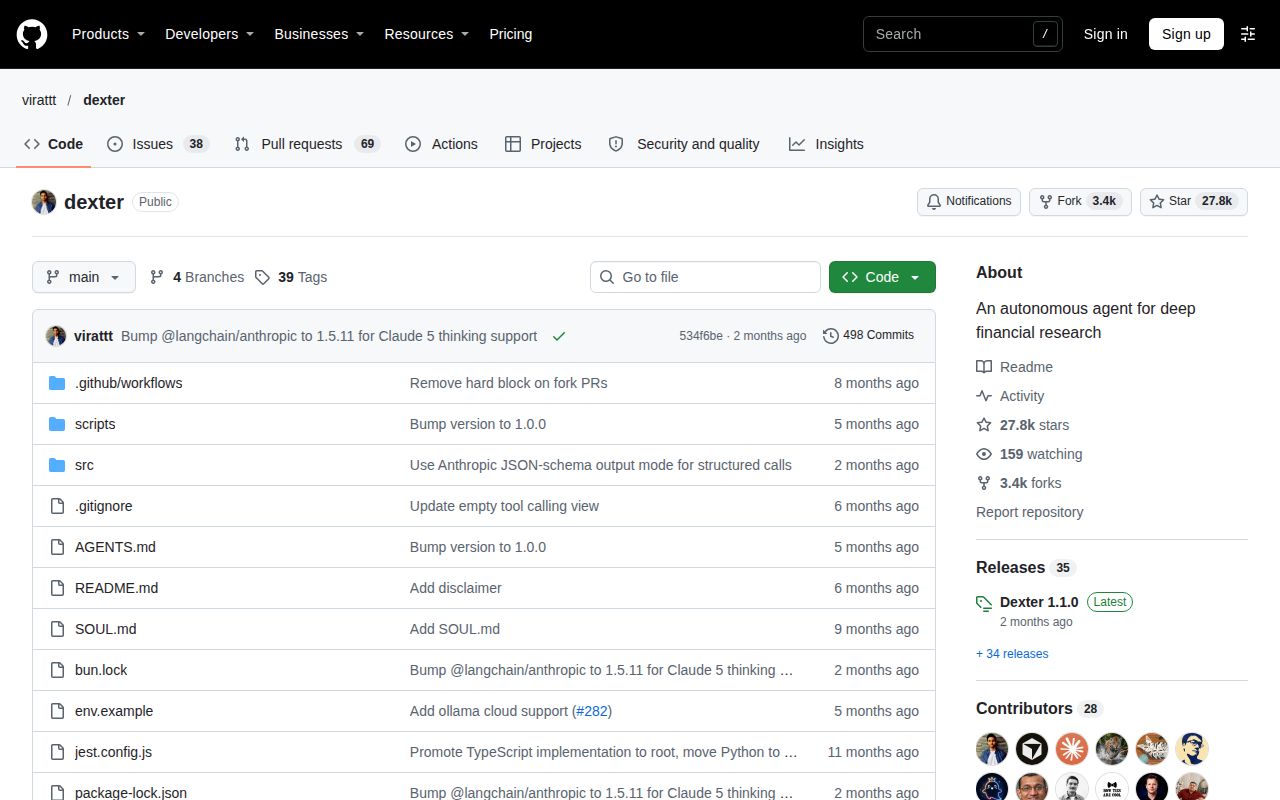
GitHub's repository metadata records the last push as September 23, 2026. The issue feed still contains activity in November: issue #309, updated November 2, proposes an additional official-source data integration. A contributor's proposal doesn't establish shipped support. These observations show continuing discussion alongside an older push date, without proving maintainer responsiveness or abandonment. Support capacity remains unassessed.
OpenBB and AI Hedge Fund suit different questions
OpenBB's Open Data Platform connects data sources to Python environments and application APIs. Evaluate it when you want to write the analysis yourself and mainly need a data integration layer. Its current repository is openbq-org/OpenBB. AI Hedge Fund documents historical backtesting. Its README also describes paper trading and restricts use to education. Compare it when simulated portfolio behavior is your question. Neither alternative was run in this evaluation.
Documentation receives 4/5 on an editorial scale where 1 means missing task guidance, 3 means a usable basic path and 5 means all relevant paths independently verified. The setup, logging and evaluation instructions support that score, with completeness unverified. Supported-platform setup, community support and production reliability remain unrated. Before accepting Dexter for research assistance, reconcile an answer with its raw results and review the advisory paths that could reach your provider credentials.