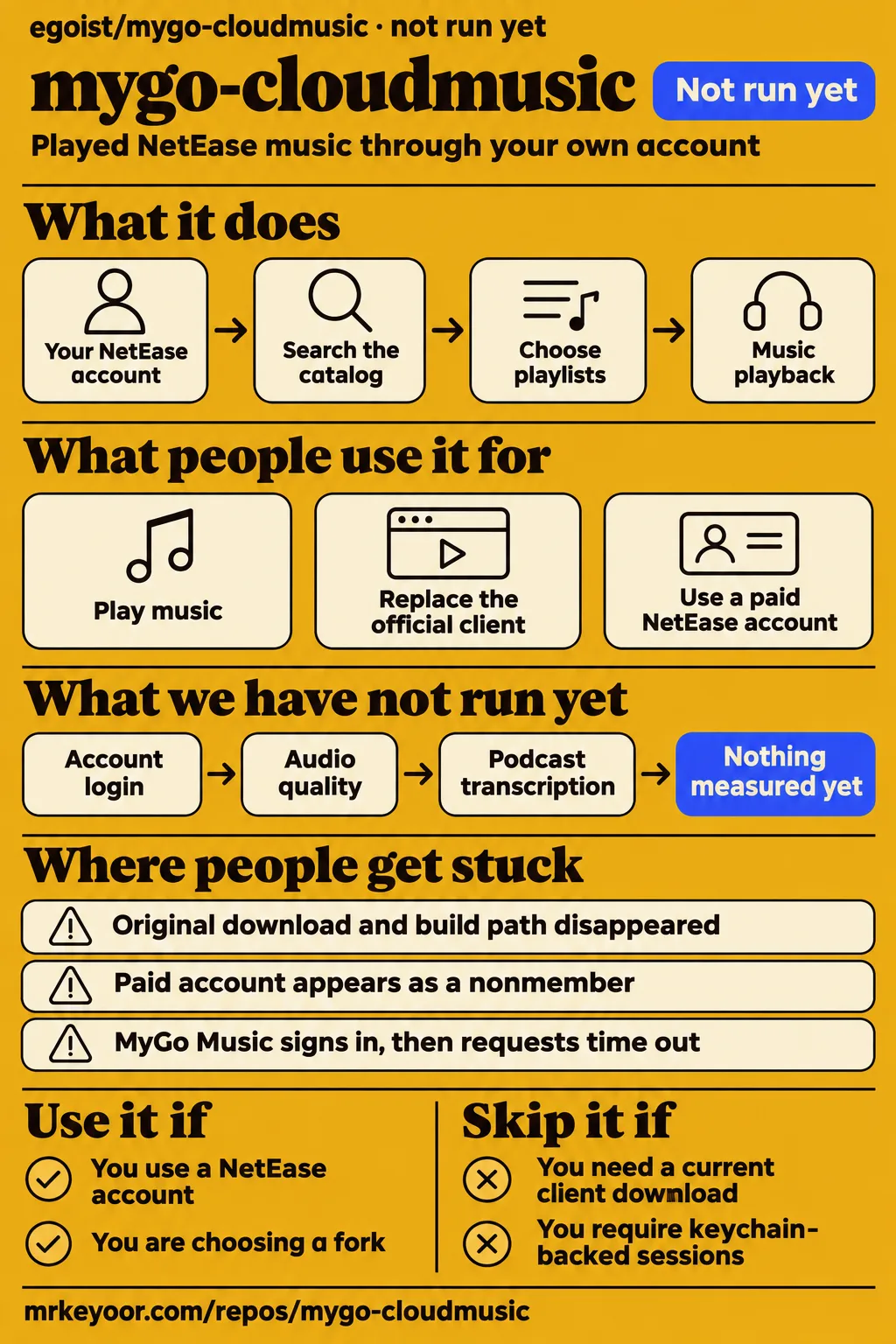
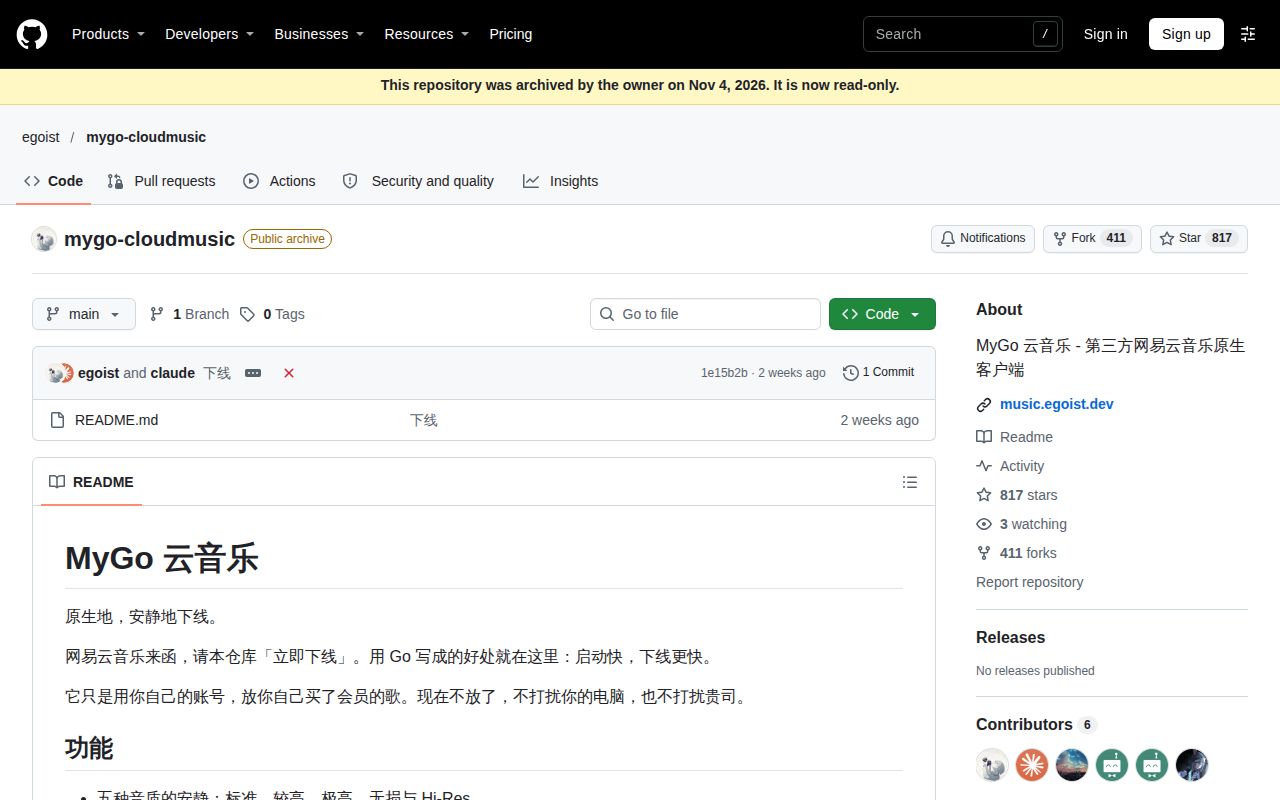
The original egoist/mygo-cloudmusic distribution has been removed after a NetEase takedown request. Use this review if you're choosing between the remaining forks and a separate plugin route. Skip the original repository if you need a client to download today: its README sends you to NetEase's official app. Our sandbox attempt stopped before application execution. Original project status.
The strongest reason to reconsider the early praise comes from one listener. On October 27, 周尔复 (@cholf5) reported 82 MB of memory use while playing music. On November 15, the same person said a paid account appeared as a nonmember and they had uninstalled the app. Responsiveness made it appealing; access to the music made the decision. Those are personal reports, with no controlled comparison or demonstrated cause for the account failure. October playback report, November uninstall report.
What people use mygo-cloudmusic for
Listeners used MyGo Cloud Music to replace the official NetEase desktop experience, including one person who later abandoned it after membership recognition failed. These accounts describe actual choices, rather than a list of features someone hoped to use.
| Who and when | What they did | Reported outcome |
|---|---|---|
| 周尔复 (@cholf5), October 27, 2026 | Played music through MyGo Cloud Music | Reported 82 MB memory use during playback and said the more responsive experience made listening appealing again. Post |
| MoeDejavu, November 4, 2026 | Replaced the official NetEase client | Said they had uninstalled the official client and regretted MyGo Cloud Music's removal. X discussion |
| 周尔复 (@cholf5), November 15, 2026 | Used the app with a paid NetEase account | Reported being treated as a nonmember and uninstalled the app. Post |
The author's MyGo project listing describes daily picks, playlists, search, Personal FM, word-by-word lyrics, lossless and Hi-Res playback, podcasts with on-device transcripts, and a player in the screen notch. That's the historical feature pitch. It explains why a NetEase listener might have wanted the app, while the individual accounts show what made people keep or remove it. Author's project listing.
For someone starting today, the practical question is which project still serves their library. An old screenshot or enthusiastic post can help explain the attraction, but choose the current repository before choosing a download. The original name appears on projects that now describe different music sources.
What happened when we ran it
Our November 17, 2026 sandbox attempt at commit 1e15b2b did not run the application: the harness found no supported ecosystem, recorded language as null, and found no Dockerfile. The configured sandbox had 3 CPUs and 8 GB of RAM; its image was recorded as n/a. Those are configuration facts, not measured application requirements.
| Check | Recorded result | Meaning for this review |
|---|---|---|
| Ecosystem detection | No supported ecosystem; language: null | The harness had no supported execution path. |
| Container entry point | No Dockerfile | There was no Dockerfile route for this attempt. |
| Separate hands-on safety step | FAILED: no compose.yaml, compose.yml, docker-compose.yaml or docker-compose.yml | The lab's rule required a Compose file, so this step stopped. |
| Teardown | ok | Cleanup completed. |
The failed safety step calls the repository "unsafe" because it lacks a required Compose file. That wording describes the lab's execution rule. It supplies no evidence of malicious code or a defect in music playback. Likewise, the missing execution path doesn't establish a package or operating-system problem. The public README independently says there is nothing left to build. Shutdown notice.
A generic record labels the attempt as deployed with its own Docker Compose, but the specific safety result reports that no Compose file exists. We give the explicit failure precedence and report no successful deployment. The conflicting label belongs in the record, not in a claim that we listened to music.
Where people get stuck: account access and a separate proxy problem
A paid-membership failure caused @cholf5 to uninstall MyGo Cloud Music; a different project's issue describes sign-in working through a proxy while subsequent requests time out. Keep those failures separate. Neither record identifies a common cause between the original client and MyGo Music. Membership report, MyGo Music issue #51.
| Problem | What the evidence supports | Action or status |
|---|---|---|
| Original download and build path disappeared | The original README directs users to the official client. | Choose another distribution or the official app; old original-repository instructions are obsolete. Status |
| Paid account appears as a nonmember | One user reports the outcome and asks whether the app or NetEase caused it. | No documented fix accompanies the report. User report |
| MyGo Music signs in, then requests time out | Binaryify's issue #51 says ordinary requests ignore system proxy settings while sign-in and updating follow them. | The author documents a launchctl HTTPS_PROXY workaround and supplies a proposed branch. The sampled issue is open. Issue #51 |
| Proposed proxy change cannot become a PR | Binaryify reports collaborator-only pull requests and permission errors. | A collaborator must import the branch or the restriction must change. The record ends without a merge. Contribution discussion |
The proxy report is especially useful if login succeeds and you assume connectivity is settled. Binaryify describes a split between the sign-in page and the requests that retrieve covers, songs and plugin data. They also explain that an app opened through Finder doesn't inherit shell variables. A terminal-only proxy change can therefore leave the launched app behaving differently. That is the issue author's account of MyGo Music, rather than a repair instruction for every fork carrying the cloudmusic name.
The original, the forks and MyGo Music are different choices
The cfour-hi fork now describes a private-cloud music client. The separate MyGo Music NetEase plugin describes access to NetEase's catalog. Similar repository names conceal a meaningful difference in what you'll connect to. cfour-hi README, NetEase plugin.
| Project | What its record says | Decision consequence |
|---|---|---|
| egoist/mygo-cloudmusic | Original distribution removed after a takedown request | Treat the repository as a shutdown notice. Status |
| vicnoah/mygo-cloudmusic | Release record lists v0.2.24 published November 7 | A fork release is a separate artifact, not a restoration of the original distribution. Release record |
| cfour-hi/mygo-cloudmusic | README focuses on FN Music, Songloft and Subsonic-compatible services | Consider it for a private music server; its NetEase-oriented About text doesn't describe that README's focus. Repository |
| MyGo Music plus AkinoKaede's NetEase plugin | Separate host app and catalog plugin | Evaluate the host and plugin together, including session storage and account restrictions. Plugin README |
For a private library, the cfour-hi README's server list is more useful than its inherited About line. For a NetEase account, start with the plugin's own documentation. These choices deserve separate support and compatibility checks because a release under one owner says nothing about the behavior of another owner's distribution. A fork needs its own playback record before I'd recommend it for a paid account.
Security: the plugin stores sessions in unencrypted files
AkinoKaede's NetEase plugin stores sessions unencrypted in the host's plugin data files rather than the system keychain. Its README says session cookies go only to music.163.com and interfacepc.music.163.com. That's a concrete storage tradeoff to weigh before signing in. Plugin session policy.
The plugin README describes QR sign-in through the NetEase app and a web sign-in option. It also says the plugin uses private APIs that may change without notice. If your requirement is keychain-backed session storage, this documented design is a reason to skip the plugin. Restricting where cookies are sent and protecting them on disk answer different questions; the stated destination list doesn't change the unencrypted storage policy.
Subscription, purchase and regional restrictions still apply to the plugin, and trial previews are not played as full songs. It also excludes video playback and FM dislike/trash actions. Choose it for the catalog features it documents, without treating a different client as a route around your account's permissions. For a worldwide reader, regional access belongs in that decision alongside the subscription you hold. Plugin restrictions.
English readers get different documentation across these projects
The original repository's current README is in Chinese, while the separate NetEase plugin has an English README and follows MyGo Music's English or Simplified Chinese setting. The original notice offers no English setup guide; its installation section points to the official app. Original repository, Plugin language documentation.
The community accounts used here are Chinese-language posts, translated or paraphrased into English with attribution. They describe NetEase listeners' experiences, not a survey of users worldwide. The plugin's explicit language setting is useful for an English-speaking reader, but it belongs to the plugin and its host. It shouldn't be carried over into a promise about the original app or either fork's interface.
mygo-cloudmusic vs the official NetEase client and web player
The original project's installation section now recommends the official NetEase client. The Go community article presents the web player as an option without a desktop installation. That gives a new listener a clearer starting point than an obsolete download guide. Original status, Go community comparison.
| Choice | Why someone would choose it | Evidence behind the tradeoff |
|---|---|---|
| Original MyGo Cloud Music | Historical reports describe a more responsive listening experience. | @cholf5 reported 82 MB during playback; the original distribution was subsequently removed. User report, Status |
| Official NetEase desktop client | It is the download destination the original project now recommends. | MoeDejavu had previously removed it in favor of MyGo Cloud Music. That preference isn't a current comparison test. Status, User discussion |
| NetEase web player | The Go community article describes avoiding installation. | That article also says it needs a browser and offers fewer features; these are the article's judgments. Comparison |
| MyGo Music with the NetEase plugin | A separate plugin documents search, playlists, podcasts and account features. | It retains account restrictions and stores sessions unencrypted. Plugin README |
I'd start with the official route if the goal is simply to hear a paid NetEase library. Consider the plugin if you specifically want its host and accept its session policy. A private-cloud listener should examine the cfour-hi fork instead of assuming it is another NetEase client. Those are choices about music source and account handling; the evidence doesn't support ranking their current speed against each other.
What the other reviews get wrong
The Go community article's original-repository download and source-build instructions are outdated against the shutdown notice. It tells readers to use GitHub Releases or build the original source, while that repository now says there is nothing left to build. Following the older tutorial is the wrong first step for a new listener. Go community article, Current status.
OpenToolsHub describes an open-source client and an AGPL-3.0 license. The supplied status record instead describes an original repository with no programming-language code and no declared license. That corrects the listing's current-availability implication. It doesn't settle the license of historical releases or erase their history. A license claim for a fork must come from that fork's own files. OpenToolsHub listing, Status record.
The Go community article also lists podcasts as absent, but the author's MyGo listing explicitly describes podcasts with on-device transcripts. Attribute that feature to the author rather than repeating the article's exclusion. Its tables also make broad performance judgments about frameworks; our evidence supplies no matched test to justify those rankings. Limitations list, Author's listing.
Questions people ask
The November 15 membership report gives no diagnosis: @cholf5 asks whether MyGo Cloud Music or NetEase caused the paid account to appear as a nonmember. The post records an uninstall, not a demonstrated service restriction. Membership report.
Is MyGo Cloud Music failing to recognize paid membership because of an app problem or a NetEase restriction?
The cause is unknown in the supplied report. The user describes a paid account showing nonmember status and raises both explanations as possibilities. Calling it a deliberate NetEase restriction would turn their question into a finding. There is no accompanying account trace or confirmed repair to distinguish those explanations. Original post.
How can the Mac music client's DMG be smaller than 8 MB?
The supplied extracts don't explain that size claim. The attached X search record contains a later Lee_points post about the takedown, rather than the October Mac-size post described in the synthesis. We therefore can't use it to establish a download size or explain packaging choices. The question needs the original artifact and a source that actually describes its contents. Supplied X extract.
Should the separate MyGo Music app follow the system proxy automatically or offer a proxy setting?
Binaryify's proposed branch offers Follow the System, Custom and Direct modes, with Follow the System as the default. The issue discussion favors making the app's requests consistent with sign-in and updating while retaining a direct option. That is a proposed behavior for MyGo Music, not evidence that those controls have shipped. Proposal in issue #51.
Has there been progress on MyGo Music's system-proxy issue?
Issue #51 contains a proposed branch, a documented environment-variable workaround and a collaborator-only PR obstacle. The supplied record remains open and ends with a November 12 request for progress. A branch being available is progress toward a fix; the thread contains no completed merge or release carrying it. Issue activity.
What we have not tested yet
We did not test playback, account login, membership recognition, audio quality, podcast transcription or any fork or plugin. Our harness stopped before execution, so this page contains no application memory benchmark, installation duration, build result or test-suite outcome from our lab. The configured 8 GB sandbox is not a minimum requirement, and the image label supplies no runtime or operating-system version.
The YouTube record for Nemo Cheung's MyGo Music video and the Bilibili search extract supply a title about local music and plugins, without a substantive demonstration or transcript. They cannot confirm successful playback or a setup procedure. Unrelated MyGO entertainment results and Music Assistant troubleshooting describe other subjects. YouTube record, Bilibili results.
Our next useful check would be a named fork or host-and-plugin combination on a desktop, using a paid account and tracks whose entitlement is known. It should check session persistence, full playback versus previews, proxy behavior and account recognition before measuring responsiveness. Until then, a release asset proves availability of an artifact. It doesn't answer whether your paid library will play.