MTPLX only makes sense on an Apple Silicon Mac
MTPLX requires an M1 or newer Mac, macOS 14 or later, and enough unified memory for the selected model. The README says 16 GB runs its 4B and 9B catalog choices comfortably, while its recommended Qwen 3.8 27B speed build starts at 32 GB. Linux users are explicitly directed to vLLM. This narrow target lets the project optimize for MLX and Metal instead of carrying several hardware backends.
The central idea is native multi-token prediction. A compatible model already contains heads that propose future tokens. MTPLX verifies a proposed block in one batched pass and uses rejection sampling with residual correction when sampling is enabled. It does not load a second draft model, which saves the memory that an external speculative decoder would need. Models without matching MTP weights can still be rejected or run in autoregressive mode, depending on their classified compatibility.
The README reports 1.6x speed on a 16 GB M4 Mac mini and 2.24x on an M5 Max. Its tuning example moves a 9B model from 14.4 to 23.0 tokens per second at draft depth 1. Those are project measurements, not our results. MTPLX sensibly includes a tuner that compares each depth with autoregressive decoding on the actual Mac and saves nothing when MTP loses.
The app removes much of the local-server plumbing
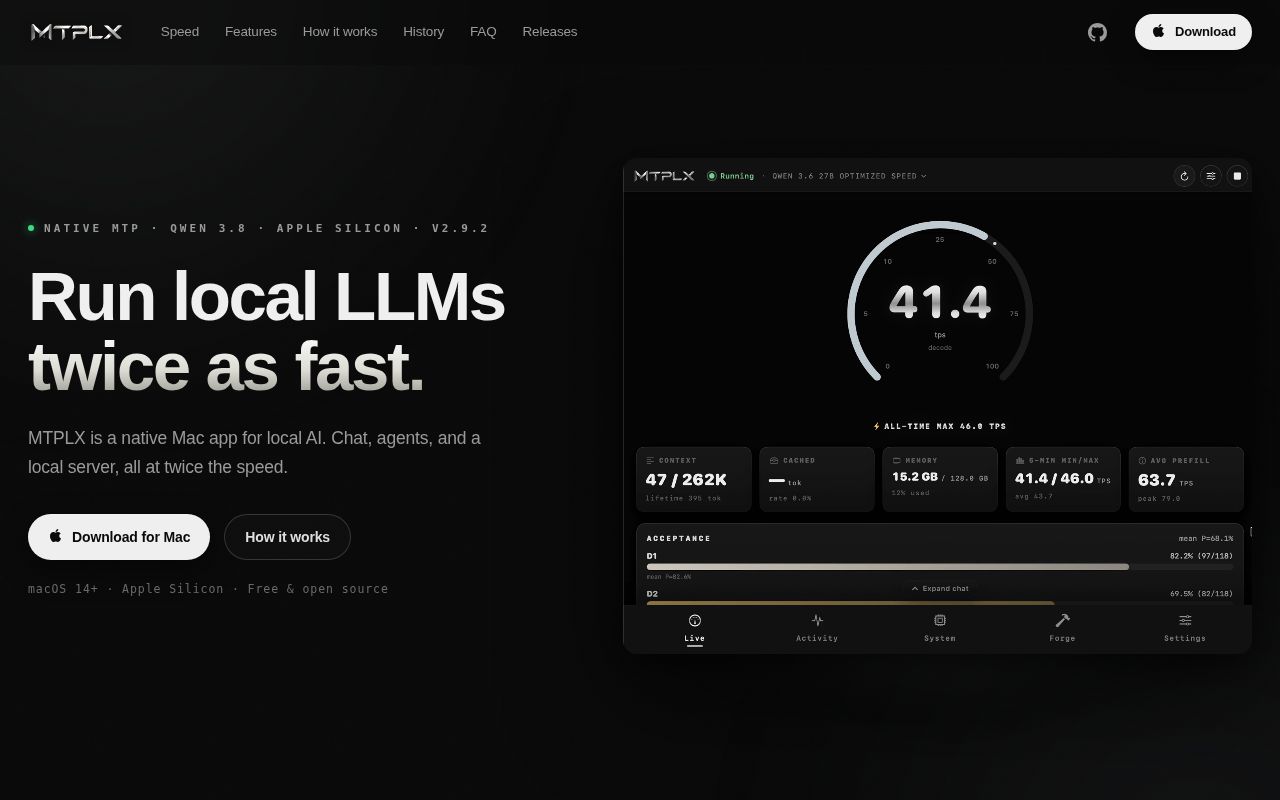
The native app checks hardware, recommends a model, downloads it, installs its Python engine, and can place mtplx on the shell path. Its dashboard exposes decode rate, acceptance by depth, cache state, verification work, and system pressure. Chat supports attachments and web search. Launch buttons can point OpenCode, Pi, Hermes, Open WebUI, and other compatible clients at the local server.
The server listens on 127.0.0.1:8000 by default and implements OpenAI chat, completions, models, optional embeddings and reranking, plus Anthropic messages. Streaming and tool calls are supported in both API styles. Claude Code can use it as a local endpoint. The app and CLI share one loaded model, avoiding a second copy when mtplx start detects the app's server.
Retrieval support is carefully separated from generation. Embedding and reranking models load on first request, have a default resident cap of 2, and do not use MTP because they return vectors or scores rather than next tokens. Checkpoints carrying custom Python are refused with HTTP 403 until an operator enables remote code. That default is the right one because downloading a model should not silently grant code execution.
What happened when we ran it
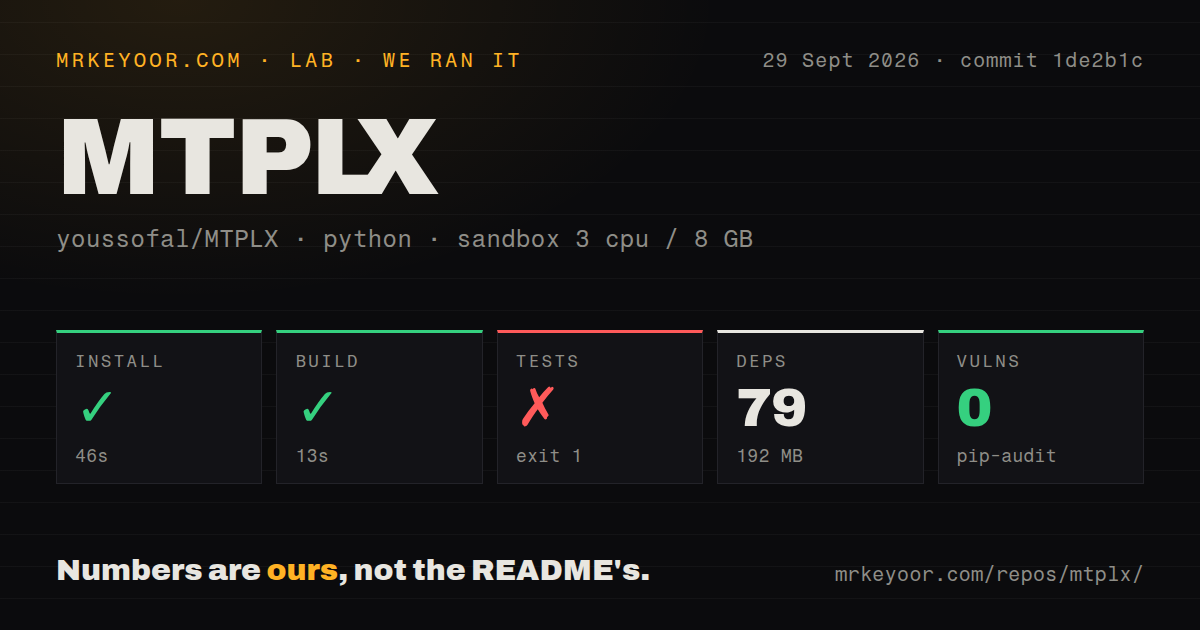
Our run installed 77 Python packages in 138 seconds, consuming 191 MB on disk. Building the Python package succeeded in 15 seconds. The checkout was 35.5 MB with 1,202 files and about 435,467 lines of source. pip-audit reported 0 known vulnerabilities, and the repository contained 5 CI workflow files plus a tests directory.
Tests failed with exit code 1 after 69 seconds. The supplied tail lists repeated failures in tests/test_engine_session_env.py, each ending with ModuleNotFoundError: No module named 'mlx'. The cases cover memory-size strings such as 16G, 512M, 4K, and invalid or nonpositive values, but the log gives no passed-test count and we will not invent one.
The packaging explains the platform result. mlx, mlx-lm, Transformers, and nanobind are conditional dependencies for Darwin on arm64. Our Python 3.12 Debian container could install 77 other packages and produce a distribution, but it did not receive MLX. The failed suite shows that some supposedly small environment-parsing tests still cross an Apple-only import boundary on Linux. It does not measure inference correctness or speed.
Compatible heads matter more than a matching tensor shape
MTPLX refuses to attach a separately supplied MTP sidecar to an arbitrary MLX trunk. The README argues that matching architecture fields and shapes cannot prove that a head was trained against those exact weights. Users should download a complete supported model or use Forge, which converts an upstream checkpoint, trains an adapter, and measures whether the result is both exact and faster before publishing.
mtplx inspect labels models as verified, family-compatible but unverified, architecture-compatible but unverified, autoregressive-only, incompatible, or missing MTP heads. There is no promise that every Qwen or MLX checkpoint works. Open issue 299 reports Forge builds failing for official Qwen 3.5 2B and 4B models on an M1 Mac with 8 GB, a useful warning for hardware below the README's 16 GB comfort point.
The official catalog includes several Qwen generations and Gemma 4 variants. Model licenses remain separate from MTPLX's Apache-2.0 code license. A product redistributing MTPLX must also retain its NOTICE and show the required visible attribution inside the product, not only in a repository or website.
Agent sessions still have sharp cache edges
Version 2.9.2 changed agent endpoints to pass transcripts through by default, after issue 282 objected to automatic tool-result compaction and steering. Rewrites now require an explicit master switch plus feature settings, and request logs record what changed. That is a better default for agents because a model server should not silently edit tool history.
Open issue 323 documents a 100K-plus-token coding-agent conversation that stayed warm in RAM but never wrote to the SSD session tier. Restarting caused a complete prefill that the reporter measured around 7 minutes. Another open report describes decode speed falling from 41 to 4 tokens per second without an intentional configuration change. These are individual reports, but both justify watching metrics and keeping a plain autoregressive comparison.
GitHub showed 1,667 stars, 76 open issues and PRs, a push on 2026-08-25, and release v2.9.2 that same day. Production users should pin a tested version.
MTPLX deserves a trial when one supported Mac is the deployment target and native MTP heads are available. Run its tuner, compare output and speed with autoregressive mode, test the exact agent transcript, and restart the server to check cache behavior. For broader hardware or model support, llama.cpp and MLX LM are safer defaults; for Linux GPU serving, vLLM fits the job better.