Seven protocols share one desktop download queue
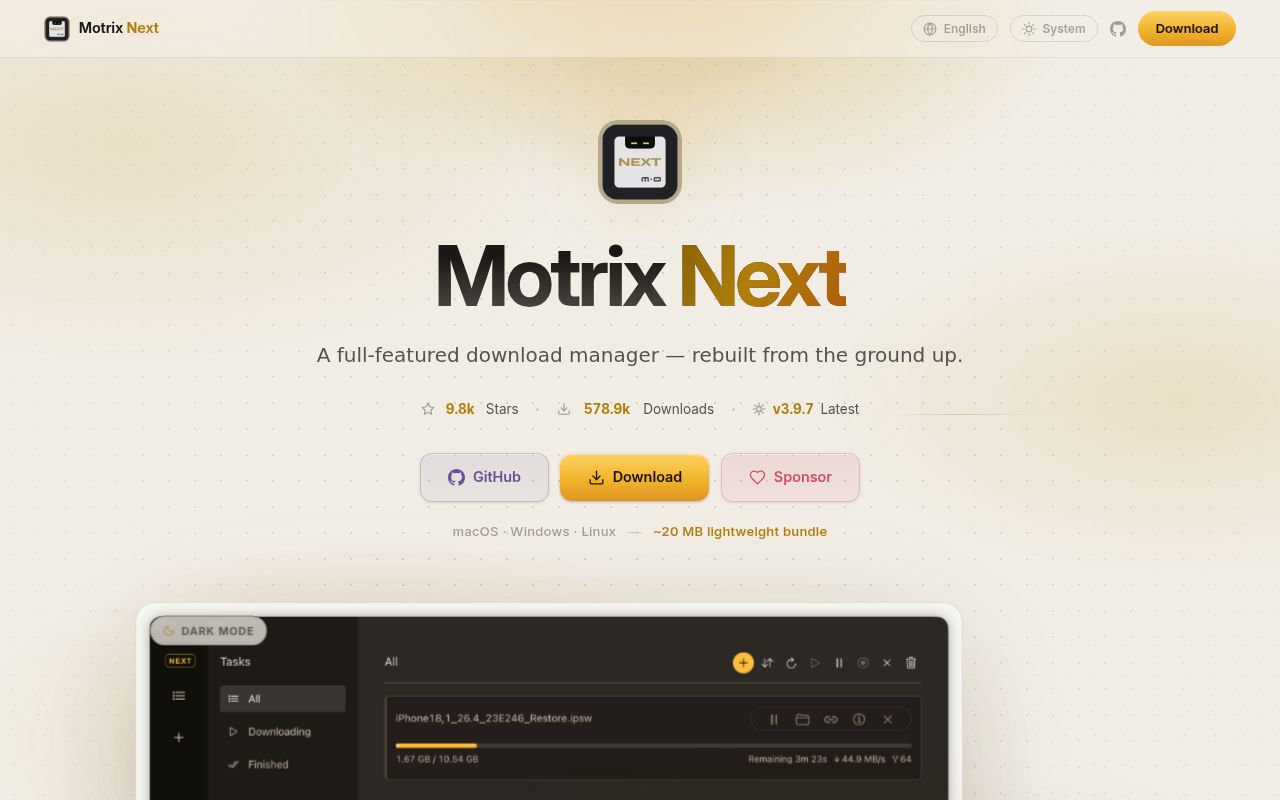
Motrix Next handles HTTP, HTTPS, SFTP, ED2K, BitTorrent, magnet links, and torrent files through a graphical task list. The backend uses Aria2 Next, a maintained fork of aria2 with the same interfaces, while Tauri 2 and Rust manage the engine as a sidecar. Vue 3 and Pinia provide the interface. Users get selective torrent files, DHT, peer exchange, scheduled speed limits, proxies, completed history, and native notifications in one application.
The rewrite keeps the old Motrix layout while replacing Electron, Vue 2, and Vuex. Its README claims an application bundle around 20 MB compared with roughly 80 MB for the legacy app. We did not verify those binary sizes, so they should be treated as project documentation rather than our measurement. Our source checkout was 56.4 MB before installing dependencies and included binaries for 6 desktop targets.
Browser capture can preserve cookies and referers
A separate extension can intercept browser downloads and forward filename hints, cookies, referers, and controls to the running application. Motrix Next exposes an authenticated extension API and can either ask for confirmation or submit automatically. That is useful for sites whose download URL depends on the browser session, and for users who want downloads to continue after the browser closes.
The integration spans 3 moving parts: browser extension, desktop app, and Aria2 Next engine. Open issue 534 reports that v3.9.8-beta.2 did not send start notifications for jobs added through an extension or direct aria2 RPC, while completion notifications still worked. A pull request contains a tested fix, but stable v3.9.7 users should judge notification behavior on their installed version rather than an unmerged change.
What happened when we ran it
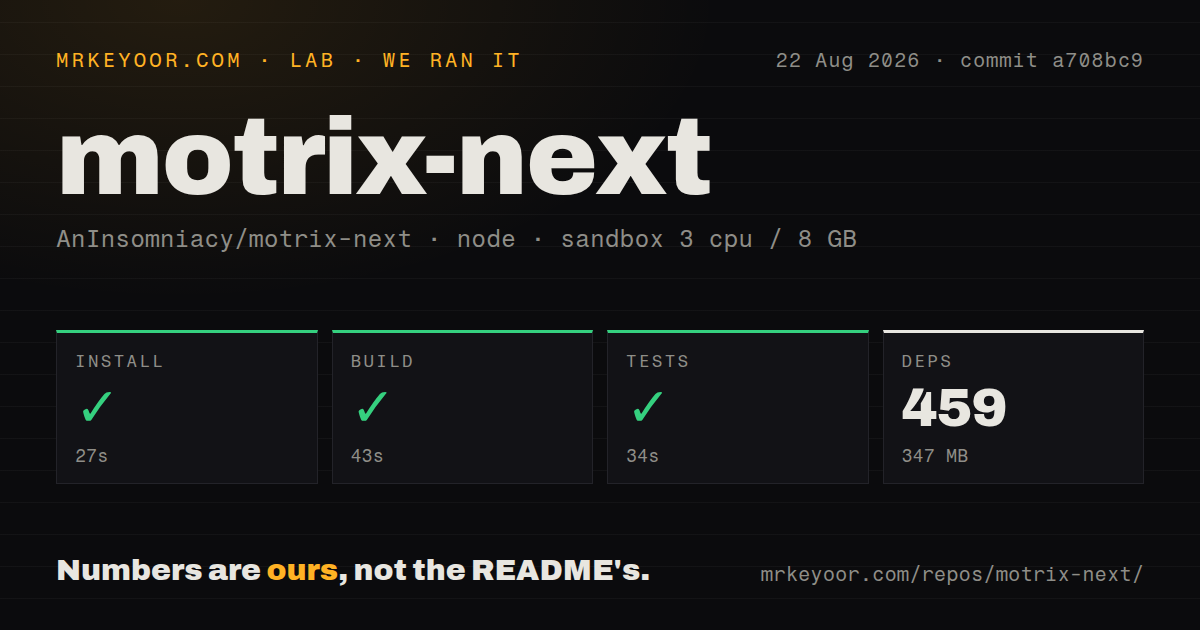
Our sandbox installed 459 pnpm packages in 27 seconds and used 347 MB. The build completed in 43 seconds, and the test command completed successfully in 34 seconds. We ran commit a708bc9 in an unprivileged Debian container with 3 CPUs, 8 GB of RAM, Node.js 22, and no secrets.
The repository contained 729 files, about 109,908 lines of source, 3 CI workflow files, pnpm workspaces, no Dockerfile, and no top-level tests directory. Those signals fit a packaged desktop application rather than a server container. Our run verified the supplied repository commands; it did not launch a graphical session, transfer a file, connect to peers, test protocol handlers, or install a signed release artifact.
Release packages cover 3 operating systems and 2 architectures
Version 3.9.7 ships macOS disk images for Apple Silicon and Intel, Windows installers for x64 and ARM64, and Linux AppImage and native packages for x64 and ARM64. Homebrew and Scoop are the recommended macOS and Windows routes. FlatPark maintains an independent Flatpak using official binaries. Contributors need stable Rust, Node.js 22 or newer, and pnpm 10.
Windows has no portable build because the Aria2 Next sidecar must remain next to the main executable, deep-link protocols and torrent associations need registry entries, and the updater needs a known installation path. That is a defensible engineering choice, but it rules out locked-down or temporary machines where installation is forbidden. Use aria2 directly when a headless binary and JSON-RPC client meet the need.
Unsigned binaries require a trust decision on every desktop
The project says Windows and macOS artifacts are not code-signed. Browsers, antivirus products, SmartScreen, or Gatekeeper may warn. macOS instructions remove the quarantine attribute with xattr, including after Homebrew upgrades. CI-built binaries do carry Tauri updater signatures, and the README gives a minisign public key and verification steps, but it explains that these are not GPG signatures or an operating-system publisher identity.
That distinction matters in companies. A verified download can still violate a policy requiring Apple Developer ID notarization or Windows Authenticode. Individual users can inspect CI, build from source, or verify updater signatures. Managed fleets usually need a signed package, a private repackaging process, or a formal exception. The application's MIT license does not solve endpoint trust policy.
Wayland tray setup can still block startup
The Rust backend handles the system tray, SQLite history, engine lifecycle, deep links, power management, and a Linux GPU fallback. Lightweight mode destroys the WebView when minimized while leaving downloads, monitoring, extension routing, and notifications alive in Rust. That reduces idle UI cost without stopping the engine. Desktop integration is a core feature, which also means desktop-specific failures can stop the whole application.
Issue 521 reports v3.9.7 exiting on an EndeavourOS setup using labwc because Tauri tray initialization returned operating-system error 13. The same report includes a deprecated app-indicator warning and a missing GTK theme file, but it does not establish which environment detail causes the permission failure. Linux users should launch once from a terminal, inspect diagnostics, and confirm tray behavior before trusting unattended downloads.
Active betas now overlap with a revived original Motrix
GitHub showed 9,762 stars, 141 combined issues and pull requests, and a last push on August 26, 2026. Stable v3.9.7 was released on August 3 with Aria2 Next 2.5.5, BitTorrent controls, safer deletion, theme work, rollback for preference saves, and diagnostic exports. Later beta issues and pull requests show continued development across platforms and extension behavior.
There is also a project-identity question. Issue 532 says the original Motrix resumed work with 2.0.0 betas and directs users to a discussion about Motrix Next's response and possible rebrand. That does not weaken the measured build or current features. It does mean new users should compare both active projects instead of assuming the original is dormant. For Motrix Next, the clean 27-second install and passing checks justify that comparison.