Mocha is the conservative JavaScript testing choice
Mocha describes itself as a classic test framework for Node.js and the browser, and that is the useful way to view it in 2026. It is infrastructure for expressing and running software checks, not a hosted service or a product that asks a team to reorganize its whole stack. The repository dates to 2011, carries an MIT license, and has about 22,900 GitHub stars. Those facts do not prove that it is the right framework for a new codebase, but they do show why many developers will already recognize its name and conventions.
The project also emphasizes independence: it says volunteers maintain it rather than a single vendor. Version 12.0.0 arrived on August 31, 2026, and the repository was pushed again on September 8, one day before this review date. That pairing matters more than an old reputation. It indicates current development around the latest major release, although one release date is not enough evidence to calculate a dependable release cadence.
Our install and build were quick, but the test command was not clean
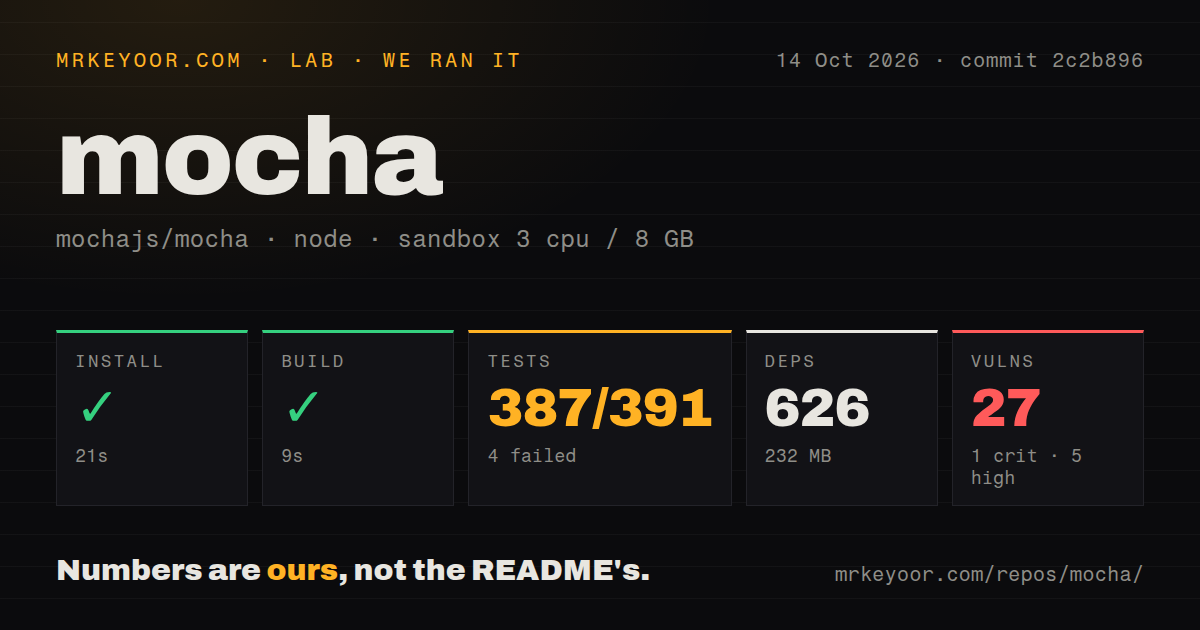
In our sandbox run, cloning commit 3a11840 produced a 3.2 MB checkout containing 676 files and roughly 45,719 lines of source. Installation succeeded in 23 seconds, placing 609 packages on disk and consuming 214 MB. The build then succeeded in 7 seconds. For a mature JavaScript project, that is a straightforward first mile: no secret was required, and the process ran in an unprivileged Debian container with 3 CPUs and 8 GB of RAM.
The test stage is the qualification. It ran for 313 seconds and exited with status 1, so the overall result was a failure. At the same time, our measured summary recorded 374 passing and 0 failing tests out of 374. The final log lines showed several nested successful checks, plus separate summaries of 158 passing, 1 passing, and 1,234 passing with 3 pending. Nothing in that excerpt identifies what produced the nonzero exit, so blaming a test, dependency, or container constraint would be guesswork.
That mismatch is worth treating as engineering work, not hand-waving it away. A team evaluating v12.0.0 should reproduce the command in its own CI environment and preserve the complete log, because a green-looking tail is not equivalent to a successful process exit. Our box completed the checks rather than hitting a stated time cap, but the 313-second duration also means this is not an instant validation loop at repository scale. The supplied evidence supports a clear conclusion: installation and compilation worked, while the repository's complete test invocation did not pass as a command.
The dependency report deserves similar restraint. Npm audit found 19 known vulnerabilities: 1 critical, 6 high, 5 moderate, and 7 low. The evidence does not say which packages are affected, whether they are development-only, or whether they are reachable in normal use. It would therefore be wrong to call Mocha unsafe from these counts alone. It would also be careless to ignore them, especially for organizations whose policy blocks critical findings even in development dependency trees.
Documentation and project plumbing are tangible strengths
The README provides direct routes to the documentation site, release history, code of conduct, contribution guide, development guide, issue tracker, and Discord. It also points newcomers to labeled good-first issues and issues accepting pull requests. More unusually useful is a dedicated maintainer handbook explaining how project work gets done. Those links reduce the hunt for basic governance and support information, while 14 CI workflow files show that automation is a meaningful part of the repository itself.
Mocha also makes its funding and ownership model visible through Open Collective, backer information, and sponsor slots. For a volunteer-maintained project at v12.0.0, transparency about support is valuable because widespread use does not automatically fund maintenance. The repository says Mocha is among npm's most depended-upon modules, citing libraries.io, though this review has not independently quantified that claim. What is directly visible here is a mature support surface rather than an abandoned package page.
The rough edges require local policy decisions
The largest immediate weakness is not a missing feature, but unresolved validation. A 1 exit code after 313 seconds prevents us from saying the checkout passed its own full test process. The 19 audit findings add another gate, and the absence of a Dockerfile means teams wanting an official container recipe will have to create and maintain one. None of these issues makes Mocha unusable, but together they turn a seemingly routine adoption into a small due-diligence task.
Issue count needs context too. There were 233 open issues on the review date, a meaningful queue but not enough information to judge maintainer responsiveness, age distribution, or severity. Against that, the August 31 release and September 8 push show recent activity, while the README openly asks for help with triage, answers, reviews, and merges. The fair health assessment is active and established, with visible maintenance demand, not spotless and not dormant.
It belongs in development and CI, with audit review beside it
In a real stack, Mocha fits where developers and CI workers execute JavaScript checks before deployment. It does not need to sit in the production request path, and teams should keep the framework version and its 609-package installation footprint under the same dependency update policy as other development tooling. Its browser and Node.js positioning makes it especially reasonable when one organization wants a recognizable testing foundation across both environments.
For an existing Mocha codebase, staying put is usually the sensible choice unless the team has a concrete pain it can name. For a new Vite-centered project, Vitest deserves comparison; teams already organized around Jest may gain little by switching; and users satisfied by Node.js's included test runner can avoid another framework dependency. Mocha wins on familiarity, longevity, open governance, and clear project documentation. It loses points in this evaluation because our 2026 run did not achieve a zero test exit and because the audit findings demand follow-up before adoption.