SerenityOS targets developers, not desktop buyers
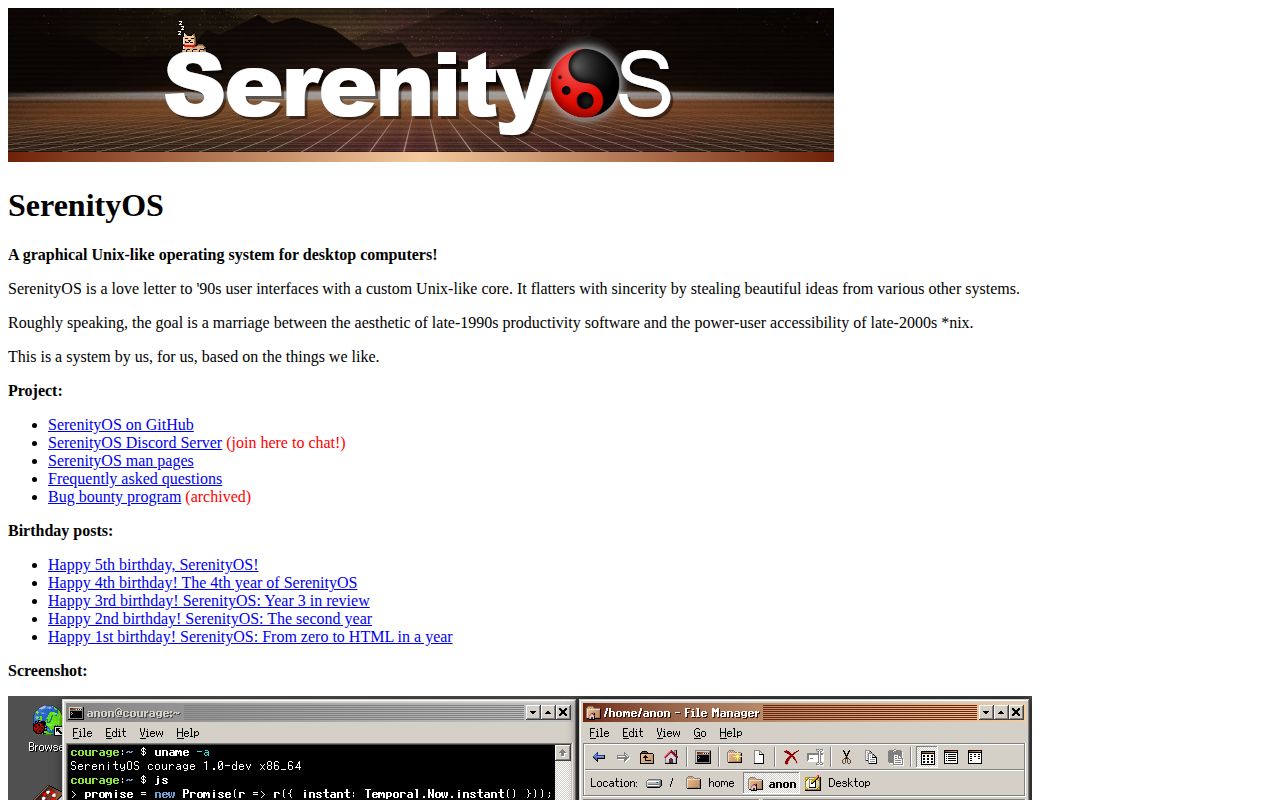
SerenityOS puts a custom kernel, desktop, browser, applications, and libraries in one 18,646-file source tree. The project calls itself a graphical Unix-like system for x86_64, Arm, and RISC-V computers. Its visual reference is late-1990s productivity software, while its command-line ambitions come from later Unix systems. This combination is unusually coherent because the same repository owns the window server, shell, GUI toolkit, system services, and everyday applications.
The intended user is stated with refreshing bluntness. SerenityOS exists for its developers, and its FAQ says there are no ISO images because it does not cater to non-technical users. The default route is a source build that opens the result in QEMU. Someone looking for a polished replacement for Windows, macOS, or Linux is shopping in the wrong aisle. Someone curious about how an operating system fits together can inspect about 1,383,167 lines of source without crossing repository boundaries.
The first run builds a cross-compiler before QEMU opens
Building the operating system requires GCC 14 or Clang 17+, CMake 3.25+, and QEMU 6.2 or newer. Debian and Ubuntu users also need a long list of host packages covering compilation, disk images, emulation, caching, compression, and cryptographic libraries. Older host distributions may need another compiler source. If the installed CMake is too old, the SerenityOS scripts attempt to build a suitable copy themselves.
Meta/serenity.sh run compiles the system, installs it into a build root, creates a disk image, and starts the virtual machine. The first run also downloads required database files and builds the cross-compiler toolchain. SerenityOS supports 3 target architectures, with the host architecture selected by default. Rebuilds should be faster after that toolchain exists, but the documentation supplies no promised full-build time, and our lab did not measure one.
What happened when we ran it
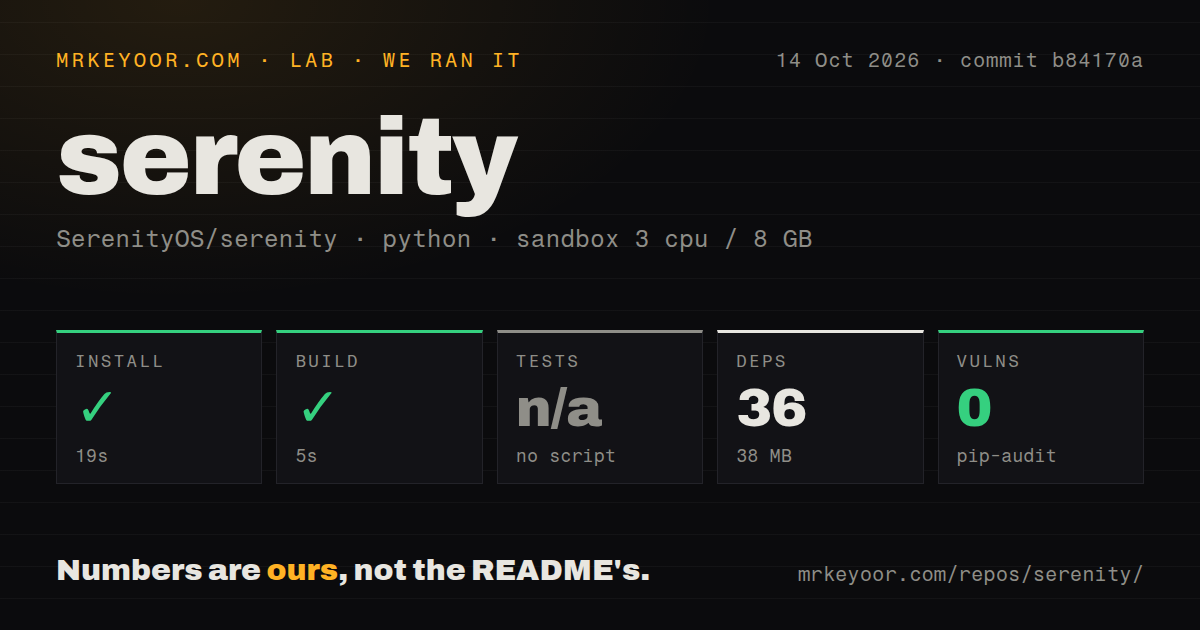
Our sandbox run at commit c594b79 located a Python project under Tests/ClangPlugins, then installed 36 packages in 20 seconds. The installed dependencies occupied 37 MB. The build step for that project succeeded in 7 seconds. These are useful numbers for the clang-plugin checks only; presenting them as a SerenityOS kernel or disk-image build would be false.
The harness found no test script or target, so it skipped tests. Pip-audit reported 0 known vulnerabilities in the installed Python environment. The checkout itself occupied 113.5 MB and contained about 1,383,167 source lines. Its structural scan counted 13 CI workflow files, no Dockerfile, and no tests directory. None of those signals proves that the full C++ system builds in the fresh Debian container used for this run.
More than 300 ports still compile from source
The repository lists more than 300 ports, including compilers, Unix utilities, games, and multimedia software. That is a substantial catalog for an independent operating system. SerenityOS also ships its own browser stack, POSIX-style virtual filesystems, networking, development tools, file-format support, and desktop programs. The attraction is the shared design language: a contributor can trace behavior from a GUI application through project libraries into the kernel without switching to several upstream codebases.
Package handling remains intentionally developer-facing. There is no Linux-style manager for prebuilt binaries, and the FAQ says the SerenityOS ABI may change at any moment. Each port is built from source, usually on the host and added to the filesystem image before boot. Compiling ports inside SerenityOS requires manual work and is not an actively supported workflow. The 300-plus catalog therefore signals breadth, while installation remains closer to image construction than clicking an app-store button.
Thirteen CI workflows do not make the default image secure
Our scan found 13 CI workflow files, and the README describes memory protections, process promises, address randomization, and web-content isolation. The build guide still warns that its development defaults are deliberately unsafe: the anon user can become root without a password, and its documented password is foo. Anyone exposing a SerenityOS instance to untrusted users must change those defaults and review the system as experimental software, not assume the security feature list settles the question.
Contribution rules are equally direct. New contributors should keep their first couple of pull requests small and avoid starting with a new application or library. Code uses SerenityOS C++26 conventions and project containers, while formatting requires clang-format 20 or later. Build-support questions belong in Discord rather than GitHub issues. Those constraints can feel strict, but they tell a prospective contributor how review works before a large patch consumes a month.
September activity outweighs the missing release feed
GitHub recorded 33,806 stars, 744 combined issues and pull requests, and a last push on September 6, 2026. A search separated 724 open issues from that combined count, while pull requests were still receiving updates on September 9. This is current development activity across a very large monorepo. The open count should be read as workload and discussion, not as 744 confirmed defects.
GitHub's latest-release endpoint returned no release, which matches the project's source-first posture more than an abandoned repository. Recent code, pull-request, and issue activity are stronger health evidence here than a missing tag. SerenityOS is mature enough to reward serious study and broad enough to occupy years of contribution. Its unstable ABI, source-built ports, development credentials, and absent ISO make the boundary just as clear: this is a living operating-system workshop, not a supported general-purpose desktop product.